
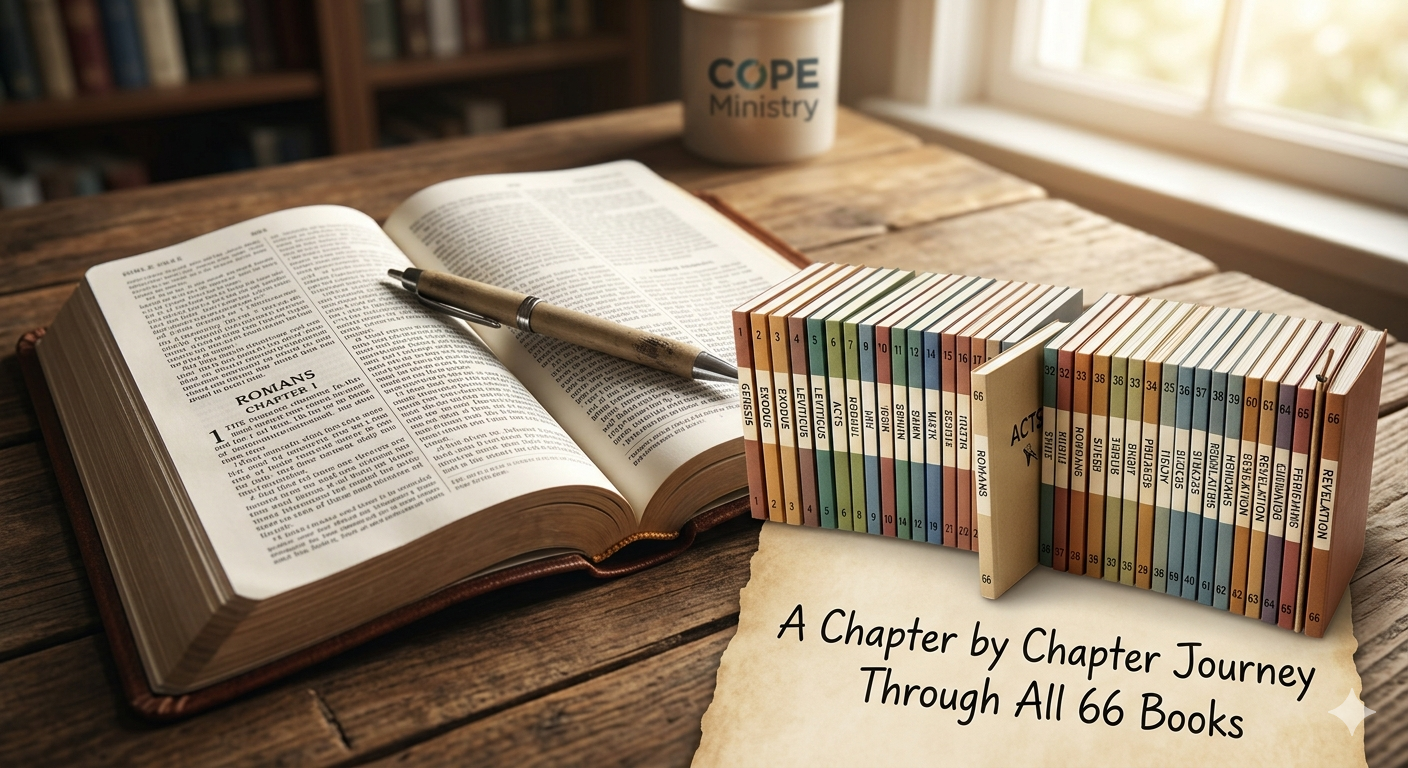
Which Order To Start Reading All The Books Of The Bible?
By Fin Dalton | COPE Ministry Wakefield
Have you ever opened the Bible and felt overwhelmed by where to start? Or perhaps you’ve finished one book—like the action-packed Book of Acts—and wondered, “What’s next?”
At COPE Ministry, we believe that “Nobody is too far gone and anyone can be saved.” To understand that “new life” fully, we need a roadmap. If you want to journey through all 66 books of the Bible but don’t know the path, this Acts-First Study Plan is for you.
Why Start with the Book of Acts?
Most people start at the beginning (Genesis) or with a Gospel (like Luke). However, starting your deep dive with Acts is a powerful strategy.
Acts is the “bridge.” It connects the life of Jesus to the birth of the Church. It shows us how ordinary people, fueled by the Holy Spirit, turned the world upside down. Once you understand the history of the early church in Acts, the rest of the Bible suddenly makes much more sense.
The “Foundational Flow” Study Order
If you have just finished Acts, here is the best sequence to follow to complete your study of all 66 books.
Phase 1: The Epistles (The “Why” Behind the “How”)
Now that you’ve seen Paul and Peter in action, read the letters they wrote to the churches they started.
- Romans: The masterpiece of Christian doctrine.
- 1 & 2 Corinthians: Practical help for church life and unity.
- Galatians: A deep dive into Grace vs. Law (perfect after Acts 15).
- The Prison & Pastoral Epistles: Ephesians, Philippians, Colossians, 1 & 2 Thessalonians, 1 & 2 Timothy, Titus, and Philemon.
- The General Letters: Hebrews through Jude.
- Revelation: The final vision of Christ’s victory.
Phase 2: The Foundations (The Beginning of the Story)
To understand why Jesus had to come, we go back to the start.
- The Pentateuch: Genesis, Exodus, Leviticus, Numbers, and Deuteronomy. These books establish the Covenant and the Law.
Phase 3: The Rise and Fall (Israel’s History)
These books provide the context for the speeches given by Stephen and Paul in the Book of Acts.
- Joshua, Judges, and Ruth
- 1 & 2 Samuel, 1 & 2 Kings, 1 & 2 Chronicles
- Ezra, Nehemiah, and Esther (The story of the return from exile).
Phase 4: Wisdom and Worship
When life gets difficult, these books provide the language for our prayers.
- Job, Psalms, Proverbs, Ecclesiastes, and Song of Solomon.
Phase 5: The Prophets (The Promise of the Messiah)
The prophets warned Israel and pointed forward to the “New Life” we find in Christ.
- Major Prophets: Isaiah, Jeremiah, Lamentations, Ezekiel, and Daniel.
- Minor Prophets: Hosea through Malachi.
Phase 6: The Gospels (The Full Circle)
We end our 66-book journey by returning to the source: the life, death, and resurrection of Jesus.
- Matthew, Mark, Luke, and John. Studying these after the Old Testament makes every miracle and prophecy shine brighter.
Fin’s Study Tip for Success
Don’t rush! At COPE Ministry, we suggest the 5-Minute Daily Challenge. Spend five minutes every morning in the Word.
”Transformation isn’t about how much of the Bible you get through; it’s about how much of the Bible gets through to you.”