
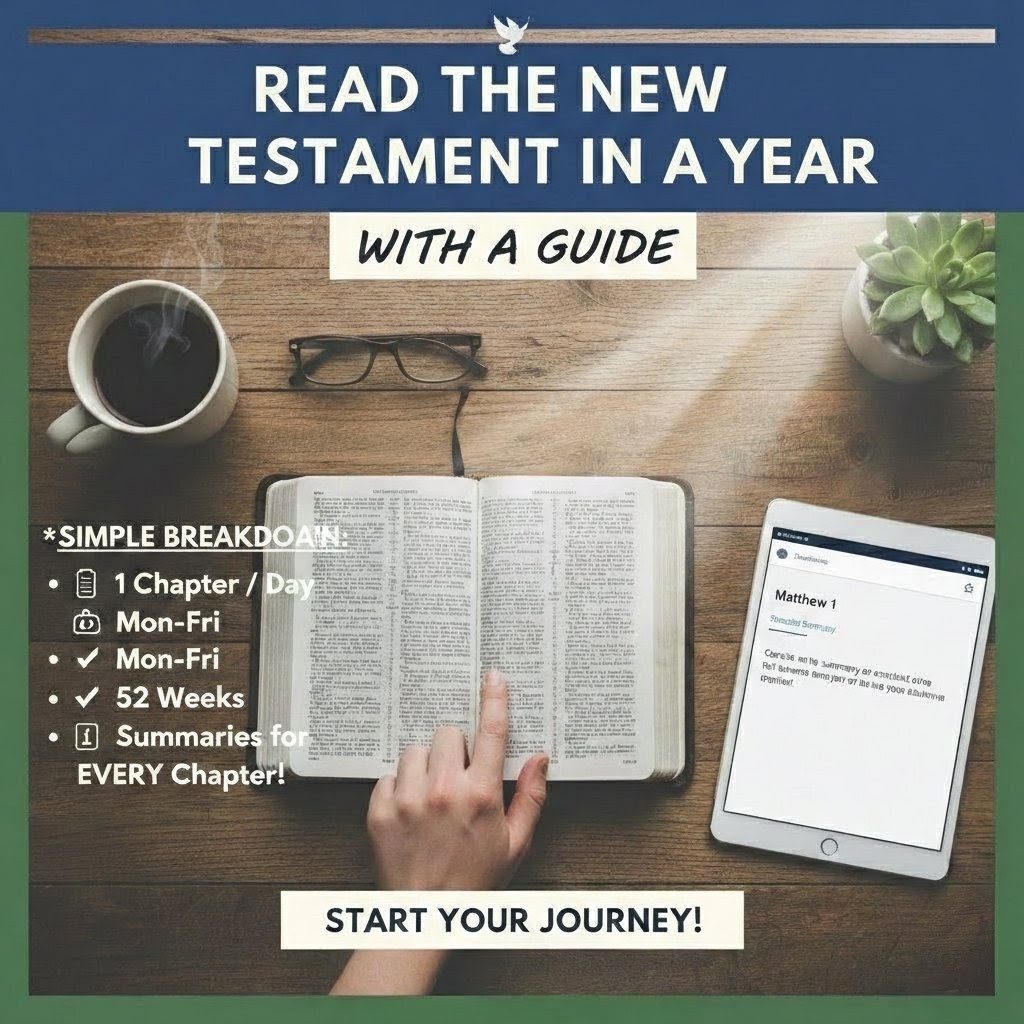
Mon–Fri New Testament
Use Alongside Reading Your Bible
Welcome to the New Testament Journey
Whether you’re opening the Bible for the first time or looking to deepen a lifelong habit, this New Testament Reading Plan is designed to meet you where you are. We’ve removed the “overwhelm” by focusing on a sustainable Monday through Friday rhythm—giving you the weekends to rest, reflect, or catch up.
How it Works:
One Chapter a Day: We walk through the New Testament one chapter at a time.
Context at a Glance: Below every chapter title, you’ll find a concise summary. Use these to get your bearings before you read or to recap the key themes after you’re done.
A Full Year of Growth: By the end of 52 weeks, you will have navigated the life of Christ, the birth of the early church, and the profound wisdom of the Epistles.
A 52-week New Testament reading guide. Read one chapter every weekday to finish the entire New Testament in one year. Use the provided summaries as a quick primer before you read or a review for your notes afterward.
To help you navigate the New Testament alongside your reading plan, here is a breakdown of all 27 books, categorized by their purpose and style.
The Gospels (The Life of Christ)These four books provide different perspectives on the life, death, and resurrection of Jesus.
Matthew: Written primarily for a Jewish audience, it emphasizes Jesus as the promised Messiah and King who fulfills Old Testament prophecies.
Mark: The shortest and most fast-paced Gospel. It focuses on Jesus as the “Suffering Servant” and highlights His actions and miracles.
Luke: A detailed, historical account written by a physician. It emphasizes Jesus’ humanity and His compassion for the marginalized, the poor, and the outcast.
John: A deeply theological and spiritual Gospel. It focuses on the divinity of Jesus, using “I Am” statements to show He is God in the flesh.
History (The Early Church)
Acts: A sequel to the Gospel of Luke. It chronicles the birth of the early church, the coming of the Holy Spirit, and how the Gospel spread from Jerusalem to Rome.
The Pauline Epistles (Letters by Paul)These letters were written by the Apostle Paul to specific churches or individuals to address theological issues and provide practical living advice.
Romans: A comprehensive explanation of the Gospel, focusing on justification by faith and the righteousness of God.
1 Corinthians: Addresses problems in the Corinthian church, including divisions, immorality, and questions about spiritual gifts and love.
2 Corinthians: Paul defends his apostleship and discusses the nature of ministry and the comfort found in God.
Galatians: A firm defense of Christian liberty, arguing that believers are justified by faith in Christ alone, not by keeping the Jewish Law.
Ephesians: Focuses on the “Body of Christ” (the Church) and the spiritual blessings believers have in Him.
Philippians: Often called the “Letter of Joy,” written from prison to encourage believers to have the mind of Christ.
Colossians: Asserts the supremacy and sufficiency of Jesus Christ over all creation and all human philosophies.
1 & 2 Thessalonians: Written to a young church to clear up misunderstandings about the Second Coming of Jesus.
1 & 2 Timothy: Practical “manuals” for leadership, written to a young pastor (Timothy) regarding church order and sound doctrine.
Titus: A letter to a leader on the island of Crete about choosing good leaders and teaching “good works.”
Philemon: A personal letter asking a slave owner to forgive and welcome back his runaway slave as a brother in Christ.
The General Epistles
(Letters by Other Authors)
These letters were generally written to a broader audience of believers.Hebrews: Written to Jewish Christians to show that Jesus is “better” than the old sacrificial system and the final fulfillment of the Law.
James: A very practical book focusing on “faith in action.” It argues that true faith should result in changed behavior.
1 & 2 Peter: Written to encourage Christians facing persecution, focusing on hope, suffering, and guarding against false teachers.
1, 2, & 3 John: Letters focusing on the love of God, the certainty of salvation, and the importance of walking in the truth.
Jude: A brief, urgent letter warning the church to “contend for the faith” against godless teachers.
Prophecy Revelation: The final book of the Bible. It uses vivid, symbolic imagery (Apocalyptic literature) to reveal Jesus as the ultimate Victor over evil and to describe the New Heaven and the New Earth.
Week 1
- Mon | Matthew 1: Establishes Jesus’ legal right to the throne of David through a genealogy from Abraham and recounts His miraculous conception by the Holy Spirit, fulfilling the prophecy of “Immanuel.”
- Tue | Matthew 2: Follows the visit of the Magi, the escape to Egypt to flee King Herod’s massacre, and the eventual settlement of the holy family in Nazareth.
- Wed | Matthew 3: Introduces John the Baptist preaching repentance in the wilderness and concludes with the baptism of Jesus, where God’s voice identifies Him as His beloved Son.
- Thu | Matthew 4: Covers Jesus’ victory over Satan’s temptations in the wilderness, the calling of the first four disciples, and the beginning of His healing ministry in Galilee.
- Fri | Matthew 5: The start of the Sermon on the Mount, containing the Beatitudes and Jesus’ radical teaching that internal heart posture is as important as external obedience to the Law.
Week 2
- Mon | Matthew 6: Jesus teaches on “secret” devotion—giving, praying (The Lord’s Prayer), and fasting—while warning against the anxiety of chasing worldly wealth.
- Tue | Matthew 7: Concludes the Sermon on the Mount with warnings against hypocritical judgment, the “Golden Rule,” and the parable of the wise and foolish builders.
- Wed | Matthew 8: Demonstrates Jesus’ authority over physical and spiritual realms through the healing of a leper, a centurion’s servant, and the calming of a violent storm.
- Thu | Matthew 9: Jesus displays His authority to forgive sins by healing a paralytic, calls Matthew the tax collector, and continues a cycle of miracles including raising a girl from the dead.
- Fri | Matthew 10: Jesus commissions the twelve apostles, giving them authority to heal and preach while warning them of the persecution they will face for His sake.
Week 3
- Mon | Matthew 11: Jesus reassures a doubting John the Baptist, rebukes unrepentant cities, and offers a famous invitation to the weary to find “rest for their souls.”
- Tue | Matthew 12: Conflicts with the Pharisees escalate over Sabbath laws; Jesus identifies Himself as “Lord of the Sabbath” and warns against the unforgivable sin of blaspheming the Spirit.
- Wed | Matthew 13: A collection of parables—including the Sower and the Weeds—explaining the nature of the Kingdom of Heaven and why Jesus speaks in hidden stories to the crowds.
- Thu | Matthew 14: Recounts the death of John the Baptist, the miraculous feeding of the 5,000, and Jesus walking on water during a storm to reach His disciples.
- Fri | Matthew 15: Jesus confronts religious traditions that bypass God’s heart, heals a Canaanite woman’s daughter, and feeds another crowd of 4,000 people.
Week 4
- Mon | Matthew 16: Peter makes his great confession that Jesus is the Christ; Jesus then predicts His death for the first time and explains the cost of following Him.
- Tue | Matthew 17: Jesus is transfigured in glory before Peter, James, and John; afterward, He heals a demon-possessed boy and pays the temple tax miraculously through a fish.
- Wed | Matthew 18: Jesus teaches on the humility of a child, the “lost sheep,” and the necessity of radical forgiveness through the parable of the unmerciful servant.
- Thu | Matthew 19: Jesus addresses marriage, divorce, and wealth, telling the Rich Young Ruler that it is difficult for those with many possessions to enter the Kingdom.
- Fri | Matthew 20: Includes the Parable of the Laborers in the Vineyard, Jesus’ third prediction of His death, and His teaching that “greatness” in His kingdom means being a servant.
Week 5
- Mon | Matthew 21: The Triumphal Entry into Jerusalem, the clearing of the Temple, and several parables challenging the authority of the religious leaders.
- Tue | Matthew 22: Jesus answers trap questions about taxes, the resurrection, and the greatest commandment, identifying “Love God” and “Love your neighbor” as the foundation of the Law.
- Wed | Matthew 23: A searing critique of the Pharisees and scribes, where Jesus pronounces “seven woes” upon them for their hypocrisy and spiritual blindness.
- Thu | Matthew 24: Jesus predicts the destruction of the Temple and describes the signs of the end of the age and His eventual Second Coming.
- Fri | Matthew 25: Three parables on readiness for the end times: the Ten Virgins, the Talents, and the Sheep and the Goats, emphasizing faithfulness and serving “the least of these.”
Week 6
- Mon | Matthew 26: The beginning of the Passion narrative, including the Last Supper, Jesus’ agonizing prayer in Gethsemane, His betrayal by Judas, and His arrest and trial before the Sanhedrin.
- Tue | Matthew 27: Records the trial before Pilate, the crucifixion of Jesus at Golgotha, His death amidst supernatural signs, and His burial in the tomb of Joseph of Arimathea.
- Wed | Matthew 28: The climax of the Gospel, featuring the empty tomb, the appearance of the resurrected Jesus to the women, and the Great Commission to make disciples of all nations.
- Thu | Mark 1: A fast-paced opening that introduces John the Baptist, Jesus’ baptism, the calling of the first disciples, and an immediate series of healings and exorcisms in Galilee.
- Fri | Mark 2: Jesus sparks controversy with the religious leaders by forgiving the sins of a paralytic, eating with tax collectors, and declaring Himself Lord of the Sabbath.
Week 7
- Mon | Mark 3: Jesus heals on the Sabbath, appoints the twelve apostles, and addresses accusations that His power comes from Beelzebul, defining His “true family” as those who do God’s will.
- Tue | Mark 4: A series of Kingdom parables, including the Sower and the Mustard Seed, followed by a display of Jesus’ divine power as He stills a Great Storm on the sea.
- Wed | Mark 5: Three major miracles showcasing Jesus’ power over different realms: the deliverance of the Gerasene demoniac, the healing of a woman with a hemorrhage, and the raising of Jairus’ daughter.
- Thu | Mark 6: Jesus is rejected in His hometown, sends out the Twelve in pairs, and feeds 5,000 people; the chapter also recounts the tragic execution of John the Baptist.
- Fri | Mark 7: Jesus confronts the Pharisees over “traditions of men” versus the heart, emphasizing that defilement comes from within, then heals a Gentile woman’s daughter and a deaf-mute man.
Week 8
- Mon | Mark 8: Jesus feeds 4,000, warns against the “leaven” of the Pharisees, heals a blind man in stages, and Peter confesses Jesus as Christ, followed by Jesus’ first prediction of His death.
- Tue | Mark 9: The Transfiguration reveals Jesus’ glory to Peter, James, and John; afterward, Jesus heals a boy with an unclean spirit and teaches the disciples that greatness comes through service.
- Wed | Mark 10: Jesus teaches on marriage, blesses the children, and speaks to the rich young ruler; the chapter concludes with Jesus’ third death prediction and the healing of blind Bartimaeus.
- Thu | Mark 11: Jesus enters Jerusalem triumphantly on a colt, curses a fruitless fig tree as a sign of judgment, and clears the temple of moneychangers.
- Fri | Mark 12: Jesus tells the parable of the Wicked Tenants, answers questions about taxes and the resurrection, and praises the widow who gave her last two mites.
Week 9
- Mon | Mark 13: Known as the “Little Apocalypse,” Jesus sits on the Mount of Olives and describes the coming destruction of the Temple and the signs of His future return.
- Tue | Mark 14: The events of the Last Supper, Jesus’ prayer in Gethsemane, and His arrest; the chapter ends with Jesus’ trial before the high priest and Peter’s three denials.
- Wed | Mark 15: Jesus stands before Pontius Pilate, is mocked and beaten by soldiers, and is crucified; the chapter ends with His cry of “My God, my God, why have you forsaken me?” and His burial.
- Thu | Mark 16: The resurrection of Jesus is announced by an angel at the tomb; the chapter concludes with His appearances to the disciples and His ascension into heaven.
- Fri | Luke 1: The longest chapter in the New Testament, featuring the angelic announcements of the births of John the Baptist and Jesus, and Mary’s famous song of praise, the Magnificat.
Week 10
- Mon | Luke 2: The narrative of Jesus’ birth in Bethlehem, the visit of the shepherds, Jesus’ circumcision, and the only recorded story of Him as a twelve-year-old in the Temple.
- Tue | Luke 3: Focuses on the preaching of John the Baptist and Jesus’ baptism, ending with a genealogy that traces Jesus all the way back to Adam, emphasizing His humanity.
- Wed | Luke 4: Jesus overcomes temptation in the wilderness and begins His ministry in Nazareth; though He is rejected there, He begins a widespread ministry of healing and teaching.
- Thu | Luke 5: Jesus calls His first disciples after a miraculous catch of fish, heals a leper and a paralytic, and calls Levi (Matthew) the tax collector to follow Him.
- Fri | Luke 6: Jesus selects the twelve apostles and delivers the “Sermon on the Plain,” which includes the Beatitudes and instructions to love enemies and build on a solid foundation.
Week 11
- Mon | Luke 7: Jesus heals a centurion’s servant, raises a widow’s son from the dead, and is anointed by a sinful woman, demonstrating His compassion for the marginalized and the power of faith.
- Tue | Luke 8: Jesus tells the Parable of the Sower, calms a storm, heals a demon-possessed man, and raises Jairus’ daughter, showing His authority over nature, spirits, and death.
- Wed | Luke 9: The Twelve are sent out, Jesus feeds the 5,000, Peter confesses Jesus as Christ, and the Transfiguration occurs; Jesus then begins His final journey toward Jerusalem.
- Thu | Luke 10: Jesus sends out seventy-two disciples, tells the Parable of the Good Samaritan to define “neighbor,” and visits Martha and Mary, emphasizing the importance of listening to His word.
- Fri | Luke 11: Jesus teaches the disciples how to pray (The Lord’s Prayer), defends His power against accusations, and pronounces “woes” on the Pharisees for their legalism and hypocrisy.
Week 12
- Mon | Luke 12: Jesus warns against hypocrisy and the love of money (Parable of the Rich Fool), encouraging His followers to trust God for their needs and be ready for His return.
- Tue | Luke 13: Jesus calls for repentance, heals a crippled woman on the Sabbath, and uses the parables of the Mustard Seed and Leaven to describe the growing Kingdom of God.
- Wed | Luke 14: While dining at a Pharisee’s house, Jesus teaches on humility and hospitality (Parable of the Great Banquet) and explains the radical “cost” of being His disciple.
- Thu | Luke 15: A famous chapter containing three parables of the “lost”—the Lost Sheep, the Lost Coin, and the Prodigal Son—highlighting God’s joy when a sinner repents.
- Fri | Luke 16: Jesus teaches on stewardship through the Parable of the Dishonest Manager and warns about the eternal consequences of greed with the story of the Rich Man and Lazarus.
Week 13
- Mon | Luke 17: Jesus teaches on forgiveness, faith, and gratitude (healing ten lepers), and provides warnings about the sudden and unexpected nature of the coming “Day of the Son of Man.”
- Tue | Luke 18: Jesus encourages persistent prayer, humbles the self-righteous (Pharisee and Tax Collector), blesses children, and encounters the Rich Young Ruler.
- Wed | Luke 19: Jesus visits the home of Zacchaeus the tax collector, tells the Parable of the Ten Minas, and enters Jerusalem triumphantly, weeping over the city’s future destruction.
- Thu | Luke 20: Jesus’ authority is challenged by religious leaders; He responds with the Parable of the Wicked Tenants and answers questions about taxes to Caesar and the resurrection.
- Fri | Luke 21: Jesus observes the widow’s small offering, predicts the destruction of the Temple, and describes the signs of the end times, urging His followers to stay watchful.
Week 14
- Mon | Luke 22: The betrayal by Judas leads to the Last Supper, Jesus’ prayer in Gethsemane, His arrest, and Peter’s denial, all while Jesus prepares His disciples for the coming trial.
- Tue | Luke 23: Jesus is tried before Pilate and Herod, is crucified between two criminals, dies, and is buried, with Luke highlighting Jesus’ innocence and His prayer for His executioners.
- Wed | Luke 24: The resurrection is revealed to the women at the tomb and to two disciples on the road to Emmaus; the Gospel ends with Jesus’ appearance to the Twelve and His ascension.
- Thu | John 1: A theological opening identifying Jesus as “The Word” who was with God from the beginning, followed by the testimony of John the Baptist and the calling of the first disciples.
- Fri | John 2: Jesus performs His first miracle, turning water into wine at a wedding in Cana, and then cleanses the Temple, signaling the beginning of His public ministry.
Week 15
- Mon | John 3: Jesus explains the necessity of being “born again” to Nicodemus, leading to the famous declaration of God’s love in John 3:16 and John the Baptist’s final testimony.
- Tue | John 4: Jesus speaks with a Samaritan woman at a well, revealing Himself as the “living water,” and then heals an official’s son, demonstrating His power reaches across social boundaries.
- Wed | John 5: After healing a man at the pool of Bethesda on the Sabbath, Jesus defends His divinity by explaining His unique relationship and equal authority with God the Father.
- Thu | John 6: Following the feeding of the 5,000 and walking on water, Jesus delivers a difficult discourse calling Himself the “Bread of Life,” causing many followers to turn away.
- Fri | John 7: Jesus travels to Jerusalem for the Feast of Booths, where He teaches in the Temple amidst growing controversy and debate regarding His true identity and origin.
Week 16
- Mon | John 8: Jesus declares Himself the “Light of the World” and has a sharp debate with the Pharisees about spiritual freedom, concluding with the powerful claim, “Before Abraham was, I am.”
- Tue | John 9: Jesus heals a man born blind on the Sabbath, sparking an investigation by the religious leaders that highlights the man’s spiritual sight versus the Pharisees’ spiritual blindness.
- Wed | John 10: Jesus describes Himself as the “Good Shepherd” who lays down His life for His sheep and asserts His unity with the Father, leading to further attempts on His life.
- Thu | John 11: Jesus demonstrates His power over death by raising Lazarus from the grave, an event that confirms His identity as “the Resurrection and the Life” but seals His death sentence.
- Fri | John 12: Following His anointing by Mary at Bethany and His Triumphal Entry into Jerusalem, Jesus explains that His impending death is the way to bring life to the world.
Week 17
- Mon | John 13: During the Last Supper, Jesus washes the disciples’ feet as an example of servanthood, predicts Judas’s betrayal, and gives the “New Commandment” to love one another.
- Tue | John 14: Jesus comforts His disciples with the promise of heaven, identifies Himself as “the Way, the Truth, and the Life,” and promises the coming of the Holy Spirit (the Helper).
- Wed | John 15: Using the metaphor of the “True Vine,” Jesus instructs His followers to remain connected to Him to bear fruit and warns them that the world will hate them as it hated Him.
- Thu | John 16: Jesus speaks further about the work of the Holy Spirit and warns of coming persecution, but encourages the disciples with the promise that His sorrow will turn to joy.
- Fri | John 17: Known as the High Priestly Prayer, Jesus prays for Himself, His immediate disciples, and all future believers, emphasizing spiritual unity and protection from the evil one.
Week 18
- Mon | John 18: Recounts the arrest of Jesus in the garden, His trials before Annas and Caiaphas, Peter’s three denials, and Jesus’ appearance before Pontius Pilate.
- Tue | John 19: Jesus is flogged, mocked, and crucified; the chapter details His final words on the cross, His death, and His burial in a new tomb provided by Joseph of Arimathea.
- Wed | John 20: The resurrection is discovered by Mary Magdalene, followed by Jesus’ appearances to the disciples and “Doubting Thomas,” proving His victory over death.
- Thu | John 21: Jesus appears to the disciples by the Sea of Galilee, performs a miraculous catch of fish, and restores Peter by asking him three times, “Do you love Me?”
- Fri | Acts 1: After Jesus ascends to heaven, the disciples return to Jerusalem to wait for the Holy Spirit and choose Matthias to replace Judas as the twelfth apostle.
Week 19
- Mon | Acts 2: The Holy Spirit descends at Pentecost, enabling the disciples to speak in tongues; Peter preaches a powerful sermon, and about 3,000 people are baptized into the early church.
- Tue | Acts 3: Peter and John heal a lame man at the Temple gate “Beautiful,” drawing a massive crowd which Peter uses as an opportunity to preach the Gospel of repentance.
- Wed | Acts 4: Peter and John are arrested and commanded to stop preaching, but they pray for boldness; the chapter ends with the believers sharing all their possessions in unity.
- Thu | Acts 5: The judgment of Ananias and Sapphira for lying to the Spirit is followed by the apostles performing many signs and being miraculously released from prison by an angel.
- Fri | Acts 6: To handle the needs of the growing church, seven deacons (including Stephen) are chosen to serve; however, Stephen is soon seized by religious leaders for his bold testimony.
Week 20
- Mon | Acts 7: Stephen delivers a long speech recounting Israel’s history of resisting God’s messengers, which leads to him becoming the first Christian martyr as he is stoned to death.
- Tue | Acts 8: Persecution scatters the church, leading Philip to preach in Samaria and interpret Scripture for an Ethiopian eunuch, showing the Gospel moving beyond Jerusalem.
- Wed | Acts 9: Saul of Tarsus, a persecutor of the church, has a radical encounter with Jesus on the Road to Damascus, leading to his conversion and the beginning of his ministry.
- Thu | Acts 10: Through a vision of “unclean” animals and a meeting with the Roman centurion Cornelius, Peter realizes that God has opened the door of salvation to the Gentiles.
- Fri | Acts 11: Peter explains his visit to the Gentiles to the church in Jerusalem, and the ministry expands to Antioch, where the followers of Jesus are first called “Christians.”
Week 21
- Mon | Acts 12: King Herod executes James and imprisons Peter, who is miraculously freed by an angel; the chapter ends with the sudden, divine judgment and death of Herod.
- Tue | Acts 13: The church at Antioch sends out Barnabas and Saul (Paul) on their first missionary journey, where they preach in Cyprus and Pisidian Antioch, shifting focus to the Gentiles.
- Wed | Acts 14: Paul and Barnabas continue through Iconium, Lystra, and Derbe, facing both worship and stoning from the crowds before returning to Antioch to report on God’s work.
- Thu | Acts 15: The Jerusalem Council meets to decide if Gentile believers must follow Jewish laws; the leaders conclude that salvation is through grace alone, not legalism.
- Fri | Acts 16: Paul begins his second journey, picks up Timothy, and is led by a vision to Macedonia, where he is imprisoned in Philippi but converts his jailer after an earthquake.
Week 22
- Mon | Acts 17: Paul preaches in Thessalonica and Berea—where the people “searched the Scriptures”—and then delivers a famous sermon to the philosophers at the Areopagus in Athens.
- Tue | Acts 18: Paul spends a year and a half in Corinth, meeting Aquila and Priscilla, before returning to Antioch and starting his third journey; Apollos is also introduced as a powerful preacher.
- Wed | Acts 19: Paul ministers in Ephesus for over two years, performing miracles and causing such a shift in the culture that the local silversmiths riot because their idol-making business is threatened.
- Thu | Acts 20: Paul travels through Macedonia and Greece, raises a young man named Eutychus from the dead, and gives a tearful farewell to the Ephesian elders, knowing he faces prison.
- Fri | Acts 21: Despite warnings, Paul returns to Jerusalem; he is falsely accused of defiling the Temple, attacked by a mob, and eventually arrested by Roman soldiers to save his life.
Week 23
- Mon | Acts 22: Paul stands before the angry Jerusalem mob and tells the story of his conversion on the Damascus Road, but the crowd turns violent again when he mentions the Gentiles.
- Tue | Acts 23: Paul appears before the Sanhedrin, causing a dispute between Pharisees and Sadducees; after a plot to kill him is discovered, he is whisked away under Roman guard to Caesarea.
- Wed | Acts 24: Paul is tried before Governor Felix; though Paul speaks powerfully about faith, righteousness, and judgment, Felix leaves him in prison for two years to please the Jews.
- Thu | Acts 25: Paul appears before the new governor, Festus; to avoid a trial in Jerusalem, Paul uses his rights as a Roman citizen and famously declares, “I appeal to Caesar.”
- Fri | Acts 26: Paul gives a masterful defense of his life and the Gospel before King Agrippa, nearly persuading the king to become a Christian and proving his innocence of any Roman crime.
Week 24
- Mon | Acts 27: Paul is sent by ship toward Rome; the chapter provides a dramatic account of a violent storm and a shipwreck on the island of Malta, where everyone is safely spared as God promised.
- Tue | Acts 28: After three months in Malta, Paul finally reaches Rome; he is placed under house arrest, where he spends two years boldly preaching the Kingdom of God to all who visit.
- Wed | Romans 1: Paul introduces his “Gospel of power” and argues that the natural world reveals God’s existence, leaving humanity without excuse for their rejection of Him and their subsequent moral decay.
- Thu | Romans 2: Paul warns that religious people are just as guilty as the “pagans” because God judges the heart and the “secrets of men” rather than just outward adherence to the Law.
- Fri | Romans 3: After establishing that “all have sinned,” Paul introduces the core of the Gospel: that we are justified (made right with God) through faith in Jesus Christ, apart from legalistic works.
Week 25
- Mon | Romans 4: Paul uses the Old Testament figure of Abraham to prove that God has always credited righteousness to people based on their faith, not their religious rituals or circumcision.
- Tue | Romans 5: Paul explains the benefits of justification—including peace with God and hope in suffering—and compares Adam (who brought death) to Christ (who brings life).
- Wed | Romans 6: Addressing the question of whether grace allows for sin, Paul argues that believers have “died to sin” and are now “slaves to righteousness,” united with Christ in His resurrection.
- Thu | Romans 7: Paul describes the internal struggle between the desire to do good and the “law of sin” at work in the human body, concluding that only Jesus Christ can deliver us from this conflict.
- Fri | Romans 8: A triumphant chapter describing life in the Spirit, the adoption of believers as God’s children, and the promise that nothing can separate us from the love of God in Christ.
Week 26
- Mon | Romans 9: Paul discusses God’s sovereignty and His choice of Israel, explaining that God’s promises have not failed but are fulfilled in a “remnant” chosen by grace.
- Tue | Romans 10: Paul emphasizes that Christ is the end of the law for righteousness and declares that “everyone who calls on the name of the Lord will be saved” through faith and confession.
- Wed | Romans 11: Paul uses the metaphor of an Olive Tree to explain how Gentiles have been “grafted in” to God’s plan, warning them against pride and looking forward to Israel’s restoration.
- Thu | Romans 12: A shift to practical application; Paul urges believers to be “living sacrifices,” renewing their minds and using their diverse spiritual gifts to serve the body of Christ.
- Fri | Romans 13: Paul instructs Christians on their relationship to civil authorities, the importance of paying taxes, and the command to fulfill the Law by loving one’s neighbor.
Week 27
- Mon | Romans 14: Paul addresses “disputable matters” like diet and special days, urging stronger believers not to look down on the weak, but to avoid being a stumbling block to others.
- Tue | Romans 15: Paul encourages unity between Jews and Gentiles, following the example of Christ, and shares his personal desire to visit Rome after delivering a gift to the poor in Jerusalem.
- Wed | Romans 16: A warm conclusion where Paul greets over two dozen specific friends by name, warns against those who cause divisions, and offers a final doxology of praise to God.
- Thu | 1 Corinthians 1: Paul writes to a troubled church in Corinth, rebuking them for dividing into cliques based on favorite leaders and reminding them that the “message of the cross” is true wisdom.
- Fri | 1 Corinthians 2: Paul explains that the Gospel is not understood through human logic or eloquence but is revealed by the Holy Spirit to those who are spiritually mature.
Week 28
- Mon | 1 Corinthians 3: Paul corrects the church for their “fleshly” behavior, explaining that leaders like himself and Apollos are merely servants planting seeds in God’s field or building on His foundation.
- Tue | 1 Corinthians 4: Paul defends his apostolic ministry, describing the apostles as “fools for Christ” and “scum of the earth,” and warns the arrogant Corinthians that he will soon visit them.
- Wed | 1 Corinthians 5: Paul addresses a scandalous case of sexual immorality within the church, commanding the believers to remove the unrepentant man to protect the community’s purity.
- Thu | 1 Corinthians 6: Paul rebukes the church for taking one another to secular courts and delivers a strong teaching on the sanctity of the body, calling it the “temple of the Holy Spirit.”
- Fri | 1 Corinthians 7: Paul answers specific questions regarding marriage, singleness, and divorce, advising believers to remain in the situation they were in when God called them.
Week 29
- Mon | 1 Corinthians 8: Paul discusses food sacrificed to idols, teaching that while “knowledge puffs up, love builds up,” and believers should limit their freedom for the sake of those with sensitive consciences.
- Tue | 1 Corinthians 9: Paul defends his rights as an apostle but explains why he voluntarily gives them up to become “all things to all people” for the sake of winning others to the Gospel.
- Wed | 1 Corinthians 10: Using Israel’s history as a warning against idolatry and overconfidence, Paul famously promises that God will always provide a “way of escape” during temptation.
- Thu | 1 Corinthians 11: Paul addresses order in corporate worship, specifically concerning head coverings and the proper, reverent way to observe the Lord’s Supper (Communion).
- Fri | 1 Corinthians 12: Paul teaches on the Spiritual Gifts, explaining that while there are many different gifts and members, they all form “one body” in Christ and are equally necessary.
Week 30
- Mon | 1 Corinthians 13: Often called the “Love Chapter,” Paul argues that even the greatest spiritual gifts are useless without agape love, which he describes as patient, kind, and eternal.
- Tue | 1 Corinthians 14: Paul provides guidelines for the orderly use of prophecy and tongues in church meetings, emphasizing that God is not a God of confusion but of peace.
- Wed | 1 Corinthians 15: A foundational defense of the Resurrection, arguing that if Christ was not raised, faith is futile, and explaining the nature of the future “glorified” body.
- Thu | 1 Corinthians 16: Paul gives instructions for a collection for the poor, shares his travel plans, and offers final greetings and a stern yet loving exhortation to “stand firm in the faith.”
- Fri | 2 Corinthians 1: Paul begins his second letter by praising the “God of all comfort” who sustains us in affliction and explaining why he delayed his previous visit to the Corinthian church.
Week 31
- Mon | 2 Corinthians 2: Paul explains he wrote to them out of love, not to cause pain, and urges the church to forgive and restore an repentant offender so they aren’t outwitted by Satan.
- Tue | 2 Corinthians 3: Paul describes the “New Covenant” written on hearts by the Spirit, which is far more glorious than the Old Covenant of stone because it brings life and freedom.
- Wed | 2 Corinthians 4: Paul speaks of the Gospel as a treasure held in “jars of clay,” emphasizing that while our physical bodies waste away, our inner selves are being renewed daily.
- Thu | 2 Corinthians 5: Paul discusses the hope of a heavenly body and the ministry of reconciliation, explaining that in Christ we are “new creations” and ambassadors for God.
- Fri | 2 Corinthians 6: Paul lists the hardships he has endured for the Gospel and appeals to the Corinthians to open their hearts and live lives separate from the world’s values.
Week 32
- Mon | 2 Corinthians 7: Paul expresses his joy over the church’s “godly grief,” explaining how their repentance after his previous stern letter led to spiritual health and restoration.
- Tue | 2 Corinthians 8: Paul encourages the church to give generously to the poor in Jerusalem, pointing to the example of the Macedonians and the ultimate grace of Jesus.
- Wed | 2 Corinthians 9: Paul continues the theme of giving, famously stating that “God loves a cheerful giver” and promising that those who sow generously will also reap generously.
- Thu | 2 Corinthians 10: Paul defends his apostolic authority against critics, explaining that his “weapons of warfare” are not worldly but are spiritual for tearing down mental strongholds.
- Fri | 2 Corinthians 11: Paul warns against “false apostles” and lists his extensive sufferings—shipwrecks, beatings, and hunger—to prove his sincere devotion to the church.
Week 33
- Mon | 2 Corinthians 12: Paul recounts a vision of “the third heaven” but focuses on his “thorn in the flesh,” teaching that God’s grace is sufficient and His power is made perfect in weakness.
- Tue | 2 Corinthians 13: Paul gives a final warning for the church to examine their faith before he arrives, concluding with a classic benediction of the Father, Son, and Holy Spirit.
- Wed | Galatians 1: Paul expresses shock that the Galatians are turning to a “different gospel” and defends the fact that his message came by direct revelation from Jesus Christ.
- Thu | Galatians 2: Paul recounts his meeting with the apostles in Jerusalem and his public rebuke of Peter, asserting that we are justified by faith in Christ, not by keeping the Law.
- Fri | Galatians 3: Paul uses the example of Abraham to prove that the blessing of God comes through faith, calling the Law a “tutor” meant to lead us to Christ.
Week 34
- Mon | Galatians 4: Paul explains that through Christ we are no longer slaves to the law but “sons and heirs,” using the allegory of Sarah and Hagar to illustrate freedom versus bondage.
- Tue | Galatians 5: Paul warns against legalism and defines the Christian life as “faith working through love,” contrasting the works of the flesh with the Fruit of the Spirit.
- Wed | Galatians 6: Paul instructs believers to “bear one another’s burdens” and warns that we reap what we sow, concluding that the only thing worth boasting in is the Cross.
- Thu | Ephesians 1: A grand opening that lists the spiritual blessings we have in Christ—being chosen, redeemed, and sealed by the Holy Spirit—revealing God’s eternal plan.
- Fri | Ephesians 2: Paul describes the transition from being “dead in sin” to “alive in Christ” by grace, and how Jesus has broken down the wall of hostility between Jew and Gentile.
Week 35
- Mon | Ephesians 3: Paul speaks of the “mystery” of the Gospel being revealed to the Gentiles and offers a profound prayer for the church to be filled with the immeasurable love of Christ.
- Tue | Ephesians 4: Paul calls for unity in the body of Christ, explains the purpose of spiritual offices (like pastors and teachers), and urges believers to “put on the new self.”
- Wed | Ephesians 5: Paul instructs believers to walk in love and light, offering specific guidance for Christian households and the relationship between husbands and wives as a picture of Christ and the Church.
- Thu | Ephesians 6: Paul discusses the duties of children and servants before concluding with the famous description of the Armor of God needed to stand against spiritual evil.
- Fri | Philippians 1: Writing from prison, Paul expresses his joy and confidence in the Gospel, famously declaring, “To live is Christ, and to die is gain.”
Week 36
- Mon | Philippians 2: Contains the “Hymn of Christ,” describing Jesus’ humility in leaving heaven to become a servant; Paul urges the church to have this same mind and to “shine as lights” in the world.
- Tue | Philippians 3: Paul warns against legalism, counting all his personal achievements as “rubbish” compared to knowing Christ, and encourages believers to press on toward the heavenly prize.
- Wed | Philippians 4: Paul offers practical advice on anxiety, urging believers to pray with thanksgiving; he concludes by thanking them for their support, stating he can do all things through Christ who strengthens him.
- Thu | Colossians 1: Paul presents a powerful vision of the Supremacy of Christ, identifying Him as the creator and sustainer of all things and the one who reconciles the world through His blood.
- Fri | Colossians 2: Paul warns the church against “hollow and deceptive” philosophies and legalistic rules, reminding them that their fullness is found in Christ alone, who canceled their debt at the cross.
Week 37
- Mon | Colossians 3: Paul instructs believers to set their minds on things above and “put to death” their old sinful nature, replacing it with the virtues of Christ like compassion, kindness, and love.
- Tue | Colossians 4: Paul encourages devoted prayer and wise speech toward outsiders, concluding the letter with personal greetings to various coworkers, including Luke the physician.
- Wed | 1 Thessalonians 1: Paul commends the Thessalonian church for their “work of faith” and “labor of love,” noting how their conversion from idols to the living God has become an example to all believers.
- Thu | 1 Thessalonians 2: Paul reminds the church of his sincere and mother-like care for them, explaining that he worked hard to support himself so as not to be a burden while preaching.
- Fri | 1 Thessalonians 3: After receiving a good report from Timothy, Paul expresses his intense joy and relief at their spiritual perseverance and prays for their love to increase and overflow.
Week 38
- Mon | 1 Thessalonians 4: Paul gives instructions on living a holy life—specifically regarding sexual purity—and provides comfort concerning the “dead in Christ” who will rise first at the Second Coming.
- Tue | 1 Thessalonians 5: Paul urges the church to be ready for the “Day of the Lord,” which comes like a thief in the night, and concludes with short commands to pray without ceasing and give thanks in everything.
- Wed | 2 Thessalonians 1: Paul encourages the church in the midst of continued persecution, assuring them that God is just and will bring relief to the suffering and judgment to the oppressors when Jesus returns.
- Thu | 2 Thessalonians 2: Paul corrects a misunderstanding about the Day of the Lord, explaining that a “falling away” and the appearance of the “man of lawlessness” must occur before Christ’s return.
- Fri | 2 Thessalonians 3: Paul asks for prayer and issues a stern warning against idleness, commandingly telling the believers that “if anyone is not willing to work, let him not eat.”
Week 39
- Mon | 1 Timothy 1: Paul charges Timothy to protect the church from false teachers and “endless genealogies,” sharing his own testimony as the “chief of sinners” who found mercy.
- Tue | 1 Timothy 2: Paul emphasizes the importance of prayer for all people, especially those in authority, and discusses the roles and conduct of men and women within the church assembly.
- Wed | 1 Timothy 3: Paul outlines the specific qualifications for Overseers (Bishops) and Deacons, emphasizing that church leaders must be people of high character and integrity.
- Thu | 1 Timothy 4: Paul warns of coming apostasy and instructs Timothy to be a “good servant of Christ Jesus” by training himself in godliness and not letting others despise his youth.
- Fri | 1 Timothy 5: Paul gives instructions on how to treat different age groups in the church, with a significant focus on the proper care of widows and the honoring of elders who lead well.
Week 40
- Mon | 1 Timothy 6: Paul warns against the love of money—the “root of all kinds of evil”—and urges the wealthy to be generous, while telling Timothy to “fight the good fight of faith.”
- Tue | 2 Timothy 1: Writing from a cold prison cell before his death, Paul encourages Timothy to “fan into flame” his spiritual gift and not to be ashamed of the Gospel or of Paul’s imprisonment.
- Wed | 2 Timothy 2: Paul uses the metaphors of a soldier, an athlete, and a farmer to describe the endurance needed for ministry, urging Timothy to “rightly handle the word of truth.”
- Thu | 2 Timothy 3: Paul describes the “perilous times” of the last days marked by human wickedness and affirms that All Scripture is God-breathed and useful for training in righteousness.
- Fri | 2 Timothy 4: In his final words, Paul solemnly charges Timothy to “preach the word,” declares that he has “finished the race,” and asks Timothy to visit him before winter.
Week 41
- Mon | Titus 1: Paul instructs Titus on appointing godly elders in Crete and warns him to silence false teachers who claim to know God but deny Him by their actions.
- Tue | Titus 2: Paul describes how different groups—older men, older women, and young people—should live out their faith, emphasizing that the grace of God trains us to live self-controlled lives.
- Wed | Titus 3: Paul reminds believers to be submissive to rulers and gentle toward all, emphasizing that God saved us by His mercy and the “washing of regeneration,” not by our own works.
- Thu | Philemon 1: A personal and tactful letter where Paul appeals to a slave owner to receive his runaway slave, Onesimus, back not as a slave, but as a beloved brother in Christ.
- Fri | Hebrews 1: The author establishes the Supremacy of Christ, arguing that Jesus is the exact representation of God’s being and is far superior to the angels.
Week 42
- Mon | Hebrews 2: A warning against drifting away from the Gospel, followed by an explanation of why Jesus became fully human: to suffer death and become a “merciful and faithful high priest.”
- Tue | Hebrews 3: Compares Jesus to Moses, showing that while Moses was a faithful servant in God’s house, Jesus is the Son over the house; it warns against having an unbelieving heart.
- Wed | Hebrews 4: Focuses on the “Sabbath rest” remains for the people of God and describes the Word of God as a living, double-edged sword that pierces to the soul.
- Thu | Hebrews 5: Discusses the qualifications of a high priest and identifies Jesus as a priest forever in the “order of Melchizedek,” while rebuking the readers for their lack of spiritual maturity.
- Fri | Hebrews 6: A stern warning against apostasy and an encouragement to hold fast to the hope set before us, which acts as an “anchor for the soul,” sure and steadfast.
Week 43
- Mon | Hebrews 7: Explains the mysterious figure of Melchizedek and how Jesus’ eternal priesthood is superior to the old Levitical priesthood because it is based on an indestructible life.
- Tue | Hebrews 8: Contrasts the Old Covenant with the New Covenant, explaining that Jesus serves in a heavenly sanctuary and mediates a better promise written on human hearts.
- Wed | Hebrews 9: Describes the earthly Tabernacle and the blood sacrifices of the Old Law, then shows how Christ entered the heavenly Most Holy Place once for all with His own blood.
- Thu | Hebrews 10: Argues that animal sacrifices could never take away sins, but Christ’s single sacrifice does; it concludes with a call to persevere and not “shrink back” in faith.
- Fri | Hebrews 11: Known as the “Faith Hall of Fame,” this chapter lists Old Testament heroes—from Abel to Rahab—who lived and died by faith in God’s promises.
Week 44
- Mon | Hebrews 12: Encourages believers to “run the race” with endurance, looking to Jesus as the author of faith, and explains that God’s discipline is a sign of His love for His children.
- Tue | Hebrews 13: Provides final ethical instructions on hospitality, marriage, and obedience to leaders, ending with a beautiful benediction for the God of peace to equip the believers.
- Wed | James 1: James encourages believers to find joy in trials, as they produce steadfastness, and warns them to be “doers of the word,” not just hearers who forget what they look like.
- Thu | James 2: Rebukes the sin of partiality (favoring the rich) and famously argues that “faith without works is dead,” using Abraham and Rahab as examples of faith in action.
- Fri | James 3: Warns about the power and danger of the tongue, describing it as a small fire that can set a forest ablaze, and contrasts earthly “wisdom” with wisdom from above.
Week 45
- Mon | James 4: Addresses the causes of conflict and worldliness within the church, calling believers to humble themselves before God and resist the devil so that he will flee.
- Tue | James 5: A warning to the oppressive wealthy is followed by an exhortation to be patient until the Lord’s return and a teaching on the “effective, fervent prayer” of a righteous person.
- Wed | 1 Peter 1: Peter writes to “elect exiles,” encouraging them that their suffering tests the genuineness of their faith and reminding them they were ransomed by the precious blood of Christ.
- Thu | 1 Peter 2: Describes believers as “living stones” being built into a spiritual house and a “royal priesthood,” urging them to live honorably as “sojourners” in a hostile world.
- Fri | 1 Peter 3: Provides instructions for wives and husbands, calls for unity and sympathy among believers, and explains that it is better to suffer for doing good than for doing evil.
Week 46
- Mon | 1 Peter 4: Peter encourages believers to arm themselves with the mind of Christ, expecting “fiery trials” and using their spiritual gifts to glorify God despite suffering.
- Tue | 1 Peter 5: Peter gives instructions to church elders to shepherd the flock willingly and urges everyone to humble themselves and cast their anxieties on God.
- Wed | 2 Peter 1: Peter emphasizes that God has given us everything needed for life and godliness, urging believers to confirm their calling and reminding them that Scripture is divinely inspired.
- Thu | 2 Peter 2: A strong warning against false teachers who secretly bring in destructive heresies, assuring the church that God knows how to rescue the godly and punish the unrighteous.
- Fri | 2 Peter 3: Peter addresses skeptics of the Second Coming, explaining that God is patient, not wanting any to perish, and describes the future renewal of the heavens and earth.
Week 47
- Mon | 1 John 1: John emphasizes that “God is light” and that fellowship with Him requires walking in the light and confessing our sins to receive His faithful forgiveness.
- Tue | 1 John 2: Describes Jesus as our Advocate and defines the “new commandment” to love one another, while warning against the “love of the world” and the “antichrist.”
- Wed | 1 John 3: Marvels at the love of God that calls us His children and teaches that true children of God are marked by their practice of righteousness and love for others.
- Thu | 1 John 4: Instructs believers to “test the spirits” and provides the definitive teaching that “God is love,” which is perfected in us when we love one another without fear.
- Fri | 1 John 5: Explains that faith in Jesus overcomes the world and discusses the “testimony” of God regarding His Son, giving believers the assurance of eternal life.
Week 48
- Mon | 2 John 1: A brief letter to “the elect lady” and her children, emphasizing the inseparable link between walking in truth and walking in love while avoiding false teachers.
- Tue | 3 John 1: A personal note to Gaius commending his hospitality and truth-walking, while rebuking the prideful Diotrephes who refused to welcome the brothers.
- Wed | Jude 1: A vigorous call to “contend for the faith” against ungodly people who have crept into the church, ending with one of the Bible’s most famous doxologies of praise.
- Thu | Revelation 1: John introduces his vision from the island of Patmos, describing a majestic and glorified Jesus standing among seven golden lampstands.
- Fri | Revelation 2: Contains specific messages from Jesus to the first four churches (Ephesus, Smyrna, Pergamum, and Thyatira), praising their strengths and correcting their failures.
Week 49
- Mon | Revelation 3: Concludes the messages to the final three churches (Sardis, Philadelphia, and Laodicea), famously picturing Jesus standing at the door and knocking.
- Tue | Revelation 4: John is taken up into the heavenly throne room, where he witnesses the continuous worship of God by four living creatures and twenty-four elders.
- Wed | Revelation 5: Focuses on a sealed scroll that no one can open until the Lion of the Tribe of Judah, appearing as a slain Lamb, steps forward to take it.
- Thu | Revelation 6: The Lamb begins opening the first six seals, releasing the “four horsemen” and bringing various judgments of war, famine, and cosmic disturbances upon the earth.
- Fri | Revelation 7: Describes the sealing of the 144,000 from the tribes of Israel and a great multitude from every nation standing before the throne, having come out of the great tribulation.
Week 50
- Mon | Revelation 8: The opening of the seventh seal leads to silence in heaven and the sounding of the first four trumpets, which bring judgment upon the earth’s physical environment.
- Tue | Revelation 9: The fifth and sixth trumpets are sounded, releasing demonic plagues and a massive army that brings further destruction upon unrepentant humanity.
- Wed | Revelation 10: An angel with a “little scroll” appears, and John is commanded to eat it—finding it sweet in his mouth but bitter in his stomach—and told he must prophesy further.
- Thu | Revelation 11: Describes the ministry and martyrdom of the “two witnesses” in Jerusalem and the sounding of the seventh trumpet, declaring that the kingdom of the world has become the Kingdom of Christ.
- Fri | Revelation 12: Presents a symbolic vision of a woman, a male child, and a Great Red Dragon (Satan), depicting the spiritual war behind the history of salvation.
Week 51
- Mon | Revelation 13: Introduces the “beast from the sea” and the “beast from the earth,” who exercise global authority and force people to receive a mark to buy or sell.
- Tue | Revelation 14: Contasts the doom of the followers of the beast with the 144,000 standing with the Lamb, concluding with a vision of the “harvest” of the earth’s judgment.
- Wed | Revelation 15: A brief chapter depicting those who conquered the beast singing the “Song of Moses” while seven angels receive seven golden bowls full of God’s wrath.
- Thu | Revelation 16: The seven bowls are poured out, bringing rapid and final plagues of sores, blood, scorching heat, and darkness, culminating in the battle at Armageddon.
- Fri | Revelation 17: John sees a vision of a “Great Prostitute” sitting on a scarlet beast, symbolizing the corrupt systems of the world that oppose God and are destined for ruin.
Week 52
- Mon | Revelation 18: Proclaims the final and total fall of “Babylon the Great,” as the merchants and kings of the earth mourn the sudden loss of their wealth and power.
- Tue | Revelation 19: Heaven erupts in “Hallelujahs” for the Marriage Supper of the Lamb, and Jesus appears as the “Word of God” on a white horse to defeat the beast.
- Wed | Revelation 20: Describes the thousand-year reign (Millennium), the final defeat of Satan, and the Great White Throne Judgment where all are judged according to their works.
- Thu | Revelation 21: A vision of the New Heaven and New Earth, where the New Jerusalem descends and God wipes away every tear, dwelling forever with His people.
- Fri | Revelation 22: Describes the River of Life and the Tree of Life in the center of the city, ending the Bible with the promise of Jesus’ soon return and a final invitation of grace.