Category: Bible Study Notes

  • Book of Romans: Study Notes Overview

    Book of Romans: Study Notes Overview

    Welcome to the Journey: Exploring the Word

    A COPE Ministry Study Guide

    As you scroll through these notes, ask the Holy Spirit to speak to you. If you feel a “nudge” in your heart, that’s God inviting you into a deeper relationship.

    Romans Chapter by Chapter Overview

    Author: PAUL (Formerly Saul of Tarsus, the Apostle to the Gentiles)

    Written: Approximately AD 57 while Paul was in Corinth.

    Written For: The believers in Rome (both Jewish and Gentile converts).

    Where: Rome was the heart of the Empire—a city of power, diversity, and deep spiritual need.

    Why: To explain the Gospel clearly and show how it unites people across all backgrounds.

    Structure (16 Chapters): * 1–8: The Core Gospel (Sin, Salvation, and Life in the Spirit).

    • 9–11: God’s Plan (His faithfulness to Israel and the Gentiles).
    • 12–16: The Gospel in Action (How to live out “New Life” in the real world).

    Key Themes of Romans

    • The Righteousness of God: How a Holy God makes unholy people right with Him.
    • Justification by Faith: We are saved by trusting in what Jesus did, not by our own “climbing the ladder.”
    • Unity in Christ: Breaking down the walls between different cultures and backgrounds

    Romans Chapter 1: The Power of the Gospel

    Paul’s Greeting • The Condition of Humanity • The Power for Salvation Timeline: AD 57  Location: Written from Corinth to the Church in Rome

    1. Paul’s Identity and Mission (Verses 1–7)

    ​Paul introduces himself not as a celebrity, but as a servant.

    • The Servant: Paul calls himself a “servant of Christ Jesus” and an apostle set apart for the Gospel.
    • The Promise: He reminds them that this Gospel isn’t a “new” idea—it was promised beforehand through the prophets in the Holy Scriptures.
    • The Son: The Gospel is entirely about Jesus, who was a descendant of David but declared to be the Son of God through His resurrection.

    2. Paul’s Heart for the People (Verses 8–15)

    ​Before he teaches them, he tells them how much he cares for them.

    • Prayer: Paul constantly thanks God for the Roman believers because their faith is being reported all over the world.
    • Longing to Visit: He explains that he has often planned to come to Rome to “impart some spiritual gift” and to be mutually encouraged by each other’s faith.
    • The Obligation: Paul feels a “debt” to preach the Gospel to everyone—both the cultured and the uncultured.

    3. The Theme of the Book (Verses 16–17)

    ​These two verses are the “heartbeat” of the entire letter and of COPE Ministry.

    • Unashamed: “For I am not ashamed of the gospel, because it is the power of God that brings salvation to everyone who believes.”
    • The Righteousness: It reveals a righteousness that is “by faith from first to last,” just as it is written: “The righteous will live by faith.”

    4. The Downward Spiral of Humanity (Verses 18–32)

    ​Paul explains why we need the Gospel: because humanity has turned away from its Creator.

    • General Revelation: God has made His power and nature plain through what has been made (creation), so no one has an excuse.
    • The Great Exchange: Instead of worshipping the Creator, humans began to worship “created things.” They exchanged the truth of God for a lie.
    • The Consequence: When people abandoned God, He “gave them over” to their own desires. This led to a spiral of brokenness, depravity, and lostness.

    Themes of Transformation

    • Not Ashamed: In a world that often mocks faith, Paul stands bold. Transformation starts when we stop apologizing for the Gospel and start realizing it is the only thing with the “power” to actually change a life in Wakefield.
    • Faith Over Effort: Verse 17 tells us that righteousness is “by faith from first to last.” This is the “Gift, not a Ladder” concept. We don’t start by faith and then switch to “working hard” to keep God happy. We stay in the gift.
    • The Reality of the Fall: Paul doesn’t sugarcoat the “downward spiral.” He shows that without God, we are naturally “far gone.” But this sets the stage for the rest of the book: if the problem is this big, the Savior must be even bigger.

    Romans Chapter 2: The Righteous Judgment of God

    ​Paul’s Warning to the Religious • The Reality of God’s Judgment • True Circumcision

    Timeline: AD 57  Location: Written from Corinth to the Church in Rome

    ​1. The Danger of Self-Righteousness (Verses 1–5)

    ​After listing the “downward spiral” of the world in Chapter 1, Paul turns his attention to those who feel morally superior.

    • The Mirror: Paul points out that when we judge others, we condemn ourselves because we often do the exact same things.
    • The Warning: He warns against “presuming” on the riches of God’s kindness and patience, as if God’s silence means He ignores our sin.
    • Kindness Leads to Repentance: Paul clarifies that God’s kindness isn’t an excuse to stay the same; it is specifically designed to lead us to change our hearts.

    ​2. God’s Impartial Standards (Verses 6–16)

    ​Paul explains that God doesn’t have “favorites” when it comes to justice; He looks at the heart and the life lived.

    • The Just Judge: God will render to each person according to their deeds—eternal life for those seeking glory and honor, and wrath for those who are self-seeking and disobey the truth.
    • No Partiality: It doesn’t matter if you are “religious” (the Jew) or “unreligious” (the Gentile); God applies the same standard of righteousness to everyone.
    • The Law Written on Hearts: Paul notes that even those who don’t have the written Bible have a conscience. Their own thoughts and “inner law” will testify for or against them on the day of judgment.

    ​3. Religion vs. Reality (Verses 17–24)

    ​Paul addresses those who rely on their religious heritage or “knowledge” of the Bible rather than a relationship with God.

    • The Name Stealer: He challenges those who call themselves “guides to the blind” but fail to teach themselves.
    • Hypocrisy: Paul asks pointed questions: “You who preach against stealing, do you steal?” He notes that the name of God is often blasphemed among “outsiders” because of the inconsistent lives of religious people.

    ​4. True Circumcision is of the Heart (Verses 25–29)

    ​Paul redefines what it means to truly belong to God, moving from outward symbols to inward transformation.

    • Inward vs. Outward: External rituals (like circumcision) only have value if the heart is actually obedient. If the heart is far from God, the ritual is meaningless.
    • The Spirit’s Work: A “true” follower of God is one who is changed inwardly. This isn’t a matter of following a written code perfectly, but a work of the Holy Spirit in the heart.
    • God’s Approval: The goal isn’t to get “praise from people” for being religious, but to seek the “praise from God” that comes from a sincere and humble heart.

    ​Themes of Transformation

    • No One is “Safe” by Association: Just as being in Wakefield doesn’t make one an evangelist, being “religious” or “moral” doesn’t make one right with God. Transformation requires a personal, internal shift, not just a clean social reputation.
    • The Trap of Comparison: Paul dismantles the idea that we are “okay” just because we aren’t as bad as the people described in Chapter 1. The Gospel levels the playing field: we all fall short of God’s perfect standard.
    • The Heart of the Matter: This chapter shifts the focus from “what I do” to “who I am” in secret. Real change—the kind COPE Ministry seeks to see in the community—starts when the Holy Spirit performs “surgery” on the heart, replacing religious pride with genuine faith.

    Romans Chapter 3: God’s Righteousness Revealed

    ​The Universal Problem of Sin • The Solution in Christ • Justice and Mercy Meet

    Timeline: AD 57  Location: Written from Corinth to the Church in Rome

    ​1. The Advantage and the Level Field (Verses 1–8)

    ​Paul addresses the logical “pushback” from religious people who feel their history should give them a head start.

    • The Oracle: Paul acknowledges that having the Scriptures (the “very words of God”) is a great advantage and a trust.
    • God’s Faithfulness: Even if people are unfaithful, God remains true. Our failure doesn’t cancel out His promises; if anything, our darkness makes His light shine brighter.
    • The Rejection of “Slander”: He shuts down the idea that “we should do evil so that good may come.” Grace is never an excuse for recklessness.

    ​2. The Universal Diagnosis (Verses 9–20)

    ​Paul brings his “closing argument” to the courtroom of humanity. No one is exempt.

    • Under Sin: Jews and Gentiles (religious and non-religious) are all “under the power of sin.”
    • The Litany of Failure: Using a “string of pearls” from the Psalms and Isaiah, Paul describes humanity: “There is no one righteous, not even one.” He points to our throats, tongues, lips, and feet to show how pervasive the problem is.
    • The Silent Mouth: The Law (the rules) exists to stop us from making excuses. It acts like a X-ray—it shows the “broken bone” of sin, but it doesn’t have the power to heal it.

    ​3. The Great Pivot: Righteousness Through Faith (Verses 21–26)

    ​This is the turning point of the entire book. Paul introduces the “But now…” that changes everything.

    • Apart from the Law: A way to be right with God has been revealed that doesn’t depend on our performance. It’s the righteousness of God through faith in Jesus Christ.
    • The Shortfall: Verse 23 is the ultimate equalizer: “For all have sinned and fall short of the glory of God.”
    • The Gift of Justification: We are “justified” (declared “not guilty”) freely by His grace. This happened through the “redemption” that is in Christ Jesus.
    • The Sacrifice: God presented Christ as a sacrifice of atonement. Through the Cross, God remains “just” (punishing sin) and the “justifier” (forgiving the sinner).

    ​4. Boasting is Excluded (Verses 27–31)

    ​If salvation is a gift, then no one can take the credit.

    • No Room for Pride: Paul asks, “Where then is boasting? It is excluded.” Since we are saved by faith and not by “doing,” we have nothing to brag about.
    • One God for All: Because there is only one God, He justifies everyone—regardless of background—on the same basis: faith.
    • Upholding the Law: Faith doesn’t throw the moral law out the window; it actually “upholds” it by recognizing that the Law’s perfect standard was met by Christ on our behalf.

    ​Themes of Transformation

    • The Level Playing Field: In the streets of Wakefield, this chapter reminds us that there is no “us vs. them.” From the pulpit to the pavement, everyone shares the same diagnosis (sin) and the same potential cure (Jesus).
    • Justification – “Just-As-If-I’d” Never Sinned: This is the core of the COPE Ministry message. Transformation isn’t about “trying harder” to fix a broken past; it’s about accepting a legal declaration of “Not Guilty” because of what Jesus did.
    • The End of Comparison: When we realize we all “fall short,” we stop looking down on others. True community transformation happens when we realize we are all standing at the foot of the Cross on equal ground.

    Romans Chapter 4: Abraham Justified by Faith

    ​The Example of Abraham • Faith vs. Works • The Promise to All Believers

    Timeline: AD 57  Location: Written from Corinth to the Church in Rome

    ​1. Abraham’s Faith Credited as Righteousness (Verses 1–8)

    ​Paul uses the “Father of the Faith” to show that even in the Old Testament, God’s way of saving people hasn’t changed.

    • Not by Works: If Abraham had earned his salvation by being a good man, he could brag about it. But the Scriptures say he simply believed God, and that faith was credited to him as righteousness.
    • The Worker vs. The Believer: Paul uses a workplace analogy. A paycheck isn’t a gift; it’s an obligation. But righteousness isn’t a “wage” we earn; it is a gift given to those who trust the One who justifies the ungodly.
    • David’s Confirmation: Paul quotes King David, who spoke of the joy of the person whose sins are forgiven and whose transgressions are “covered”—not because they were perfect, but because God chose not to count their sins against them.

    ​2. Faith Precedes the Rules (Verses 9–12)

    ​Paul addresses a common religious misconception: that you have to follow certain rituals before God will accept you.

    • The Timing Matters: Paul points out that Abraham was declared righteous before he was circumcised.
    • The Father of All: This makes Abraham the spiritual father of everyone who has faith—both those who follow religious traditions and those who don’t. The ritual was just a “seal” or a sign of the faith he already had.

    ​3. The Promise Realized Through Faith (Verses 13–17)

    ​The promise that Abraham would inherit the world didn’t come through his ability to keep the Law, but through the righteousness that comes by faith.

    • Law vs. Promise: If the inheritance depended on following the rules perfectly, no one would get it because everyone breaks the rules.
    • Guaranteed by Grace: Because the promise depends on faith, it is based on God’s grace and is guaranteed to all of Abraham’s “offspring”—not just those under the Law, but all who share his faith.
    • The God of the Impossible: Abraham trusted in the God who “gives life to the dead and calls into being things that were not.”

    ​4. Against All Hope: The Nature of Faith (Verses 18–25)

    ​Paul describes exactly what “saving faith” looks like by looking at Abraham’s final years.

    • Facing Reality: Abraham didn’t ignore the facts—he knew he and Sarah were far too old to have children. Yet, he didn’t waver in unbelief.
    • Fully Persuaded: He grew strong in his faith because he was “fully persuaded” that God had the power to do what He had promised.
    • For Our Sake: Paul concludes that this wasn’t just a history lesson for Abraham. The same righteousness is credited to us today when we believe in the God who raised Jesus our Lord from the dead.

    ​Themes of Transformation

    • The “Gift, Not a Wage” Concept: In our daily lives in Wakefield, we are used to working for what we get. But Chapter 4 reminds us that the “New Beginning” COPE Ministry speaks of cannot be bought or earned. It is a gift received by simply taking God at His word.
    • Faith in the Midst of “Dead” Situations: Abraham looked at his “dead” body and believed God for life. Likewise, someone might look at a “dead” addiction or a “dead” relationship and think it’s over. Transformation happens when we trust the God who brings life out of dead places.
    • Breaking Religious Barriers: Just as Abraham was accepted before he had the “rules,” anyone can come to Christ exactly as they are. You don’t have to “clean up” to get the gift; the gift is what gives you the power to clean up.

    Romans Chapter 5: Peace and Hope

    ​Results of Justification • The Triumph of Grace • Two Adams: Death vs. Life

    Timeline: AD 57  Location: Written from Corinth to the Church in Rome

    ​1. The Benefits of Being Right with God (Verses 1–5)

    ​Now that Paul has proven we are justified by faith, he explains the immediate “fringe benefits” of this new status.

    • Peace with God: We are no longer at war with our Creator. Through Jesus, the hostility caused by sin is over.
    • Access to Grace: We now stand in a permanent state of God’s favor. It’s not a temporary visit; it’s our new home.
    • The Purpose of Suffering: Paul makes a bold claim: we can rejoice in “tribulations” because they produce perseverance, character, and hope.
    • Poured Out Love: This hope doesn’t disappoint because the Holy Spirit has flooded our hearts with God’s love.

    ​2. Proof of God’s Love (Verses 6–11)

    ​How do we know God actually loves us? Paul points to the timing of Christ’s sacrifice.

    • While We Were Weak: Christ didn’t wait for us to get our lives together. He died for us when we were still “powerless” and “ungodly.”
    • The Ultimate Sacrifice: Very rarely will someone die for a good person, but God demonstrates His own love by having Christ die for us while we were still “sinners.”
    • The Logic of Grace: If God loved us enough to die for us while we were His “enemies,” how much more will He save and keep us now that we are His friends?

    ​3. Death Through Adam, Life Through Christ (Verses 12–19)

    ​Paul compares the two most influential figures in human history: Adam and Jesus.

    • The Infection of Sin: Just as one man (Adam) brought sin and death into the world, infecting every human being, his act of disobedience changed the human condition for everyone.
    • The Free Gift: The “gift” of Jesus is not like the “trespass” of Adam. Adam’s act brought condemnation, but Jesus’ act of “one righteous deed” brought justification and life for all who receive it.
    • Reigning in Life: Because of Jesus, we don’t just “survive” sin; we “reign in life” through the abundance of grace.

    ​4. Grace Abounds More (Verses 20–21)

    ​Paul explains the relationship between the Law (the rules) and Grace.

    • The Magnifying Glass: The Law was brought in so that the “trespass might increase”—not to make us sin more, but to make our sin more visible and obvious.
    • The Overwhelming Flood: Paul famously states that “where sin increased, grace increased all the more.” No matter how deep the pit of sin, God’s grace is always deeper.

    ​Themes of Transformation

    • Peace as a Foundation: Transformation in Wakefield doesn’t start with “doing more,” but with the realization that the war with God is over. When you have peace with God, you can finally have the peace of God.
    • A “While We Were Sinners” Ministry: This chapter is the heartbeat of COPE Ministry’s motto: “Nobody Is Too Far Gone.” If Jesus died for us at our absolute worst, then no one in our community is too “unclean” or “broken” for His grace to reach.
    • Grace Outruns Sin: Many people feel their past is too heavy. But verse 20 promises that Grace is more aggressive than Sin. If your mistake was a “10,” God’s grace is an “11.” It always has the final word.

    Romans Chapter 6: Dead to Sin, Alive in Christ

    ​The Problem of “Cheap Grace” • United with Christ • Slaves to Righteousness

    Timeline: AD 57  Location: Written from Corinth to the Church in Rome

    ​1. Dead to Sin’s Power (Verses 1–7)

    ​Paul addresses a dangerous misunderstanding: if God loves to forgive, should we keep sinning so He can show off more grace? His answer is a definitive “By no means!”

    • The Spiritual Funeral: Paul explains that when we trusted Christ, we were “baptized into His death.” Our old, sinful self was buried with Him.
    • Newness of Life: Just as Christ was raised from the dead, we have been raised to live a “brand new life.”
    • The Broken Chain: A dead man is no longer a slave. Since our “old self” died with Christ, sin has lost its legal claim on our lives.

    ​2. Count it as True (Verses 8–14)

    ​Transformation involves a shift in how we think about ourselves. Paul gives three practical steps: Know, Count, and Offer.

    • The Reality: We must know that Christ, having been raised, will never die again. Death no longer has mastery over Him.
    • The Mental Shift: We must “count” (reckon) ourselves dead to sin but alive to God. This isn’t “faking it until you make it”; it’s agreeing with what God has already done.
    • The Choice of Ownership: Do not let sin reign in your body. Don’t offer your hands, eyes, or mind to “wickedness” as tools, but offer your whole self to God as “instruments of righteousness.”

    ​3. Choosing Your Master (Verses 15–19)

    ​Paul uses the analogy of slavery (common in Rome) to explain that everyone serves something.

    • The Myth of “Total Freedom”: You are a slave to the one you obey—either to sin, which leads to death, or to obedience, which leads to righteousness.
    • The Great Exchange: Paul thanks God that while they used to be slaves to sin, the Roman believers had become “obedient from the heart” to the teaching they received.
    • Practical Progress: Just as you used to give your body over to more and more “ever-increasing wickedness,” now give your body over to “ever-increasing holiness.”

    ​4. The Two Paychecks (Verses 20–23)

    ​Paul concludes with the ultimate “bottom line” comparison.

    • The Fruit of the Past: He asks, “What benefit did you reap from the things you are now ashamed of?” Those things only lead to death.
    • The Fruit of the Present: Now, being set free from sin, the benefit is holiness, and the result is eternal life.
    • The Famous Summary: Verse 23 provides the final contrast: “For the wages of sin is death, but the free gift of God is eternal life in Christ Jesus our Lord.”

    ​Themes of Transformation

    • A New Identity in Wakefield: Many people in our community feel stuck in their “old story”—the addict, the failure, the outcast. Romans 6 says that person is dead. Transformation starts when you stop trying to “fix” the old you and start walking as the “new you.”
    • Instruments of Righteousness: Think of your life like a musical instrument. In the hands of sin, it makes noise and discord. But when you “offer” yourself to God, He begins to play a beautiful song through your life in your family and neighborhood.
    • The Difference Between a Wage and a Gift: A “wage” is what you deserve for what you’ve done (Death). A “gift” is what you receive because of what He has done (Life). COPE Ministry exists to tell people: “Quit working for the wrong boss; the pay is terrible!”

    Romans Chapter 7: Released from the Law

    ​The Analogy of Marriage • The Purpose of the Law • The Internal War

    Timeline: AD 57  Location: Written from Corinth to the Church in Rome

    ​1. Bound No Longer (Verses 1–6)

    ​Paul uses the legal concept of marriage to explain our new relationship with God’s rules.

    • Death Breaks the Contract: A married woman is legally bound to her husband only as long as he lives. If he dies, she is free.
    • The Spiritual Death: Paul explains that we “died to the Law” through the body of Christ. Our “legal obligation” to perform for God to earn life is over.
    • Bearing Fruit for God: We weren’t set free just to be “single” and do whatever we want; we were set free so that we could be “married” to Jesus. This new union allows us to actually produce “fruit” (good works) out of love, not fear.

    ​2. The Law is Good, but I am Not (Verses 7–13)

    ​Paul defends the Law of God, showing that the problem isn’t the rules—it’s us.

    • The Diagnostic Tool: The Law is like a flashlight in a dark room. It doesn’t create the dirt; it just reveals it. Paul says he wouldn’t have known what “coveting” was if the Law hadn’t said, “You shall not covet.”
    • Sin’s Opportunity: Sin took that good commandment and used it to stir up rebellion. Like telling a child “don’t touch the red button,” the rule often highlights our desire to do the opposite.
    • The Verdict: The Law is holy, righteous, and good. Its job is to show just how “utterly sinful” sin really is.

    ​3. The War Within (Verses 14–23)

    ​In one of the most relatable passages in the Bible, Paul describes the frustrating struggle of the believer.

    • The Conflict: Paul describes the “civil war” inside: “For what I want to do I do not do, but what I hate I do.”
    • Two Laws at Work: He sees a “law” in his mind that wants to obey God, but another “law” at work in his body that tries to make him a prisoner of sin.
    • The Reality of the Flesh: This passage shows that even after we are saved, our old “fleshly” nature still tries to pull us back into old habits.

    ​4. The Only Way Out (Verses 24–25)

    ​Paul reaches a point of total desperation before finding the answer.

    • The Cry for Help: “What a wretched man I am! Who will rescue me from this body that is subject to death?”
    • The Answer: He doesn’t say “How can I work harder?” He says, “Thanks be to God, who delivers me through Jesus Christ our Lord!”
    • The Summary: On our own, we are stuck in this tug-of-war. But the rescue doesn’t come from our willpower; it comes from a Person.

    ​Themes of Transformation

    • Honesty About the Struggle: At COPE Ministry, we don’t pretend that following Jesus is suddenly easy. Romans 7 gives us permission to be honest: “I want to do good, but I’m struggling.” Knowing that even the Apostle Paul felt this “war” gives us hope when we stumble in our walk in Wakefield.
    • Stop Trying, Start Trusting: The “wretched man” in verse 24 is the man who is trying to be holy by his own strength. Transformation happens when we move from the “I” of Chapter 7 (“I do,” “I want,” “I find”) to the “Spirit” of Chapter 8.
    • The Rescue is External: If you are stuck in a pit, you can’t pull yourself up by your own hair. You need someone outside the pit to reach down. Paul shows us that Jesus is the one who reaches into our “wretchedness” and pulls us out.

    Romans Chapter 8: Life Through the Spirit

    ​No Condemnation • Life in the Spirit • Future Glory • More Than Conquerors

    Timeline: AD 57  Location: Written from Corinth to the Church in Rome

    ​1. The Great Release (Verses 1–4)

    ​After the internal war of Chapter 7, Paul opens with the most liberating “Therefore” in history.

    • No Condemnation: For those in Christ Jesus, the legal case is closed. There is no guilt or shame hanging over you.
    • The New Law: The “Law of the Spirit of life” has set us free from the “law of sin and death.”
    • The Power of the Spirit: What the Law couldn’t do (make us holy because of our weak flesh), God did by sending His Son to be a sin offering. Now, we can live out righteousness by walking according to the Spirit.

    ​2. Mindset and Adoption (Verses 5–17)

    ​Paul explains that where we set our focus determines our destination.

    • The Mindset: A mind set on the flesh leads to death, but a mind set on the Spirit is life and peace.
    • The Spirit Within: If you belong to Christ, His Spirit lives in you! You aren’t a slave to your old habits anymore; you have the power to put them to death.
    • Abba, Father: We haven’t received a spirit of fear, but the Spirit of “adoption.” We can call out to God as “Abba” (a term of endearment like “Papa”). We are no longer orphans; we are heirs of God.

    ​3. Future Glory vs. Present Groaning (Verses 18–30)

    ​Paul acknowledges that life is still hard, but he puts our pain into perspective.

    • Incomparable Glory: Our current sufferings are not even worth comparing to the glory that will be revealed in us.
    • The Groaning: All of creation—and we ourselves—groan for the day everything is made new.
    • The Spirit’s Help: When we are too weak or overwhelmed to even know what to pray, the Holy Spirit “intercedes” for us with groans that words cannot express.
    • The Golden Chain: God works all things together for the good of those who love Him. He has a plan that leads from being “called” to being “glorified.”

    ​4. More Than Conquerors (Verses 31–39)

    ​Paul concludes this masterpiece with a series of “unanswerable” questions.

    • God Is For Us: “If God is for us, who can be against us?” If He gave us His own Son, He won’t hold back anything else we truly need.
    • No Accusers: Who can bring a charge against God’s elect? No one, because Christ is at the right hand of God interceding for us.
    • The Unbreakable Bond: Paul lists everything that might try to separate us from God’s love—trouble, hardship, persecution, famine, danger, sword.
    • Total Victory: He concludes that in all these things, we are “more than conquerors.” Nothing in all of creation (life, death, angels, demons, present, or future) can separate us from the love of God that is in Christ Jesus.

    ​Themes of Transformation

    • The End of Shame: In Wakefield, many carry the weight of “condemnation” from their past. Romans 8:1 is the ultimate “clean slate.” Transformation is fueled by the security of being loved, not the fear of being punished.
    • The Power of the “Inward Help”: We aren’t just given a list of rules and told to “get on with it.” We are given the Holy Spirit. COPE Ministry emphasizes that the same power that raised Jesus from the dead is available to help us change our lives today.
    • Unstoppable Hope: No matter how dark the circumstances, the “No Separation” promise means God hasn’t left the building. Even when we are “groaning,” we are still winning, because the end of our story is already written in His love.

    Romans Chapter 9: God’s Sovereign Selection

    ​Paul’s Anguish for Israel • God’s Purpose in Election • The Potter and the Clay

    Timeline: AD 57  Location: Written from Corinth to the Church in Rome

    ​1. Paul’s Heart for the Lost (Verses 1–5)

    ​Paul shifts from the “mountain peak” of Chapter 8 to a deep, personal sorrow.

    • Deep Anguish: Paul expresses a “unceasing anguish” for his own people, the Israelites. He even says he would be willing to be “cursed and cut off from Christ” if it meant they would be saved.
    • The Spiritual Heritage: He reminds the readers that Israel was given everything: the adoption, the glory, the covenants, the Law, the temple worship, and the promises.
    • The Messiah: Most importantly, he notes that from their lineage came the Christ, who is God over all.

    ​2. The Children of the Promise (Verses 6–13)

    ​Paul explains why some have accepted the Gospel and others haven’t, showing that being “religious” by birth isn’t enough.

    • Not All are Israel: Paul argues that God’s word hasn’t failed. Being a physical descendant of Abraham doesn’t automatically make someone a child of God.
    • The Choice of Grace: He uses the examples of Isaac (not Ishmael) and Jacob (not Esau) to show that God’s purpose in “election” depends on the One who calls, not on human effort or heritage.

    ​3. Is God Unjust? (Verses 14–24)

    ​Paul anticipates the human response: “That doesn’t seem fair!”

    • Mercy is God’s Prerogative: Paul quotes God’s words to Moses: “I will have mercy on whom I have mercy.” Mercy, by definition, is something we don’t deserve; therefore, God cannot be “unfair” for giving it.
    • The Potter and the Clay: Paul uses a famous analogy. Does the clay have the right to ask the potter, “Why did you make me like this?”
    • Patience with the “Objects of Wrath”: He explains that God bears with great patience those who reject Him, in order to make the riches of His glory known to the “objects of His mercy”—which includes both Jews and Gentiles.

    ​4. The Stumbling Stone (Verses 25–33)

    ​Paul explains the surprising “turn of events” regarding who is coming to God.

    • The Inclusion of Gentiles: Quoting the prophet Hosea, Paul shows it was always the plan to call “those who were not my people” (the Gentiles) His people.
    • The Remnant: Only a “remnant” of Israel has accepted the Messiah, fulfilling the prophecy of Isaiah.
    • Faith vs. Works (Again): The Gentiles, who weren’t even looking for righteousness, found it through faith. But many who tried to achieve righteousness by “the Law” failed because they pursued it by works, not by faith. They stumbled over the “stumbling stone”—Jesus.

    ​Themes of Transformation

    • A Passion for the People of Wakefield: Paul’s “anguish” in the opening verses reflects the heart of COPE Ministry. We aren’t just sharing information; we carry a burden for our neighbors to know the peace we’ve found.
    • God is the Author of the Story: This chapter reminds us that salvation is a “God-sized” work. We can’t “manufacture” a new life by our own pedigree or background. If we are saved, it is because of His merciful “calling.”
    • Don’t Stumble Over Jesus: Many people in our community try to get to God through being “a good person” or “doing their best.” Paul warns that this becomes a stumbling block. Transformation only happens when we stop trying to build our own ladder and instead trust the “Rock” that God has provided.

    Romans Chapter 10: The Message of Salvation to All

    ​Zeal Without Knowledge • The Simplicity of Faith • The Necessity of Preaching

    Timeline: AD 57  Location: Written from Corinth to the Church in Rome

    ​1. Zeal is Not Enough (Verses 1–4)

    ​Paul continues to pray for his people, but he identifies a tragic mistake they are making.

    • The Heart’s Desire: Paul’s primary wish is for people to be saved. He acknowledges they are “zealous” for God—they are trying hard—but their zeal is not based on knowledge.
    • The Wrong Path: Instead of accepting the righteousness that comes from God, they are trying to “establish their own.”
    • The Finish Line: Paul makes a stunning declaration: “Christ is the culmination of the law.” He is the finish line. For everyone who believes, the “climbing” is over because Christ has reached the top for us.

    ​2. The Word is Near You (Verses 5–13)

    ​Paul explains that salvation isn’t a massive, complicated quest; it’s as close as your own heart.

    • No Need to Climb or Dive: You don’t have to go up to heaven or down to the deep to find the answer. The Gospel isn’t hidden or out of reach.
    • The “Confess and Believe” Formula: Verses 9 and 10 are the core of the COPE Ministry invitation: If you confess with your mouth, “Jesus is Lord,” and believe in your heart that God raised Him from the dead, you will be saved.
    • No Distinction: Paul repeats the theme of the “Level Playing Field.” It doesn’t matter who you are or what your background is—the same Lord is Lord of all and richly blesses everyone who calls on Him. “Everyone who calls on the name of the Lord will be saved.”

    ​3. The Beautiful Feet (Verses 14–17)

    ​If salvation is for everyone who calls, Paul points out the logical necessity of outreach.

    • The Chain of Events: How can they call if they don’t believe? How can they believe if they haven’t heard? How can they hear without someone preaching? And how can someone preach unless they are sent?
    • Beautiful Feet: Quoting Isaiah, Paul says, “How beautiful are the feet of those who bring good news!”
    • Faith Comes by Hearing: Paul defines the mechanics of a “New Beginning”: Faith doesn’t just appear out of nowhere; it comes through hearing the message about Christ.

    ​4. Israel’s Rejection (Verses 18–21)

    ​Paul concludes by showing that the problem isn’t that people haven’t heard, but that some have chosen not to listen.

    • The Message Went Out: He argues that the message of God has reached the ends of the earth.
    • A Provoking Grace: God is now being found by those who “did not seek Him” (the Gentiles) to provoke His original people to jealousy, hoping they will return.
    • The Waiting Father: Paul ends with a powerful image of God: “All day long I have held out my hands to a disobedient and obstinate people.”

    ​Themes of Transformation

    • Simplicity Over Complexity: In Wakefield, people often think they need to attend a 10-week course or clean up their language before they can “join” God. Romans 10 says the “Word is near you.” It’s as simple as an honest confession and a heart of belief.
    • The Call to Speak Up: This is why COPE Ministry exists. If “faith comes by hearing,” then someone has to speak. We are called to be the “beautiful feet” in our workplaces, gyms, and neighborhoods, sharing the Good News that the ladder-climbing is over.
    • God’s Persistent Invitation: Even if you have been “obstinate” or “disobedient” for years, verse 21 shows God still has His hands held out toward you. Transformation is possible the moment you stop running and step into those waiting hands.

    Romans Chapter 11: The Remnant and the Grafted Branches

    ​The Mystery of Israel’s Future • The Ingrafting of Gentiles • The Doxology of God’s Wisdom

    Timeline: AD 57  Location: Written from Corinth to the Church in Rome

    ​1. The Remnant Chosen by Grace (Verses 1–10)

    ​Paul asks a vital question: Has God given up on His people? His answer: “By no means!”

    • The Proof: Paul points to himself—an Israelite—as proof that God still saves Jews.
    • The Elijah Example: He reminds them of Elijah, who thought he was the only faithful person left. God told him there were 7,000 others. There is always a “remnant” chosen by grace.
    • Grace vs. Works (Again): Paul emphasizes that if this remnant is chosen by grace, then it cannot be based on works; otherwise, grace wouldn’t be grace.

    ​2. Ingenious Design: Salvation for the Gentiles (Verses 11–16)

    ​Paul explains the “divine strategy” behind why many in Israel rejected Jesus.

    • A Stumble, Not a Fall: Israel didn’t stumble so that they would be destroyed, but so that salvation could come to the Gentiles.
    • Provoking Jealousy: Paul’s hope is that when the Jewish people see the joy and peace of the Gentiles who follow the Messiah, they will be “provoked to jealousy” and want to return to their God.
    • A Greater Blessing: He argues that if their rejection brought reconciliation to the world, their eventual acceptance will be like “life from the dead!”

    ​3. The Olive Tree Analogy (Verses 17–24)

    ​Paul gives a stern but loving warning to the Gentile believers about pride.

    • The Grafted Branch: He compares Israel to a cultivated olive tree and the Gentiles to wild olive shoots. The wild shoots have been “grafted in” to share in the nourishment of the root.
    • Do Not Boast: Paul warns the Gentiles not to look down on the natural branches that were broken off. “You do not support the root, but the root supports you.”
    • Kindness and Severity: He reminds them that God is both kind and severe. We stand only by faith. If God didn’t spare the natural branches when they fell into unbelief, He won’t spare us if we become proud.

    ​4. The Mystery Revealed (Verses 25–36)

    ​Paul concludes this theological section with a “mystery” and a song of praise.

    • The Hardening is Temporary: Israel has experienced a “hardening in part” until the full number of Gentiles has come in.
    • The Irrevocable Call: God’s gifts and His call are “irrevocable.” He will not break His promises to the ancestors of Israel.
    • All Included in Mercy: Just as the Gentiles were once disobedient and received mercy, the Jewish people are now in a season of disobedience so that they, too, may receive mercy.
    • The Doxology: Paul ends by worshiping God’s intellect. No one can fully grasp God’s mind or give Him advice. “For from Him and through Him and for Him are all things.”

    ​Themes of Transformation

    • The Danger of Spiritual Pride: In our walk in Wakefield, it’s easy to look at “those people” out there and think we are better because we are “in.” Romans 11 reminds us that we are only “in” because of God’s grace. Transformation stays fresh only when we stay humble.
    • God’s Multi-Generational Plan: We often see only the “now,” but God sees the “forever.” He can use a setback, a rejection, or a difficult season to open a door for someone else. Your struggle today might be the bridge to someone else’s salvation tomorrow.
    • God is the Source and the Goal: The final verses remind us that everything—our life, our ministry at COPE, our city—starts and ends with God. When we realize that it’s all “for Him,” the pressure to perform disappears and is replaced by worship.

    Romans Chapter 12: A Living Sacrifice

    ​The Call to Transformation • Humble Service • Love in Action

    Timeline: AD 57  Location: Written from Corinth to the Church in Rome

    ​1. The Total Surrender (Verses 1–2)

    ​After eleven chapters of explaining what God has done for us, Paul uses the word “Therefore” to pivot to what we should do for Him.

    • The Living Sacrifice: In the Old Testament, sacrifices were dead animals. Paul calls us to be “living sacrifices”—dedicating our daily lives, bodies, and choices to God as an act of worship.
    • Don’t Conform, Be Transformed: The world exerts constant pressure to make us fit its “mold.” Paul tells us to resist that pressure.
    • Renewing the Mind: Transformation doesn’t start with changing your behavior; it starts with changing your thinking. When your mind is renewed by God’s Word, you can discern His “good, pleasing, and perfect will.”

    ​2. Humility and Body Parts (Verses 3–8)

    ​Paul warns that a “renewed mind” must be a humble mind.

    • Sober Judgment: Don’t think of yourself more highly than you ought. We are all part of one “Body” (the Church), and no part is more important than another.
    • Diverse Gifts: Just as a human body has eyes, hands, and feet, the Body of Christ has different “graces.”
    • Use What You’ve Got: Whether your gift is prophesying, serving, teaching, encouraging, giving, leading, or showing mercy—do it with your whole heart.

    ​3. The Marks of a True Christian (Verses 9–16)

    ​Paul provides a “rapid-fire” list of what a transformed life actually looks like in the real world.

    • Love Must Be Sincere: Don’t just “fake” being nice. Hate what is evil; cling to what is good.
    • Family Values: Be devoted to one another like brothers and sisters. “Honor one another above yourselves.”
    • The Spiritual Temperature: Keep your spiritual fervor. Be joyful in hope, patient in affliction, and faithful in prayer.
    • Empathy: Share with those in need. Practice hospitality. “Rejoice with those who rejoice; mourn with those who mourn.”

    ​4. Overcoming Evil with Good (Verses 17–21)

    ​Paul concludes with the hardest part of the Christian life: how we treat people who treat us badly.

    • No Retaliation: Do not repay anyone evil for evil. If it is possible, as far as it depends on you, live at peace with everyone.
    • Leave Room for God: Never take revenge. Let God handle the justice.
    • Burning Coals: If your enemy is hungry, feed him. By being kind to those who hurt you, you “heap burning coals on their head” (convicting them through kindness).
    • The Ultimate Victory: “Do not be overcome by evil, but overcome evil with good.”

    ​Themes of Transformation

    • The “Wakefield” Mindset: Paul’s command to “not conform to the pattern of this world” is a direct call to the people of Wakefield. It means we don’t have to follow the local trends of cynicism, greed, or hopelessness. We can think differently because we have a different Master.
    • Service is Worship: At COPE Ministry, we believe that worship isn’t just singing on a Sunday; it’s how we treat our neighbors and use our talents on a Tuesday. Every act of service in the community is a “spiritual act of worship.”
    • The Power of Kindness: Verse 21 is the strategy for community change. We don’t change our city by winning arguments or fighting back; we change it by “overcoming evil with good.” Kindness is the most “subversive” and powerful tool we have.

    Romans Chapter 13: Submission and Love

    ​Submission to Authorities • Love Fulfills the Law • Living in the Light

    Timeline: AD 57  Location: Written from Corinth to the Church in Rome

    ​1. Submission to Governing Authorities (Verses 1–7)

    ​Paul addresses a practical and often difficult question: how should a follower of Jesus relate to the secular government?

    • Appointed by God: Paul explains that all authority ultimately comes from God. Civil government is a tool used to maintain order and restrain chaos in society.
    • The Role of the State: Rulers are described as “God’s servants” to do us good by punishing wrongdoers and commending those who do right.
    • A Matter of Conscience: We follow the laws of the land—not just to avoid punishment, but as a matter of conscience before God.
    • Practical Responsibility: This includes the basics of citizenship: paying taxes, giving respect, and showing honor where it is due.

    ​2. The Debt of Love (Verses 8–10)

    ​Paul shifts from our legal obligations to our moral ones, showing that love is the highest “tax” we owe.

    • The Only Standing Debt: “Let no debt remain outstanding, except the continuing debt to love one another.”
    • The Summary of the Law: Paul lists several commandments (no adultery, no murder, no stealing) and explains that they are all wrapped up in one command: “Love your neighbor as yourself.”
    • No Harm: Love does no harm to its neighbor. Therefore, if you are truly walking in love, you are automatically fulfilling everything the Law requires.

    ​3. The Urgency of the Hour (Verses 11–14)

    ​Paul concludes with a “wake-up call,” reminding believers that time is short and our mission is urgent.

    • Wake Up: Paul tells the Romans to wake up from their “slumber” because salvation is nearer now than when they first believed.
    • The Armor of Light: He uses the imagery of night and day. Since the “day” is almost here, we should put aside the “deeds of darkness” (like carousing, sexual immorality, and jealousy).
    • Clothe Yourself with Christ: Instead of planning how to gratify the desires of the flesh, we are to “clothe ourselves” with the Lord Jesus Christ. His character should be the “outfit” the world sees us wearing.

    ​Themes of Transformation

    • Citizens of Two Worlds: In Wakefield, we are called to be the best citizens possible. By respecting local laws and authorities, we show that the Gospel produces people who contribute to the peace and order of the community.
    • The “Love Debt” in the Community: At COPE Ministry, we believe that we “owe” love to everyone we meet. Transformation happens when we stop asking “What do I have to do?” and start asking “How can I love this person?” Love is the only debt that we should never stop paying.
    • Changing the Wardrobe: Verse 14 is a powerful image of transformation. We don’t just “try to be better”; we “put on” Jesus. When we start our day in Wakefield by “clothing” ourselves in His patience, His kindness, and His strength, the old habits of the “flesh” start to lose their appeal.

    Romans Chapter 14: The Weak and the Strong

    ​Handling Disagreements • Living for the Lord • Avoiding Stumbling Blocks

    Timeline: AD 57  Location: Written from Corinth to the Church in Rome

    ​1. Acceptance Without Judgment (Verses 1–4)

    ​Paul addresses “gray areas”—disputable matters where the Bible doesn’t give a black-and-white command, such as diets or specific traditions.

    • Receive the Weak: Those who are “strong” in faith (who feel more freedom) should welcome those who are “weak” (who have more personal restrictions) without arguing over opinions.
    • The Food Test: One person eats everything; another eats only vegetables. Paul’s instruction is simple: the one who eats everything must not look down on the one who doesn’t, and the one who abstains must not judge the one who eats.
    • God’s Servant: Who are we to judge someone else’s servant? To their own master they stand or fall.

    ​2. Doing It All for the Lord (Verses 5–12)

    ​Paul explains that the motivation behind our choices is often more important than the choices themselves.

    • Special Days: Some consider one day more sacred than others; others consider every day alike. Each person should be “fully convinced in their own mind.”
    • The “Why” Matters: Whether we observe a day or eat certain foods, we do it “to the Lord” and give thanks to God.
    • Ownership: None of us lives for ourselves alone. If we live, we live to the Lord; if we die, we die to the Lord.
    • The Final Courtroom: We will all stand before God’s judgment seat. Therefore, we should stop passing judgment on one another.

    ​3. Don’t Be a Stumbling Block (Verses 13–18)

    ​Paul challenges the “strong” believers to prioritize the spiritual health of their brothers and sisters over their own personal rights.

    • The Stumbling Block: Make up your mind not to put any obstacle in the way of a brother or sister.
    • Love Over Liberty: If your brother or sister is distressed by what you eat, you are no longer acting in love. Do not destroy someone for whom Christ died just for the sake of your “rights.”
    • The Real Kingdom: “For the kingdom of God is not a matter of eating and drinking, but of righteousness, peace and joy in the Holy Spirit.”

    ​4. Seeking Peace and Edification (Verses 19–23)

    ​The goal of the Christian community is building up, not tearing down.

    • The Goal: Let us make every effort to do what leads to peace and to mutual edification.
    • Keep it Private: If you have a personal conviction or a specific freedom, keep it between yourself and God. Blessed is the person who does not condemn themselves by what they allow.
    • The Definition of Sin: Paul ends with a profound principle: “Everything that does not come from faith is sin.” If you do something while doubting it’s right, you are violating your conscience.

    ​Themes of Transformation

    • Unity Over Uniformity: In a diverse place like Wakefield, the church will be full of people with different backgrounds and “rules” they grew up with. Transformation means learning to love people who see “gray areas” differently than we do.
    • The “Higher Law” of Love: At COPE Ministry, we teach that your “freedom” in Christ should never be used as a weapon. If my “freedom” hurts a newer believer who is trying to find their footing, then the most “mature” thing I can do is lay that freedom down for their sake.
    • The Kingdom Focus: It’s easy to get caught up in arguments about “do’s and don’ts.” Romans 14 resets our focus: Is it bringing Righteousness, Peace, and Joy? If not, it’s not the Kingdom.

    Romans Chapter 15: The Example of Christ

    ​Pleasing Others • The Unity of Jews and Gentiles • Paul’s Journey and Plans

    Timeline: AD 57  Location: Written from Corinth to the Church in Rome

    ​1. Follow the Leader (Verses 1–7)

    ​Paul continues the theme of Chapter 14, pointing to Jesus as the ultimate model for how to treat one another.

    • Bear with the Weak: Those of us who are “strong” have an obligation to bear with the failings of the weak and not just please ourselves.
    • Christ’s Example: Jesus didn’t live to please Himself. He took on the insults of others for our sake.
    • The Purpose of Scripture: Everything written in the past (the Old Testament) was written to teach us, giving us endurance and encouragement so that we might have hope.
    • One Voice: Paul prays that God would give the believers the same attitude of mind toward each other that Christ had, so that with “one mind and one voice” they may glorify God.

    ​2. A Global Hope (Verses 8–13)

    ​Paul shows that the inclusion of the Gentiles wasn’t an accident—it was the plan from the beginning.

    • Servant to All: Christ became a servant to the Jews to confirm the promises made to the patriarchs, but also so that the Gentiles might glorify God for His mercy.
    • The Scriptural Chorus: Paul quotes a flurry of Old Testament verses (from the Law, the Psalms, and the Prophets) showing that the Nations were always meant to sing God’s praises.
    • The Root of Jesse: He reminds them that the Messiah is the “Root of Jesse” who will rise to rule over the nations; in Him, the Gentiles will hope.

    ​3. Paul’s Ministry to the Gentiles (Verses 14–22)

    ​Paul speaks personally about his specific calling and why he is writing this letter.

    • A Bold Reminder: He acknowledges that the Romans are full of goodness and knowledge, but he wrote to them boldly as a “reminder” of God’s grace.
    • The Priestly Duty: Paul sees his work of preaching to the Gentiles as a priestly duty, offering them up as a sacrifice acceptable to God.
    • Signs and Wonders: He refuses to brag about anything except what Christ has accomplished through him, leading Gentiles to obey God by what he has said and done—backed by the power of signs and wonders.

    ​4. Paul’s Travel Plans (Verses 23–33)

    ​Paul reveals his “to-do list” and asks for prayer for his upcoming travels.

    • The Vision for Spain: Paul has finished his work in the East and now aims for Spain. He hopes to visit Rome on the way to be assisted by them in his journey.
    • The Offering for Jerusalem: Before he comes to Rome, he must go to Jerusalem to deliver a gift of money collected from the Gentile churches for the poor believers there.
    • A Request for Prayer: He asks the Romans to “join him in his struggle” by praying that he would be kept safe and that his service would be well-received, so that he might eventually come to them with joy.

    ​Themes of Transformation

    • Strength is for Service: In Wakefield, the world tells us that “strength” is for getting what we want. Romans 15 flips this: Strength is for carrying the heavy loads of those who are struggling. Transformation means using our “spiritual muscles” to lift others up.
    • Unity in Diversity: Paul’s vision of “one mind and one voice” doesn’t mean we all become identical. It means people from every background in our city can stand together, and our very differences make the “song” of praise to God more beautiful.
    • The Mission Continues: Paul was always looking for the “next place” that hadn’t heard the Gospel. At COPE Ministry, we share that heart. Transformation isn’t just for us; it’s meant to be shared until the “Good News” reaches every street in our community.

    Romans Chapter 16: Personal Greetings and Final Words

    ​Paul’s Friends in the Faith • Warnings Against Division • The Final Doxology

    Timeline: AD 57  Location: Written from Corinth to the Church in Rome

    ​1. The Commendation of Phoebe (Verses 1–2)

    ​Paul begins his conclusion by introducing the woman who likely carried this very letter from Corinth to Rome.

    • Sister and Servant: Paul commends Phoebe, a deacon (servant) of the church in Cenchreae.
    • A Great Help: He asks the Romans to receive her in a way worthy of God’s people and to give her any help she needs, noting that she has been a “benefactor” to many, including Paul himself.

    ​2. A Personal Roll Call (Verses 3–16)

    ​This section provides a rare, intimate look at the diverse group of people who made up the early church. Paul greets 26 individuals by name.

    • Priscilla and Aquila: He highlights this husband-and-wife team who “risked their lives” for him and hosted a church in their home.
    • Diverse Workers: He mentions Junia (outstanding among the apostles), Mary (who worked very hard), and Andronicus (who was in prison with him).
    • The Family of God: Paul greets people from all walks of life—some are likely from noble households, others are likely slaves. He instructs them to “greet one another with a holy kiss,” signifying their equality and unity in Christ.

    ​3. A Final Warning (Verses 17–20)

    ​Before he finishes, Paul gives a stern warning about those who might try to destroy the church’s peace.

    • Watch Out for Dividers: He warns them to keep an eye on those who cause divisions and put obstacles in people’s way that go against the teaching they received.
    • The Motivation of Deceivers: These people aren’t serving Christ; they are serving their own “appetites.” With smooth talk and flattery, they deceive the minds of innocent people.
    • The Promise of Victory: Paul encourages them to stay “wise about what is good, and innocent about what is evil.” He promises: “The God of peace will soon crush Satan under your feet.”

    ​4. Greetings from Corinth and the Doxology (Verses 21–27)

    ​Paul passes on greetings from the team currently with him and ends with a powerful song of praise.

    • The Team: Timothy (Paul’s “son in the faith”), Tertius (the scribe who physically wrote the letter), and Erastus (the city’s director of public works) all send their love.
    • The Mystery Revealed: Paul concludes by praising the God who is able to establish us according to the Gospel. This message was once a “mystery” hidden for ages but is now revealed so that all nations might believe and obey.
    • To God Be the Glory: “To the only wise God be glory forever through Jesus Christ! Amen.”

    ​Themes of Transformation

    • People are the Priority: This long list of names reminds us that the “Theology” of the first 15 chapters is for real people. In Wakefield, COPE Ministry isn’t just about “teaching”; it’s about the Marys, the Aquilas, and the Phobes in our own neighborhoods. Transformation is personal.
    • Unity in the Trenches: The early church was a mix of different races, social statuses, and genders working together. This is the model for us today. When we work “hard in the Lord” together, the barriers of our city begin to fall.
    • God’s Establishing Power: Paul’s final prayer is that God would “establish” you. This means making you firm, stable, and unshakeable. A transformed life isn’t just a “one-time event”; it’s a lifelong process of being built up on the solid rock of the Gospel.

    ​Dive Into the Word


    Explore the Word

    ​To get the most out of these in-depth study notes, we encourage you to engage directly with the text of Romans 1. You can read the chapter here on Bible.com or listen to David Suchet’s narration here on YouTube. Seeing and hearing the Word for yourself is where true transformation begins.

    Quick Links:

    If you’d like to explore a different part of the journey, you can always head back to our Bible Road Map for more chapter summaries and overviews.

    .
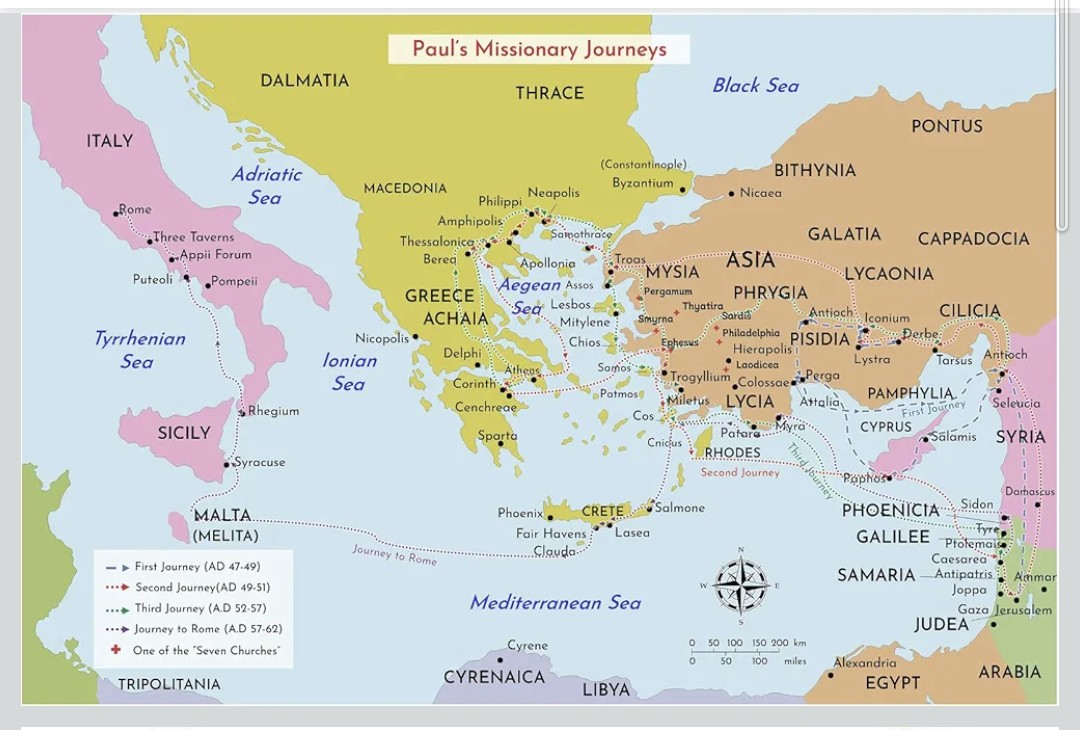
  • The Apostolic Map: Paul’s Journeys

    The Apostolic Map: Paul’s Journeys

    The Apostolic Map: A Strategic Blueprint for Modern Christian Outreach

    COPE Ministry Wakefield presents an in-depth look at the missionary journeys of the Apostle Paul. Written by Fin Dalton, this study explores how Paul’s travels in the Book of Acts serve as a dynamic blueprint for evangelism today. Our mission remains clear: “Nobody Is Too Far Gone. Anyone Can Be Saved.”

    ​Understanding the Scale of Paul’s Missionary Journeys

    ​To appreciate Paul’s outreach strategy, we must look at the staggering physical scale of his work between AD 47 and AD 62. Operating without modern transportation, Paul’s mission was a feat of endurance spanning approximately 15 years and covering over 10,000 miles (16,000 kilometers). His impact was monumental, resulting in over 12 major city-churches established across three continents.

    ​Paul’s ministry touched the heart of Turkey in locations like his birthplace, Tarsus, and the influential city of Ephesus. Following the “Macedonian Call,” he established churches throughout Greece, including Philippi, Thessalonica, and Corinth. His reach extended from his primary sending base in Antioch, Syria, to the islands of Cyprus and Malta, and eventually to the heart of the Roman Empire in Italy.

    ​Timeline of the Four Missionary Journeys

    ​The First Journey (AD 47–49): Focus on Cyprus and South Galatia

    ​During this initial phase, Paul and Barnabas established the first Gentile churches. This period proved that the Gospel was a universal message intended for all cultures, breaking regional barriers.

    ​The Second Journey (AD 49–51): The Entry into Europe

    ​After receiving a vision of a man from Macedonia, Paul crossed into Greece. This journey was defined by planting churches in major urban centers such as Philippi and Corinth, focusing on high-traffic cultural hubs.

    ​The Third Journey (AD 52–57): Deep Investment and Leadership

    ​Paul spent three years in Ephesus during this mission. This period emphasized leadership training and creating a central hub that influenced the entire region of Asia Minor, proving that deep roots produce lasting fruit.

    ​The Fourth Journey (AD 57–62): Reaching the Heart of the Empire

    ​Even as a prisoner, Paul used his Roman citizenship to reach the highest levels of government in Rome. His journey through the shipwreck at Malta to his house arrest in Italy demonstrates that circumstances cannot stop the Gospel message.

    ​Core Principles for Modern Evangelism and Outreach

    ​Paul’s strategy offers several key lessons for Christian outreach in Wakefield and beyond. He focused on Target Strategic Hubs to maximize reach and practiced Cultural Adaptability, tailoring his message for philosophers and merchants alike without compromising the truth. He prioritized Long-Term Investment through multi-year stays and maintained Unwavering Perseverance through trials. Most importantly, he built Genuine Relationships, proving that effective outreach is built on authentic connection.

    ​Interactive Bible Study Resources

    ​For those wishing to visualize the Roman Agoras where Paul stood, we recommend using Google Earth to search for “Ancient Ephesus” or “Philippi ruins.” Seeing these historical sites helps bridge the gap between ancient scripture and modern application.

    ​COPE Ministry provides a growing resource of Daily Study Notes on the Book of Acts, updated every Monday through Friday. Whether you are looking for a book-by-book summary or a deep dive into apostolic history, our digital library is designed to support your spiritual journey.

    Interactive Study Tip

    ​Want to see the actual streets Paul walked? Use Google Earth to search for “Ancient Ephesus” or “Philippi ruins.” Seeing the Roman Agoras (marketplaces) helps visualize where Paul stood to engage with the public.

    Interactive Study Tip: Explore Ancient Ephesus

    Want to see the actual streets Paul walked? Use the map below to explore the ruins of Ephesus, where Paul spent three years of his ministry.

    Pro Tip: Click “View larger map” to enter Street View and walk through the Roman Agora where Paul stood to engage with the public.

    Explore More with COPE Ministry:

    Daily Study Notes: Acts & Beyond.  This is a growing resource! As part of our daily study, I add a new chapter of notes every day Monday-Friday. Bookmark this page and check back daily to see the latest breakdown as we journey through the Book of Acts together until the book is complete”

    [  ✍️📖THE ACTS STUDY NOTES HERE ]

  • Book of Acts: Study Notes Overview

    Book of Acts: Study Notes Overview

    Welcome to the Journey: Exploring the Word

    A COPE Ministry Study Guide

    As you scroll through these notes, ask the Holy Spirit to speak to you. If you feel a “nudge” in your heart, that’s God inviting you into a deeper relationship.

    Book of Acts: Chapter by Chapter Overview

    • Author: LUKE (The physician & companion of Paul)
    • Written: Roughly 60-62 while Paul was under house arrest.
    • Written For: All believers (Theophilus)
    • Where: Starting in Jerusalem, Judea and Samaria continuing through most of the Roman Empire.
    • Why: It connects the story of Jesus with Christians.
    • Structure (28 Chapters):
      • 1–12: Focuses on Peter and the Church in Jerusalem & Judea.
      • 13–28: Follows Paul’s missionary journeys to the Gentiles ending in Rome.
    • Key Events:
    • Foundations in Jerusalem
    • ​The opening chapters focus on the empowerment of the apostles and the birth of the church.
    • The Ascension (Acts 1): Jesus provides the Great Commission and ascends to heaven, promising the Holy Spirit.
    • Pentecost (Acts 2): The Holy Spirit descends upon the disciples. Peter preaches his first sermon, resulting in approximately 3,000 baptisms.
    • The First Martyr (Acts 7): Stephen, a deacon, is stoned to death for his faith, marking the beginning of intense persecution in Jerusalem.
    • ​Expansion to Judea and Samaria
    • ​Following Stephen’s death, believers scatter, which unintentionally spreads the message to new regions.
    • Philip in Samaria (Acts 8): The gospel moves beyond Jewish boundaries to the Samaritans and an Ethiopian eunuch.
    • The Conversion of Saul (Acts 9): On the road to Damascus, the persecutor Saul encounters the risen Christ and becomes Paul, the “Apostle to the Gentiles.”
    • Peter and Cornelius (Acts 10): Through a vision and a meeting with a Roman centurion, Peter realizes that the gospel is intended for Gentiles as well as Jews.
    • ​To the Ends of the Earth
    • ​The latter half of the book follows Paul’s three missionary journeys and his eventual journey to Rome.
    • ​Paul’s Missionary Journeys
    • The First Journey: Focusing on Cyprus and Galatia, this mission established the first major Gentile churches.
    • The Second Journey: Driven by “The Macedonian Call,” Paul brought the gospel into Europe, specifically to Philippi, Thessalonica, and Athens.
    • The Third Journey: This period was marked by extensive ministry in Ephesus, resulting in significant growth and the writing of several key epistles.
    • ​The Final Narrative
    • The Jerusalem Council (Acts 15): Church leadership formally decided that Gentile converts did not need to follow the Mosaic Law (specifically circumcision) to be saved.
    • Paul’s Arrest and Trials (Acts 21–26): Paul was arrested in Jerusalem and defended his faith before various Roman officials, including Felix, Festus, and King Agrippa.
    • The Journey to Rome (Acts 27–28): After a dramatic shipwreck near Malta, Paul arrived in Rome. The book concludes with him under house arrest, continuing to preach boldly to all who visited him.

    Map of the Apostle Paul’s Four Missionary Journeys (AD 47–62)
    This map traces the extensive travels of the Apostle Paul across the Mediterranean world, from his first missionary trip starting in Antioch to his final journey to Rome as a prisoner.

    Acts Chapter 1: The Promise of the Holy Spirit

    The Ascension of Jesus • The Waiting Believers • Matthias Chosen to Replace Judas

    Timeline: Approximately AD 30 (40 days after the Resurrection) Location: Jerusalem and the Mount of Olives


    1. The Final Instructions (Verses 1–5)

    Luke begins this second volume by referring to his first (the Gospel of Luke), picking up where he left off with the resurrected Jesus.

    • The Command: Jesus gave instructions through the Holy Spirit to the apostles He had chosen. He appeared to them over a period of forty days, proving He was alive and speaking about the kingdom of God.
    • The Waiting: He told them not to leave Jerusalem but to wait for the gift the Father promised: “In a few days you will be baptized with the Holy Spirit.”

    2. The Great Commission and Ascension (Verses 6–11)

    The disciples, still thinking of a political kingdom, asked if Jesus was about to restore the kingdom to Israel.

    • The Power: Jesus redirected them: “It is not for you to know the times or dates… But you will receive power when the Holy Spirit comes on you; and you will be my witnesses in Jerusalem, and in all Judea and Samaria, and to the ends of the earth.”
    • The Departure: After saying this, He was taken up before their very eyes, and a cloud hid Him from their sight.
    • The Promise of Return: Two men dressed in white suddenly stood beside them and declared that Jesus would return in the same way they saw Him go into heaven.

    3. The Upper Room and Prayer (Verses 12–14)

    The apostles returned to Jerusalem from the Mount of Olives.

    • The Gathering: They went to the upstairs room where they were staying. The list included the eleven apostles, along with the women, Mary the mother of Jesus, and His brothers.
    • The Unity: They all joined together constantly in prayer, waiting for the promised Spirit.

    4. Matthias Replaces Judas (Verses 15–26)

    During those days, Peter stood up among the believers (about 120 people).

    • The Necessity: Peter explained that the Scripture had to be fulfilled concerning Judas, who served as a guide for those who arrested Jesus.
    • The Criteria: They needed a replacement who had been with them the entire time Jesus went in and out among them, beginning from John’s baptism to the Ascension, to be a witness of the resurrection.
    • The Selection: They nominated two men: Joseph called Barsabbas and Matthias. After praying for God to show them the heart of the right man, they cast lots, and the lot fell to Matthias.

    Themes of Transformation

    • From Curiosity to Mission: The disciples were focused on “when” the kingdom would come, but Jesus focused them on “how” they would represent it. Transformation shifts our focus from predicting the future to participating in God’s work in the present.
    • The Power of Waiting: Even though they had a global mission, they were told to wait. This reminds us that in Wakefield, our activity for God is only effective when it is fueled by the power of God. The “new life” is not a self-improvement project but a Spirit-led journey.
    • Unity in Prayer: Before the church did anything else, they prayed together. Their commitment to constant prayer mirrors our own 5-Minute Daily Challenge—true spiritual impact begins with a heart that is consistently turned toward the Father.

    Acts Chapter 2: The Coming of the Spirit

    The Day of Pentecost • Peter’s First Sermon • The Fellowship of Believers

    Timeline: Approximately AD 30 (50 days after the Resurrection) Location: Jerusalem


    1. The Outpouring of the Holy Spirit (Verses 1–13)

    When the day of Pentecost came, the believers were all gathered in one place.

    • The Manifestation: Suddenly, a sound like a blowing violent wind came from heaven and filled the house. They saw what seemed to be tongues of fire that separated and came to rest on each of them.
    • The Miracle of Language: All of them were filled with the Holy Spirit and began to speak in other tongues. God-fearing Jews from every nation under heaven, staying in Jerusalem, heard them speaking in their own native languages.
    • The Reaction: Utterly amazed, some asked, “What does this mean?” while others sneered and accused them of being drunk on wine.

    2. Peter’s Prophetic Explanation (Verses 14–36)

    Peter stood up with the Eleven and addressed the crowd, explaining that these men were not drunk but were witnessing the fulfillment of the prophet Joel.

    • The Message: Peter shifted the focus to Jesus of Nazareth, a man accredited by God through miracles, who was handed over to be killed but whom God raised from the dead.
    • The Proof: He cited King David’s prophecies to prove that the Messiah could not be held by the grave.
    • The Conclusion: Peter declared boldly: “God has made this Jesus, whom you crucified, both Lord and Messiah.”

    3. The First Response (Verses 37–41)

    When the people heard this, they were “cut to the heart” and asked what they should do.

    • The Call to Repentance: Peter replied, “Repent and be baptized, every one of you, in the name of Jesus Christ for the forgiveness of your sins. And you will receive the gift of the Holy Spirit.”
    • The Result: Those who accepted his message were baptized, and about three thousand were added to their number that day.

    4. The Life of the Early Church (Verses 42–47)

    The chapter concludes with a beautiful picture of the first Christian community.

    • The Four Pillars: They devoted themselves to the apostles’ teaching, to fellowship, to the breaking of bread, and to prayer.
    • The Generosity: Everyone was filled with awe at the many wonders and signs. All the believers were together and had everything in common, selling property and possessions to give to anyone who had need.
    • The Growth: They met every day in the temple courts and in their homes. And the Lord added to their number daily those who were being saved.

    Themes of Transformation

    • Reversing Babel: At the Tower of Babel, languages were confused to scatter people. At Pentecost, the Spirit uses languages to bring people together. Transformation means that the Gospel is for everyone, regardless of their background or where they come from in Wakefield.
    • Conviction of the Heart: The crowd wasn’t just “informed”; they were “cut to the heart.” Real change happens when the truth moves from our heads to our hearts, leading to a genuine desire for a new direction.
    • Radical Community: The early church didn’t just meet for a service; they shared their lives. Their daily devotion and extreme generosity show us that a “new life” in Christ is meant to be lived out in a community that cares for the practical and spiritual needs of others.

    Acts Chapter 3: The Lame Beggar Healed

    A Miracle at the Gate • Peter’s Address in Solomon’s Colonnade • The Call to Repent

    Timeline: Shortly after Pentecost (AD 30) Location: The Temple in Jerusalem (The Beautiful Gate)


    1. The Miracle at the Beautiful Gate (Verses 1–10)

    Peter and John were going up to the temple at the time of prayer (three in the afternoon).

    • The Encounter: A man lame from birth was being carried to the temple gate called Beautiful, where he was put every day to beg. When he saw Peter and John, he asked them for money.
    • The Command: Peter looked straight at him and said, “Silver or gold I do not have, but what I do have I give you. In the name of Jesus Christ of Nazareth, walk.”
    • The Instant Change: Taking him by the right hand, Peter helped him up, and instantly the man’s feet and ankles became strong. He jumped to his feet and began to walk, entering the temple courts with them—walking, leaping, and praising God.
    • The Crowd’s Reaction: When the people saw him, they were filled with wonder and amazement, recognizing him as the man who used to sit begging at the gate.

    2. Peter Speaks to the Onlookers (Verses 11–16)

    While the man held on to Peter and John, all the people were astonished and came running to them in the place called Solomon’s Colonnade.

    • Deflecting the Glory: Peter immediately redirected the attention away from himself: “Why do you stare at us as if by our own power or godliness we had made this man walk?”
    • The Source of Power: He explained that the God of Abraham, Isaac, and Jacob had glorified His servant Jesus.
    • Faith in the Name: Peter stated clearly: “By faith in the name of Jesus, this man whom you see and know was made strong. It is Jesus’ name and the faith that comes through him that has completely healed him.”

    3. The Invitation to Repent (Verses 17–26)

    Peter acknowledged that the people and their leaders acted in ignorance when they killed Jesus, fulfilling what God had foretold through the prophets.

    • The Solution: He offered a path forward: “Repent, then, and turn to God, so that your sins may be wiped out, that times of refreshing may come from the Lord.”
    • The Fulfillment: He reminded them that they were heirs of the prophets and of the covenant God made with their fathers, promising that through Abraham’s offspring, all peoples on earth would be blessed.
    • The First Blessing: God sent His servant Jesus first to the people of Israel to bless them by turning each of them from their wicked ways.

    Themes of Transformation

    • More Than Material Needs: The beggar asked for money, but he received a miracle. This reminds us that in Wakefield, we often focus on our immediate, “silver and gold” problems, while God wants to address the deeper, structural issues of our lives. Transformation often gives us what we need rather than what we initially ask for.
    • The Power of the Name: Peter didn’t perform the miracle by his own merit; he acted as a representative of Jesus. A “new life” means operating under a new authority. When we act “in the name of Jesus,” we are leaning on His character and His power, not our own strength.
    • Times of Refreshing: Peter describes repentance not as a burden, but as a doorway to “times of refreshing.” This counters the idea that following Christ is about rules. Instead, it is about a spiritual renewal that wipes the slate clean and brings life back to our weary hearts.

    Acts Chapter 4: Boldness Under Fire

    Peter and John Before the Sanhedrin • The Prayer of the Believers • All Things in Common

    Timeline: Shortly after the healing of the lame man (AD 30) Location: Jerusalem (The Temple and the High Council)


    1. The Arrest and Trial (Verses 1–12)

    While Peter and John were speaking, the priests, the captain of the temple guard, and the Sadducees came up to them.

    • The Interruption: They were greatly disturbed because the apostles were teaching the people and proclaiming in Jesus the resurrection of the dead. They seized Peter and John and put them in jail until the next day.
    • The Growth: Despite the arrest, many who heard the message believed; the number of men who believed grew to about five thousand.
    • The Question: The next day, the rulers, elders, and teachers of the law met in Jerusalem. They sat Peter and John in the center and asked: “By what power or what name did you do this?”
    • The Answer: Peter, filled with the Holy Spirit, declared that the man was healed by the name of Jesus Christ of Nazareth. He quoted Scripture: “The stone you builders rejected, which has become the cornerstone.”

    2. The Verdict and the Threat (Verses 13–22)

    When the council saw the courage of Peter and John and realized they were unschooled, ordinary men, they were astonished and took note that these men had been with Jesus.

    • The Dilemma: Since the healed man was standing there with them, there was nothing the council could say. They ordered them to withdraw and conferred together.
    • The Command: To stop this “thing” from spreading, they commanded them not to speak or teach at all in the name of Jesus.
    • The Defiance: Peter and John replied, “Which is right in God’s eyes: to listen to you, or to him? …As for us, we cannot stop speaking about what we have seen and heard.” After further threats, the council let them go.

    3. The Prayer for Boldness (Verses 23–31)

    On their release, Peter and John went back to their own people and reported all that had been said.

    • The Prayer: The believers raised their voices together in prayer to God. They didn’t pray for the persecution to stop; they prayed for boldness: “Now, Lord, consider their threats and enable your servants to speak your word with great boldness.”
    • The Response: After they prayed, the place where they were meeting was shaken. And they were all filled with the Holy Spirit and spoke the word of God boldly.

    4. The Unity of the Believers (Verses 32–37)

    The community of believers was one in heart and mind.

    • Shared Resources: No one claimed that any of their possessions was their own, but they shared everything they had.
    • The Testimony: With great power, the apostles continued to testify to the resurrection of the Lord Jesus.
    • Barnabas: A Levite from Cyprus, whom the apostles called Barnabas (which means “Son of Encouragement”), sold a field he owned and brought the money to the apostles’ feet.

    Themes of Transformation

    • The Authority of Christ Over Tradition: The religious leaders relied on their titles, but the apostles relied on the “Cornerstone.” Transformation changes our foundation from human approval to the authority of Christ. In Wakefield, we may face pressure to conform to the “traditions” of the world, but our strength comes from standing on the Truth.
    • Evidence That Is Irrefutable: The council was silenced because the healed man was standing right there. This reminds us that a transformed life is the best argument for the Gospel. When people see the “new life” in us, it becomes a testimony that no one can argue against.
    • Prayer as a Weapon: Instead of praying for safety, the church prayed for boldness. This is a key part of our 5-Minute Daily Challenge—praying not just for our circumstances to change, but for our courage to rise within those circumstances so we can be “witnesses to the ends of the earth.”

    Acts Chapter 5: Purity and Persecution

    Ananias and Sapphira • Signs and Wonders • The Apostles Before the Sanhedrin

    Timeline: Approximately AD 30–31 Location: Jerusalem (The Temple and the High Council)


    1. Internal Crisis: Ananias and Sapphira (Verses 1–11)

    While the church was growing in unity and generosity, a couple named Ananias and Sapphira sold a piece of property.

    • The Deception: With his wife’s full knowledge, Ananias kept back part of the money for himself but brought the rest and put it at the apostles’ feet, implying it was the full amount.
    • The Confrontation: Peter, led by the Spirit, asked, “Ananias, how is it that Satan has so filled your heart that you have lied to the Holy Spirit?” He clarified that the property and the money were theirs to do with as they pleased—the sin was in the hypocrisy and the lie.
    • The Judgment: When Ananias heard this, he fell down and died. About three hours later, Sapphira came in, repeated the lie, and also fell dead.
    • The Result: Great fear seized the whole church and all who heard about these events.

    2. Miracles and Popularity (Verses 12–16)

    The apostles performed many signs and wonders among the people.

    • The Meeting Place: Believers used to meet together in Solomon’s Colonnade.
    • The Reputation: Although some were afraid to join them, the people held them in high regard, and more and more men and women believed in the Lord.
    • The Healing Shadow: People brought the sick into the streets on beds and mats so that at least Peter’s shadow might fall on some of them as he passed by. Crowds gathered from towns around Jerusalem, and all of them were healed.

    3. Arrest and Miraculous Escape (Verses 17–26)

    Filled with jealousy, the high priest and the Sadducees arrested the apostles and put them in the public jail.

    • The Angelic Intervention: During the night, an angel of the Lord opened the doors of the jail and brought them out.
    • The Command: The angel told them, “Go, stand in the temple courts and tell the people all about this new life.”
    • The Confusion: At daybreak, the Sanhedrin assembled and sent for the apostles, only to find the jail securely locked and guarded, but completely empty. They eventually found the apostles back in the temple courts, teaching.

    4. The Advice of Gamaliel (Verses 27–42)

    The apostles were brought before the Sanhedrin again. The high priest questioned them for disobeying the order not to teach in Jesus’ name.

    • The Famous Reply: Peter and the other apostles replied: “We must obey God rather than human beings!”
    • The Counsel: A Pharisee named Gamaliel, a teacher of the law honored by all, stood up. He reminded the council of past rebels whose movements died with them.
    • The Logic: He warned: “Leave these men alone! If their purpose or activity is of human origin, it will fail. But if it is from God, you will not be able to stop these men; you will only find yourselves fighting against God.”
    • The Outcome: The council had the apostles flogged and ordered them again not to speak in the name of Jesus. The apostles left rejoicing because they had been counted worthy of suffering disgrace for the Name.

    Themes of Transformation

    • Integrity Over Image: The story of Ananias and Sapphira serves as a stark reminder that God values heart-deep honesty over outward displays of piety. Transformation isn’t about looking “holy” to our community in Wakefield; it’s about being authentic before God.
    • The Unstoppable Nature of God: Gamaliel’s logic remains a powerful truth—what is from God cannot be stopped by human opposition. This gives us confidence that as we live out our “new life,” the external pressures we face cannot thwart God’s ultimate plan for us.
    • Joy in the Midst of Suffering: The apostles didn’t leave the council complaining about their wounds; they left rejoicing. This is a radical shift in perspective. A transformed heart sees trials not just as obstacles, but as opportunities to prove our loyalty and commitment to Christ.

    Acts Chapter 6: Choosing the Seven

    The Need for Deacons • The Seven Appointed • Stephen’s Ministry and Arrest

    Timeline: Approximately AD 31–32 Location: Jerusalem


    1. A Growing Pain in the Community (Verses 1–4)

    In those days, as the number of disciples was increasing, a dispute arose between the Hellenistic Jews (Greek-speaking) and the Hebraic Jews.

    • The Complaint: The Hellenistic Jews complained that their widows were being overlooked in the daily distribution of food.
    • The Priority: The Twelve apostles gathered all the disciples and explained that it would not be right for them to neglect the ministry of the word of God in order to wait on tables.
    • The Strategy: They proposed a division of labor: “Brothers and sisters, choose seven men from among you who are known to be full of the Spirit and wisdom. We will turn this responsibility over to them and will give our attention to prayer and the ministry of the word.”

    2. The Appointment of the Seven (Verses 5–7)

    This proposal pleased the whole group. They chose seven men, including Stephen (a man full of faith and the Holy Spirit) and Philip.

    • The Commission: They presented these men to the apostles, who prayed and laid their hands on them.
    • The Result: Because the internal conflict was resolved with wisdom and care, the word of God spread. The number of disciples in Jerusalem increased rapidly, and even a large number of priests became obedient to the faith.

    3. Stephen’s Ministry and Opposition (Verses 8–15)

    Stephen, a man full of God’s grace and power, performed great wonders and signs among the people.

    • The Debate: Opposition arose from members of the “Synagogue of the Freedmen.” They began to argue with Stephen, but they could not stand up against the wisdom the Spirit gave him as he spoke.
    • The Conspiracy: Unable to win the argument, they secretly persuaded some men to say, “We have heard Stephen speak blasphemous words against Moses and against God.”
    • The Arrest: They stirred up the people and the elders, seized Stephen, and brought him before the Sanhedrin. They produced false witnesses who claimed he was speaking against the holy place and the law.
    • The Face of an Angel: All who were sitting in the Sanhedrin looked intently at Stephen, and they saw that his face was like the face of an angel.

    Themes of Transformation

    • Wisdom in Conflict: The early church didn’t ignore their internal problems or cultural tensions; they addressed them with a practical, Spirit-led solution. Transformation doesn’t mean we won’t have disagreements in Wakefield, but it gives us the “Spirit and wisdom” to resolve them so that no one is overlooked.
    • The Value of Every Role: The apostles recognized that “waiting on tables” was a holy task that required men full of the Spirit. This teaches us that every act of service—whether preaching from a pulpit or helping someone in need—is a vital part of the “new life” and contributes to the growth of the Kingdom.
    • Reflecting the Glory of God: Even under false accusation and intense pressure, Stephen’s countenance reflected God’s presence. This serves as a reminder for our 5-Minute Daily Challenge: when we spend time in the Word and in prayer, we carry a “peace that surpasses understanding” into the difficult conversations and “marketplaces” of our daily lives.

    Acts Chapter 7: The First Martyr

    Stephen’s Defense • The History of Israel • The Stoning of Stephen

    Timeline: Approximately AD 32–33 Location: Before the Sanhedrin in Jerusalem


    1. Stephen’s Review of Israel’s History (Verses 1–50)

    The High Priest asked Stephen if the charges against him were true. Stephen responded with a masterful retelling of the Hebrew Scriptures, focusing on God’s presence outside the Temple.

    • The Call of Abraham: He reminded them that God appeared to Abraham in Mesopotamia—not in a temple or even in the Promised Land.
    • The Rejection of Joseph: He pointed out that the patriarchs, out of jealousy, sold Joseph into Egypt, yet God was with him there.
    • The Resistance to Moses: Stephen highlighted that when Moses first tried to deliver his people, they rejected him, asking, “Who made you ruler and judge over us?”
    • The Tabernacle and Temple: He argued that while Solomon built a house for God, “the Most High does not live in houses made by human hands.”

    2. The Sharp Rebuked (Verses 51–53)

    Stephen shifted from history to a direct confrontation of the leaders’ hearts.

    • The Accusation: He called them “stiff-necked” and accused them of resisting the Holy Spirit just as their ancestors did.
    • The Ultimate Betrayal: He claimed they were the ones who betrayed and murdered the “Righteous One” (Jesus), whom the prophets had foretold.

    3. The Vision and the Stoning (Verses 54–60)

    When the council heard this, they were furious and gnashed their teeth at him.

    • The Heavenly Vision: Stephen, full of the Holy Spirit, looked up to heaven and saw the glory of God, and Jesus standing at the right hand of God. “Look,” he said, “I see heaven open.”
    • The Execution: At this, they covered their ears and, yelling at the top of their voices, they all rushed at him, dragged him out of the city, and began to stone him.
    • The Witness: The witnesses laid their coats at the feet of a young man named Saul.
    • The Final Words: As they were stoning him, Stephen prayed, “Lord Jesus, receive my spirit,” and then, “Lord, do not hold this sin against them.” With this, he fell asleep.

    Themes of Transformation

    • God Beyond Buildings: Stephen’s speech emphasized that God is not confined to a specific location or “holy place.” Transformation means recognizing that God is present in every part of our lives in Wakefield—our homes, our workplaces, and our streets—not just within the walls of a church.
    • The Pattern of Rejection: Stephen showed that Israel often rejected the very leaders God sent to save them. This warns us not to resist the “new life” God offers because it challenges our current comfort or traditions.
    • A Christ-like Departure: In his final moments, Stephen echoed the words of Jesus on the cross by forgiving his executioners. This is the ultimate evidence of a transformed heart—the ability to show grace and forgiveness even in the face of extreme injustice.

    Acts Chapter 8: The Church Scattered

    The Persecution in Jerusalem • Philip in Samaria • The Ethiopian Eunuch

    Timeline: Approximately AD 33–34 Location: Jerusalem, Samaria, and the Desert Road to Gaza


    1. Great Persecution and Scattering (Verses 1–3)

    The death of Stephen triggered a massive wave of persecution against the church in Jerusalem.

    • The Approval of Saul: Saul was there, giving full approval to Stephen’s execution. He began to go from house to house, dragging off both men and women and putting them in prison.
    • The Result: All except the apostles were scattered throughout Judea and Samaria. However, those who were scattered preached the word wherever they went.

    2. Philip in Samaria (Verses 4–25)

    Philip (one of the Seven) went down to a city in Samaria and proclaimed the Messiah there.

    • The Response: When the crowds heard Philip and saw the signs he performed, they all paid close attention. Spirits came out of many, and many who were paralyzed or lame were healed. There was great joy in that city.
    • Simon the Sorcerer: A man named Simon, who had practiced sorcery and amazed the people, believed and was baptized. However, when Peter and John arrived and laid hands on the believers to receive the Holy Spirit, Simon tried to buy this power with money.
    • The Rebuke: Peter rebuked him sharply: “May your money perish with you, because you thought you could buy the gift of God with money!”

    3. Philip and the Ethiopian Eunuch (Verses 26–40)

    An angel of the Lord told Philip to go south to the desert road that goes down from Jerusalem to Gaza.

    • The Meeting: He met an Ethiopian eunuch, an important official in charge of the treasury of the Kandake (Queen of the Ethiopians). The man was sitting in his chariot reading the book of Isaiah.
    • The Explanation: The Spirit told Philip to go to the chariot. Philip heard the man reading Isaiah 53 and asked, “Do you understand what you are reading?” The man invited Philip to explain.
    • The Gospel: Starting with that very passage of Scripture, Philip told him the good news about Jesus.
    • The Baptism: As they traveled, they came to some water, and the official said, “Look, here is water. What can stand in the way of my being baptized?” Philip baptized him, and the eunuch went on his way rejoicing.

    Themes of Transformation

    • God’s Sovereignty in Hardship: What the enemy intended for evil (persecution), God used for good (the spread of the Gospel). The scattering of the church meant the “light” was no longer confined to one city. This reminds us in Wakefield that our setbacks are often God’s “set-ups” for a wider impact.
    • The Gospel Breaks Barriers: The Gospel moved into Samaria—a place traditionally avoided by Jews—and reached an Ethiopian official. Transformation removes the walls of prejudice and national identity, showing that the “new life” is a global invitation.
    • Personalized Discipleship: Philip left a massive revival in Samaria to talk to just one man in the desert. This highlights the value of the individual. Our 5-Minute Daily Challenge prepares us for those “divine appointments” where we might be the only one available to explain the Truth to a searching heart.

    Acts Chapter 9: The Conversion of Saul

    The Damascus Road Encounter • Aeneas and Dorcas • The Transformation of a Persecutor

    Timeline: Approximately AD 34–37 Location: The road to Damascus, Judea, and Joppa


    1. The Road to Damascus (Verses 1–9)

    Saul was still “breathing out murderous threats” against the Lord’s disciples. He obtained letters from the high priest to the synagogues in Damascus to arrest any followers of “the Way.”

    • The Light: As he neared Damascus, a light from heaven flashed around him. He fell to the ground and heard a voice: “Saul, Saul, why do you persecute me?”
    • The Identity: When Saul asked who was speaking, the voice replied, “I am Jesus, whom you are persecuting.”
    • The Condition: Saul stood up but found he was blind. For three days he did not eat or drink anything.

    2. Ananias’s Obedience (Verses 10–19)

    In Damascus, the Lord called to a disciple named Ananias in a vision, telling him to go to the house of Judas on Straight Street and ask for Saul of Tarsus.

    • The Hesitation: Ananias was terrified, knowing Saul’s reputation for harming the saints in Jerusalem.
    • The Purpose: The Lord reassured him: “Go! This man is my chosen instrument to proclaim my name to the Gentiles and their kings and to the people of Israel.”
    • The Healing: Ananias went, placed his hands on Saul, and said, “Brother Saul, the Lord Jesus… has sent me so that you may see again and be filled with the Holy Spirit.” Immediately, scales fell from Saul’s eyes, his sight was restored, and he was baptized.

    3. Saul the Preacher (Verses 20–31)

    Saul immediately began to preach in the synagogues that Jesus is the Son of God.

    • The Amazement: People were baffled—the man who came to destroy the church was now building it.
    • The Escape: When a conspiracy was formed to kill him, followers took him by night and lowered him in a basket through an opening in the city wall.
    • The Introduction: In Jerusalem, the disciples were afraid of him until Barnabas (the Son of Encouragement) took him to the apostles and told them of Saul’s genuine transformation.

    4. Miracles in Lydda and Joppa (Verses 32–43)

    Peter traveled throughout the country, visiting the believers.

    • Aeneas: In Lydda, Peter found a man named Aeneas who had been paralyzed and bedridden for eight years. Peter said, “Jesus Christ heals you,” and the man got up immediately.
    • Tabitha (Dorcas): In Joppa, a disciple named Tabitha, known for her acts of charity, became sick and died. Peter was sent for.
    • The Resurrection: Peter knelt and prayed, then turned to the dead woman and said, “Tabitha, get up.” She opened her eyes and sat up. This became known all over Joppa, and many people believed in the Lord.

    Themes of Transformation

    • From Persecutor to Proclaimer: Saul’s conversion is the ultimate example that no one is “too far gone” for God’s grace. Transformation isn’t just about stopping bad behavior; it’s about a total redirection of our zeal and talents for the Kingdom.
    • The Necessity of “Ananias”: Even a powerhouse like Saul needed a humble disciple like Ananias to welcome him and help him heal. In Wakefield, we are called to be “Ananiases”—willing to move past our fears to welcome and mentor those who are new to the faith.
    • Restoration of Sight: The “scales” falling from Saul’s eyes symbolize the removal of intellectual and spiritual blindness. Our 5-Minute Daily Challenge serves a similar purpose: it helps clear our vision each morning so we can see the world and our neighbors through the eyes of Christ.

    Acts Chapter 10: The Gospel to the Gentiles

    Cornelius’s Vision • Peter’s Trance • The Pentecost of the Gentiles

    Timeline: Approximately AD 38–40 Location: Caesarea and Joppa (Modern-day Israel)


    1. The Vision of Cornelius (Verses 1–8)

    In Caesarea there was a man named Cornelius, a centurion in the Italian Regiment.

    • The Character: He was a devout and God-fearing man who gave generously to those in need and prayed to God regularly.
    • The Angelic Visit: One afternoon, an angel appeared to him in a vision, saying, “Your prayers and gifts to the poor have come up as a memorial offering before God.”
    • The Instruction: The angel told him to send men to Joppa to bring back a man named Simon who is called Peter. Cornelius immediately dispatched two servants and a devout soldier.

    2. Peter’s Vision on the Roof (Verses 9–23)

    The next day, as the messengers were approaching, Peter went up on the roof to pray.

    • The Trance: He became hungry and fell into a trance. He saw heaven opened and a large sheet being let down by its four corners.
    • The Command: Inside were all kinds of “unclean” animals. A voice said, “Get up, Peter. Kill and eat.”
    • The Lesson: Peter refused, saying he had never eaten anything impure. The voice spoke a second time: “Do not call anything impure that God has made clean.” This happened three times.
    • The Connection: While Peter was wondering what this meant, the Spirit told him that three men were looking for him and that he should go with them without hesitation.

    3. Peter at Cornelius’s House (Verses 24–43)

    Peter arrived at Cornelius’s house, where a large group of relatives and close friends had gathered.

    • The Breakthrough: Peter entered and said, “You are well aware that it is against our law for a Jew to associate with or visit a Gentile. But God has shown me that I should not call anyone impure or unclean.”
    • The Sermon: Peter began to speak, realizing that “God does not show favoritism but accepts from every nation the one who fears him.” He preached the message of peace through Jesus Christ, His miracles, His death, and His resurrection.

    4. The Holy Spirit Falls on Gentiles (Verses 44–48)

    While Peter was still speaking these words, the Holy Spirit came on all who heard the message.

    • The Amazement: The circumcised believers who had come with Peter were astonished that the gift of the Holy Spirit had been poured out even on Gentiles.
    • The Evidence: They heard them speaking in tongues and praising God.
    • The Baptism: Peter declared, “Surely no one can stand in the way of their being baptized with water.” He ordered that they be baptized in the name of Jesus Christ.

    Themes of Transformation

    • Breaking the Walls of Tradition: For centuries, Jews and Gentiles were separated by strict laws. Transformation means allowing God to challenge our deeply held prejudices. In Wakefield, this reminds us that the “new life” is not an exclusive club; it is an open invitation to anyone, regardless of their past or heritage.
    • Seeking and Finding: Cornelius was a seeker, and God met him exactly where he was. It shows that God responds to a sincere heart. Our 5-Minute Daily Challenge is our way of staying “positioned” like Cornelius—consistently praying and staying open to what God wants to reveal to us.
    • God’s Lack of Favoritism: This chapter is a turning point in history. It proves that the Holy Spirit is the Great Equalizer. Transformation levels the playing field, making us all one in Christ.

    Acts Chapter 11: The Gospel Expands to Antioch

    Peter’s Report to Jerusalem • The Church in Antioch • Barnabas and Saul

    Timeline: Approximately AD 40–43 Location: Jerusalem and Antioch (Modern-day Turkey)


    1. Peter Explains the Gentile Vision (Verses 1–18)

    Word reached the apostles and believers throughout Judea that Gentiles had received the word of God.

    • The Criticism: When Peter went up to Jerusalem, the “circumcised believers” criticized him for eating with uncircumcised men.
    • The Recap: Peter explained everything exactly as it happened—the vision of the sheet, the command to eat, and the Spirit’s instruction to go to Caesarea.
    • The Evidence: Peter concluded by saying that as he began to speak, the Holy Spirit fell on them just as He had on the apostles at Pentecost. “If God gave them the same gift he gave us… who was I to think that I could stand in God’s way?”
    • The Acceptance: When they heard this, they had no further objections and praised God, saying, “So then, even to Gentiles God has granted repentance that leads to life.”

    2. The Church in Antioch (Verses 19–24)

    Now those who had been scattered by the persecution that broke out when Stephen was killed traveled as far as Phoenicia, Cyprus, and Antioch.

    • The Shift: Initially, they spread the word only among Jews. However, some from Cyprus and Cyrene went to Antioch and began to speak to Greeks also, telling them the good news about the Lord Jesus.
    • The Growth: The Lord’s hand was with them, and a great number of people believed and turned to the Lord.
    • Barnabas Sent: News of this reached the church in Jerusalem, and they sent Barnabas to Antioch. When he arrived and saw what the grace of God had done, he was glad and encouraged them all to remain true to the Lord.

    3. “Christians” and the Famine Relief (Verses 25–30)

    Barnabas realized the work in Antioch was too large for one person.

    • The Partnership: Barnabas went to Tarsus to look for Saul. When he found him, he brought him to Antioch. For a whole year, they met with the church and taught great numbers of people.
    • A New Name: The disciples were called Christians first at Antioch.
    • The Prophecy: A prophet named Agabus predicted that a severe famine would spread over the entire Roman world.
    • The Response: The disciples, as each one was able, decided to provide help for the believers living in Judea. They sent their gift to the elders by Barnabas and Saul.

    Themes of Transformation

    • Accountability and Unity: Peter didn’t ignore the concerns of the Jerusalem leaders; he walked them through his experience. Transformation encourages us to be transparent with our community in Wakefield. When we share how God is moving, it turns criticism into celebration.
    • A New Identity: Being called “Christians” meant the world saw these people as a distinct group defined by their relationship with Christ, rather than their ethnic background. A “new life” means our primary identity is found in Jesus—everything else (job, nationality, history) comes second.
    • Generosity Across Borders: Even before the famine hit, the church in Antioch was ready to give to people they had never met in Judea. This radical generosity is a hallmark of a transformed heart. Our 5-Minute Daily Challenge can include asking God: “Who can I be a blessing to today, even outside my immediate circle?”

    Acts Chapter 12: Peter’s Rescue and Herod’s Fall

    The Death of James • Peter’s Miraculous Escape • The Death of Herod Agrippa

    Timeline: Approximately AD 44 Location: Jerusalem and Caesarea


    1. Persecution Under Herod Agrippa I (Verses 1–5)

    It was about this time that King Herod Agrippa (the grandson of Herod the Great) began to violently persecute the church.

    • The Martyrdom of James: He had James, the brother of John, put to death with the sword.
    • The Arrest of Peter: Seeing that this pleased the Jewish leaders, he proceeded to seize Peter during the Festival of Unleavened Bread. Peter was kept in prison, guarded by four squads of four soldiers each.
    • The Response of the Church: While Peter was in prison, the church was “earnestly praying to God for him.”

    2. The Midnight Escape (Verses 6–11)

    The night before Herod was to bring him to trial, Peter was sleeping between two soldiers, bound with two chains, while sentries stood guard at the entrance.

    • The Angelic Intervention: Suddenly an angel of the Lord appeared and a light shone in the cell. The angel struck Peter on the side to wake him up, saying, “Quick, get up!” The chains fell off Peter’s wrists.
    • The Departure: The angel told him to wrap his cloak around him and follow. They passed the first and second guards and came to the iron gate leading to the city, which opened for them by itself.
    • The Realization: Once they had walked the length of one street, the angel left him. Peter finally realized it wasn’t a vision: “Now I know without a doubt that the Lord has sent his angel and rescued me.”

    3. The Surprised Prayer Meeting (Verses 12–19)

    Peter went to the house of Mary, the mother of John Mark, where many people had gathered and were praying.

    • Rhoda’s Interruption: When Peter knocked, a servant named Rhoda went to answer. She was so overjoyed to hear Peter’s voice that she ran back without opening the gate, shouting that Peter was there.
    • The Disbelief: The group told her, “You’re out of your mind!” Even while they were praying for him, they struggled to believe he was actually standing at the door.
    • The Evidence: Peter kept on knocking. When they opened the door and saw him, they were astonished. He described how the Lord had brought him out and then left for another place.

    4. The Judgment of Herod (Verses 20–25)

    Herod went from Judea to Caesarea. After a dispute with the people of Tyre and Sidon, he sat on his throne and delivered a public address.

    • The Blasphemy: The people shouted, “This is the voice of a god, not of a man.” Because Herod did not give praise to God, an angel of the Lord struck him down; he was eaten by worms and died.
    • The Contrast: While the tyrant fell, “the word of God continued to spread and flourish.” Barnabas and Saul returned from their mission to Jerusalem, bringing John Mark with them.

    Themes of Transformation

    • The Power of Earnest Prayer: The Greek word for “earnestly” (ektenōs) implies a “stretched out” or intense effort. Transformation teaches us that our most effective weapon against the “prisons” of life is persistent, collective prayer. Even when our faith is small (like the disciples who didn’t believe Rhoda), God still honors the act of seeking Him.
    • Peace in the Storm: Peter was so at peace that he was sleeping soundly the night before his scheduled execution. This is a hallmark of the “new life” in Wakefield—a quiet confidence that our lives are in God’s hands, regardless of the “chains” or “soldiers” surrounding us.
    • The Futility of Opposing God: Herod tried to silence the church by killing James and arresting Peter, but he ended up being the one who was removed. This reminds us in our 5-Minute Daily Challenge that while we may face opposition, the Truth we carry is eternal and unhindered by human power.

    Acts Chapter 13: The First Missionary Journey

    The Call of Barnabas and Saul • Confrontation in Paphos • The Sermon at Antioch

    Timeline: Approximately AD 46–48 Location: Antioch, Cyprus, and Perga/Antioch in Pisidia (Modern-day Turkey)


    1. Set Apart for the Work (Verses 1–3)

    In the church at Antioch, there were several prophets and teachers from diverse backgrounds.

    • The Divine Command: While they were worshipping the Lord and fasting, the Holy Spirit said, “Set apart for me Barnabas and Saul for the work to which I have called them.”
    • The Commission: After further fasting and prayer, the church placed their hands on them and sent them off. This marks the beginning of the formal mission to the Gentile world.

    2. Cyprus and the Sorcerer (Verses 4–12)

    Sent on their way by the Holy Spirit, they went down to Seleucia and sailed to Cyprus.

    • The Conflict: In Paphos, they met a Jewish sorcerer and false prophet named Bar-Jesus (Elymas), who was an attendant of the proconsul, Sergius Paulus. Elymas tried to turn the proconsul from the faith.
    • The Power Shift: Saul (now called Paul for the first time in the narrative) looked at him and, filled with the Holy Spirit, rebuked him. Elymas was struck with temporary blindness.
    • The Result: When the proconsul saw what had happened, he believed, for he was amazed at the teaching about the Lord.

    3. Paul’s Sermon in Pisidian Antioch (Verses 13–41)

    Paul and his companions sailed to Perga, where John Mark left them to return to Jerusalem. Paul and Barnabas continued on to Pisidian Antioch.

    • The Synagogue Address: On the Sabbath, Paul was invited to speak. He delivered a powerful summary of Israel’s history—from the Exodus to King David—and then identified Jesus as the promised Savior from David’s line.
    • The Core Message: He preached that through Jesus, the forgiveness of sins is proclaimed, and that everyone who believes is set free from every sin—a justification that the Law of Moses could not provide.

    4. Turning to the Gentiles (Verses 42–52)

    The people were so moved they invited Paul to speak again the following Sabbath.

    • The Jealousy: On the next Sabbath, almost the whole city gathered. When the Jewish leaders saw the crowds, they were filled with jealousy and talked abusively against Paul.
    • The Pivot: Paul and Barnabas responded boldly: “Since you reject it… we now turn to the Gentiles.”
    • The Spread: The Gentiles were glad and honored the word of the Lord. Despite being expelled from the region by the local leaders, the disciples were “filled with joy and with the Holy Spirit.”

    Themes of Transformation

    • Sensitivity to the Spirit: The church in Antioch didn’t just “act”; they waited until the Spirit spoke during worship and fasting. Transformation involves learning to listen before we leap. In Wakefield, our 5-Minute Daily Challenge is that moment of quiet where we ask the Spirit: “What work have you set apart for me today?”
    • Justification Through Faith: Paul’s message in verse 39 is a cornerstone of the “new life”—we are set free from things the “Law” could never fix. Transformation isn’t about working harder to be good; it’s about accepting the freedom that Christ has already won for us.
    • Joy Despite Rejection: Even though they were literally kicked out of town, the disciples were “filled with joy.” This radical shift in perspective shows that a transformed heart isn’t dependent on its surroundings, but on the presence of the Holy Spirit within.

    Acts Chapter 14: Signs, Wonders, and Hardships

    The Work in Iconium • Mistaken Identity in Lystra • Strengthening the Churches

    Timeline: Approximately AD 47–48 Location: Iconium, Lystra, Derbe, and back to Antioch


    1. Conflict and Confirmation in Iconium (Verses 1–7)

    In Iconium, Paul and Barnabas went as usual into the Jewish synagogue.

    • The Success: They spoke so effectively that a great number of Jews and Greeks believed.
    • The Division: However, the Jews who refused to believe stirred up the Gentiles and poisoned their minds. The city was divided between those who supported the leaders and those who supported the apostles.
    • The Escape: When a plot was discovered to mistreat and stone them, they fled to the Lycaonian cities of Lystra and Derbe, where they continued to preach the gospel.

    2. From “Gods” to “Scoundrels” in Lystra (Verses 8–20)

    In Lystra, Paul met a man who had been lame from birth and had never walked.

    • The Healing: Paul saw that the man had faith to be healed and called out, “Stand up on your feet!” At that, the man jumped up and began to walk.
    • The Misunderstanding: When the crowd saw this, they shouted in their local language, “The gods have come down to us in human form!” They called Barnabas “Zeus” and Paul “Hermes.” The priest of Zeus even brought bulls and wreaths to offer sacrifices to them.
    • The Defense: Paul and Barnabas tore their clothes and rushed into the crowd, shouting, “We are only human! We are bringing you good news, telling you to turn from these worthless things to the living God.”
    • The Turnaround: Some Jews from Antioch and Iconium arrived and won the crowd over. They stoned Paul and dragged him outside the city, thinking he was dead. But after the disciples gathered around him, he got up and went back into the city!

    3. Strengthening the New Believers (Verses 21–28)

    After preaching in Derbe, they retraced their steps back through Lystra, Iconium, and Antioch (in Pisidia).

    • The Encouragement: They strengthened the disciples and encouraged them to remain true to the faith, saying, “We must go through many hardships to enter the kingdom of God.”
    • The Leadership: They appointed elders for them in each church and, with prayer and fasting, committed them to the Lord.
    • The Return Home: Finally, they sailed back to Antioch in Syria, where they had first been sent out. They gathered the church together and reported all that God had done through them and how He had opened a door of faith to the Gentiles.

    Themes of Transformation

    • Redirecting the Praise: Paul and Barnabas refused the worship of the crowd, even when it would have been easy to accept the “god” status for safety or influence. Transformation means having the humility to ensure God gets the credit for the work He does through us. In Wakefield, we are called to be mirrors that reflect God’s glory, not sponges that soak it up.
    • Resilience in the Mission: Paul was stoned and left for dead, yet he got back up and went right back into the city. This radical resilience is a fruit of the “new life.” It shows that our commitment to the mission is stronger than our fear of pain or rejection.
    • The Reality of Hardship: Paul didn’t promise a “prosperity gospel”; he told the new believers that hardships were a normal part of the journey. Our 5-Minute Daily Challenge helps us build the spiritual “muscle” needed to endure these seasons, reminding us that the struggle is often a sign that we are moving in the right direction.

    Acts Chapter 15: The Jerusalem Council

    The Great Debate • The Decision of the Elders • The Second Journey Begins

    Timeline: Approximately AD 49–50 Location: Antioch and Jerusalem


    1. The Dispute Over Circumcision (Verses 1–5)

    While Paul and Barnabas were in Antioch, certain men came down from Judea and began teaching the believers: “Unless you are circumcised, according to the custom taught by Moses, you cannot be saved.”

    • The Conflict: This brought Paul and Barnabas into sharp dispute and debate with them.
    • The Delegation: The church decided to send Paul, Barnabas, and some other believers to Jerusalem to see the apostles and elders about this question.
    • The Pharisee Party: In Jerusalem, some believers who belonged to the party of the Pharisees stood up and insisted that Gentile converts must be required to keep the Law of Moses.

    2. The Council at Jerusalem (Verses 6–21)

    The apostles and elders met to consider this question. After much discussion, the key leaders spoke.

    • Peter’s Testimony: Peter reminded them how God had given the Holy Spirit to Cornelius’s household without circumcision. He asked, “Why do you try to test God by putting on the necks of Gentiles a yoke that neither we nor our ancestors have been able to bear?”
    • Barnabas and Paul: They told of the signs and wonders God had done among the Gentiles through them.
    • James’s Judgment: James (the brother of Jesus and leader in the Jerusalem church) quoted the prophets to show that God intended for the Gentiles to seek Him. He concluded: “We should not make it difficult for the Gentiles who are turning to God.”

    3. The Letter to the Gentile Believers (Verses 22–35)

    The council decided to send a letter back to Antioch with Paul, Barnabas, and two local leaders, Judas (Barsabbas) and Silas.

    • The Verdict: The letter stated that the council had not authorized the men who were troubling them.
    • The Essentials: They asked the Gentiles to abstain only from a few things: food sacrificed to idols, blood, meat of strangled animals, and sexual immorality.
    • The Encouragement: When the people in Antioch read the letter, they were glad for its encouraging message.

    4. Paul and Barnabas Part Ways (Verses 36–41)

    Sometime later, Paul suggested to Barnabas that they go back and visit the believers in all the towns where they had preached.

    • The Disagreement: Barnabas wanted to take John Mark, but Paul didn’t think it was wise because Mark had deserted them on the first trip.
    • The Result: They had such a sharp disagreement that they parted company. Barnabas took Mark and sailed for Cyprus.
    • The New Partnership: Paul chose Silas and left, commended by the believers to the grace of the Lord. He traveled through Syria and Cilicia, strengthening the churches.

    Themes of Transformation

    • Grace Over Law: The Jerusalem Council marks a pivotal moment where the church officially chose “Grace” over “Legalism.” Transformation means understanding that our standing with God is based on what Jesus did, not on how many religious rules we keep. In Wakefield, we must be careful not to create “yokes” for others that make it difficult for them to turn to God.
    • God Works Through Conflict: Even though Paul and Barnabas had a sharp disagreement, it resulted in two missionary teams instead of one. Transformation doesn’t mean we will never have personal friction, but it means God can use even our fallibility to double the reach of the Gospel.
    • Essentials vs. Non-Essentials: The council focused on the heart and moral purity rather than cultural rituals. Our 5-Minute Daily Challenge helps us keep the “main thing the main thing”—focusing on our relationship with Christ and a life of integrity rather than getting caught up in minor disputes.

    Acts Chapter 16: The Call to Macedonia

    Timothy Joins Paul • The Vision of the Man from Macedonia • Prison Songs and an Earthquake

    Timeline: Approximately AD 50–52 Location: Derbe, Lystra, Troas, and Philippi (Modern-day Turkey and Greece)


    1. Timothy and the Guidance of the Spirit (Verses 1–10)

    Paul arrived at Derbe and then Lystra, where he met a disciple named Timothy.

    • A New Partner: Timothy had a Greek father and a Jewish mother. Paul decided to take him along on the journey. To avoid offending the Jews in the area, Paul circumcised him—showing a willingness to be flexible for the sake of the Gospel.
    • The Closed Doors: Paul and his companions traveled through Phrygia and Galatia, but they were kept by the Holy Spirit from preaching the word in the province of Asia. When they tried to enter Bithynia, the Spirit of Jesus would not allow them to.
    • The Macedonian Call: During the night, Paul had a vision of a man of Macedonia standing and begging him, “Come over to Macedonia and help us.” After the vision, they got ready at once to leave for Macedonia.

    2. Lydia’s Conversion in Philippi (Verses 11–15)

    From Troas, they sailed to Samothrace and then to Philippi, a Roman colony and the leading city of that district.

    • The Place of Prayer: On the Sabbath, they went outside the city gate to the river, where they expected to find a place of prayer. They sat down and began to speak to the women who had gathered.
    • The Open Heart: One of those listening was Lydia, a dealer in purple cloth from the city of Thyatira. The Lord opened her heart to respond to Paul’s message.
    • The Result: She and the members of her household were baptized, and she invited the team to stay at her house.

    3. Prison and the Midnight Miracle (Verses 16–34)

    While going to the place of prayer, they were met by a female slave who had a spirit by which she predicted the future.

    • The Deliverance: She followed Paul for days, shouting, “These men are servants of the Most High God!” Paul, troubled by this, commanded the spirit to leave her.
    • The Backlash: When her owners realized their hope of making money was gone, they seized Paul and Silas and dragged them into the marketplace. The authorities had them stripped, beaten with rods, and thrown into the inner cell with their feet in stocks.
    • The Earthquake: About midnight, Paul and Silas were praying and singing hymns to God, and the other prisoners were listening. Suddenly, a violent earthquake shook the foundations of the prison. All the doors flew open, and everyone’s chains came loose.
    • The Jailer’s Salvation: The jailer woke up and was about to kill himself, thinking the prisoners had escaped. Paul shouted, “Don’t harm yourself! We are all here!” The jailer asked, “Sirs, what must I do to be saved?” Paul replied, “Believe in the Lord Jesus.” That night, the jailer and his whole family were baptized.

    4. An Official Apology (Verses 35–40)

    The next morning, the magistrates sent officers to release Paul and Silas.

    • The Roman Right: Paul refused to leave quietly. He revealed that he and Silas were Roman citizens who had been beaten and imprisoned without a trial.
    • The Apology: The magistrates were alarmed to hear they were Roman citizens. They came to appease them, escorted them from the prison, and requested that they leave the city. Paul and Silas went to Lydia’s house to encourage the believers before departing.

    Themes of Transformation

    • Sensitivity to the “No”: We often talk about following God’s “Yes,” but transformation also means obeying His “No.” Paul was prevented from entering certain regions because God had a specific “Macedonian Call” waiting for him. In Wakefield, this reminds us that a closed door isn’t a failure—it’s often God’s redirection toward where we are needed most.
    • Worship in the “Inner Cell”: Paul and Silas weren’t singing because they were out of prison; they were singing while they were still in chains and in pain. Transformation gives us a “midnight song.” Our 5-Minute Daily Challenge is a way to practice that worship, so that when we find ourselves in life’s “inner cells,” our first instinct is to look upward.
    • Impact Beyond Ourselves: The jailer’s entire household was transformed because of one man’s encounter with Paul’s integrity. When we live out the “new life” with boldness and grace, the ripple effect reaches our families, our neighbors, and our city.

    Acts Chapter 17: Turning the World Upside Down

    The Uproar in Thessalonica • The Noble Bereans • Paul in Athens

    Timeline: Approximately AD 49–51 (During the Second Missionary Journey)

    Location: Thessalonica, Berea, and Athens (Modern-day Greece)

    1. The Uproar in Thessalonica (Verses 1–9)

    Paul and Silas traveled to Thessalonica and went to the synagogue. For three Sabbaths, Paul reasoned with them from the Scriptures, explaining that the Messiah had to suffer and rise from the dead.

    • The Response: Some Jews and a large number of God-fearing Greeks believed.
    • The Riot: Jealous Jews formed a mob and started a riot. They attacked the house of Jason, looking for Paul.
    • The Accusation: They dragged Jason before the city officials, shouting: “These men who have caused trouble all over the world have now come here!” (Often translated as “turned the world upside down”).

    2. The Noble Character of the Bereans (Verses 10–15)

    Paul and Silas escaped to Berea under the cover of night.

    • A Different Heart: The Bereans were described as “of more noble character” than those in Thessalonica.
    • The Strategy: They didn’t just take Paul’s word for it; they received the message with great eagerness and examined the Scriptures every day to see if what Paul said was true.
    • The Result: Many believed, including prominent Greek women and men.

    3. Paul in Athens: The Unknown God (Verses 16–34)

    While waiting in Athens, Paul was deeply troubled by the city’s idols. He began debating in the synagogue and the marketplace with Epicurean and Stoic philosophers.

    • The Areopagus: They took him to a meeting of the High Council (the Areopagus) to explain this “new teaching.”
    • The Sermon: Paul noticed an altar to “An Unknown God.” He used this as a bridge to preach the Gospel: “What you worship as something unknown, I am going to proclaim to you.”
    • The Core Message: He told them that God made the world, doesn’t live in temples made by hands, and has set a day for judgment—proven by raising Jesus from the dead.
    • The Reaction: When they heard about the resurrection, some sneered, but others wanted to hear more, and a few became followers.

    ​Themes of Transformation

    • Depicts the removal of our intellectual blindness: In Athens, Paul shows that God isn’t a statue or a philosophy, but a living Creator. The Gospel removes the “unknown” and brings us into a direct, personal relationship with the Father.
    • Symbolizes the birth of a searching heart: The Bereans show us that a “new life” in Christ is fueled by the Word. Their daily commitment to the Scriptures mirrors our 5-Minute Daily Challenge—true transformation happens when we seek the truth for ourselves.
    • Serves as a reminder of our commitment to be bold influencers: The world accused the early believers of “turning the world upside down.” This reminds us that our faith should have an impact on our community in Wakefield. We aren’t here to blend in; we are here to bring the light of Christ to every “marketplace” and “council” we encounter.

    ​💡 Fin’s Study Tip

    “The Bereans are my favorite example for COPE Ministry. Don’t just believe what I write or what you hear on TV—get into the Word yourself! That’s where the real power is.”


    Acts Chapter 18: Strengthening the Church

    The Ministry in Corinth • Apollos in Ephesus • The Start of the Third Journey

    Timeline: Approximately AD 51–53 (End of Second and Start of Third Missionary Journey) Location: Corinth, Ephesus, Antioch, and Galatia (Modern-day Greece and Turkey)


    1. The Work in Corinth (Verses 1–11)

    After Athens, Paul went to Corinth, a major commercial hub. He met Aquila and Priscilla, Jewish believers who had recently fled Rome due to the edict of Claudius.

    • The Occupation: Because they were tentmakers like him, Paul stayed and worked with them. Every Sabbath, he reasoned in the synagogue, trying to persuade Jews and Greeks.
    • The Shift: When the Jews opposed and insulted him, Paul shook out his clothes in protest and declared, “From now on I will go to the Gentiles.”
    • The Encouragement: The Lord spoke to Paul in a vision: “Do not be afraid; keep on speaking… for I have many people in this city.” Paul stayed in Corinth for a year and a half, teaching the word of God.

    2. The Trial Before Gallio (Verses 12–17)

    While Gallio was proconsul of Achaia, the Jews made a united attack on Paul and brought him to the tribunal.

    • The Accusation: They charged Paul with persuading people to worship God in ways contrary to the law.
    • The Dismissal: Gallio, uninterested in religious disputes, refused to judge the case and ejected them from the court. The crowd then turned on Sosthenes, the synagogue leader, and beat him, but Gallio remained indifferent.

    3. The Return to Antioch and New Beginnings (Verses 18–23)

    Paul stayed in Corinth for some time before sailing for Syria with Priscilla and Aquila.

    • The Vow: At Cenchreae, Paul had his hair cut off because of a vow he had taken.
    • The Layover: They arrived at Ephesus. Though the Ephesians asked him to stay longer, Paul declined but promised, “I will come back if it is God’s will.”
    • The Third Journey Begins: After spending time in Antioch, Paul set out again, traveling through the region of Galatia and Phrygia, strengthening all the disciples.

    4. The Eloquence of Apollos (Verses 24–28)

    Meanwhile, a learned man named Apollos came to Ephesus. He had a thorough knowledge of the Scriptures and spoke with great fervor.

    • The Gap: Apollos knew only the baptism of John. When Priscilla and Aquila heard him, they invited him to their home and explained the way of God more adequately.
    • The Impact: Apollos went to Achaia (Corinth), where he was a great help to those who had believed, vigorously refuting his opponents in public debate by proving from the Scriptures that Jesus was the Messiah.

    Themes of Transformation

    • The Value of Partnership: Paul’s connection with Aquila and Priscilla shows that ministry is not a solo sport. Whether through shared work (tentmaking) or shared teaching (correcting Apollos), God uses the “labor of the hands” to support the “message of the heart.”
    • Consistency in the Face of Rejection: In Corinth, Paul faced heavy opposition, yet he stayed for eighteen months. This reminds us that transformation in a city like Wakefield often requires long-term presence and the grit to stay when things get difficult.
    • The Humble Scholar: Apollos was a brilliant orator, yet he was humble enough to sit and learn from a tentmaking couple. True growth in Christ requires a “teachable spirit,” regardless of how much we think we already know.

    Acts Chapter 19: The Riot in Ephesus

    The Holy Spirit at Ephesus • The Seven Sons of Sceva • The Riot in the Theater

    Timeline: Approximately AD 53–56 (During the Third Missionary Journey) Location: Ephesus (Modern-day Turkey)


    1. The Holy Spirit at Ephesus (Verses 1–7)

    While Apollos was at Corinth, Paul took the road through the interior and arrived at Ephesus. There he found some disciples.

    • The Question: Paul asked them, “Did you receive the Holy Spirit when you believed?” They answered, “No, we have not even heard that there is a Holy Spirit.”
    • The Baptism: Paul realized they had only received John’s baptism of repentance. He explained that John told people to believe in the one coming after him, Jesus.
    • The Evidence: On hearing this, they were baptized in the name of the Lord Jesus. When Paul placed his hands on them, the Holy Spirit came on them, and they spoke in tongues and prophesied.

    2. Ministry in the Lecture Hall (Verses 8–12)

    Paul entered the synagogue and spoke boldly there for three months, arguing persuasively about the kingdom of God.

    • The Opposition: But some of them became obstinate; they refused to believe and publicly maligned the Way.
    • The Strategy: Paul left them, took the disciples with him, and had discussions daily in the lecture hall of Tyrannus.
    • The Reach: This went on for two years, so that all the Jews and Greeks who lived in the province of Asia heard the word of the Lord.

    3. Extraordinary Miracles and Counterfeits (Verses 13–20)

    God did extraordinary miracles through Paul, so that even handkerchiefs and aprons that had touched him were taken to the sick, and their illnesses were cured.

    • The Imposters: Some Jews who went around driving out evil spirits tried to invoke the name of the Lord Jesus over those who were demon-possessed. They would say, “In the name of the Jesus whom Paul preaches, I command you to come out.”
    • The Seven Sons of Sceva: Seven sons of Sceva, a Jewish chief priest, were doing this. One day the evil spirit answered them, “Jesus I know, and Paul I know about, but who are you?” Then the man who had the evil spirit jumped on them and overpowered them all.
    • The Response: When this became known to the Jews and Greeks living in Ephesus, they were all seized with fear, and the name of the Lord Jesus was held in high honor. Many of those who believed now came and openly confessed their evil deeds.

    4. The Riot in Ephesus (Verses 21–41)

    A silversmith named Demetrius, who made silver shrines of Artemis, called together his workers and those in related trades.

    • The Concern: He argued that Paul was convincing people that gods made by human hands are no gods at all, which threatened their business and the temple of Artemis.
    • The Uproar: The city was filled with confusion. They seized Paul’s traveling companions and rushed as one man into the theater. For about two hours they all shouted in unison: “Great is Artemis of the Ephesians!”
    • The Resolution: The city clerk quieted the crowd, warned them they were in danger of being charged with rioting, and dismissed the assembly.

    Themes of Transformation

    • Completeness in Christ: The believers at the start of the chapter had “repentance” but lacked the “power” of the Holy Spirit. This reminds us that a life in Christ isn’t just about turning away from old habits; it’s about being filled with a new Presence that empowers us for service.
    • Authenticity vs. Imitation: The sons of Sceva tried to use Jesus’ name like a magic spell. They had the vocabulary but no relationship. True transformation cannot be faked or borrowed from someone else’s faith; it must be personal.
    • Impact on the Culture: The Gospel in Ephesus was so effective that it actually disrupted the local economy of idol-making. This challenges us to consider: is our faith in Wakefield visible enough that it challenges the “idols” of our own culture—greed, status, or self-interest?

    Acts Chapter 20: Paul’s Farewell to the Ephesians

    Traveling Through Greece • Eutychus Raised from the Dead • The Farewell to the Elders

    Timeline: Approximately AD 56–57 (Ending the Third Missionary Journey) Location: Macedonia, Troas, and Miletus (Modern-day Greece and Turkey)


    1. Through Macedonia and Greece (Verses 1–6)

    When the uproar in Ephesus had ended, Paul sent for the disciples and, after encouraging them, said goodbye and set out for Macedonia.

    • The Journey: He traveled through that area, speaking many words of encouragement to the people, and finally arrived in Greece, where he stayed three months.
    • The Plot: Because some Jews made a plot against him just as he was about to sail for Syria, he decided to go back through Macedonia.
    • The Companions: He was accompanied by several believers from various churches (Sopater, Aristarchus, Secundus, Gaius, Timothy, Tychicus, and Trophimus).

    2. Eutychus Raised From the Dead at Troas (Verses 7–12)

    On the first day of the week, the believers met to break bread. Paul spoke to the people and, because he intended to leave the next day, kept on talking until midnight.

    • The Accident: A young man named Eutychus, sitting in a window, sank into a deep sleep as Paul talked on and on. He fell from the third story and was picked up dead.
    • The Miracle: Paul went down, threw himself on the young man and put his arms around him. “Don’t be alarmed,” he said. “He’s alive!”
    • The Fellowship: Then he went upstairs again and broke bread and ate. After talking until daylight, he left. The people took the young man home alive and were greatly comforted.

    3. Paul’s Farewell to the Ephesian Elders (Verses 13–38)

    Paul sailed to Miletus and sent to Ephesus for the elders of the church. When they arrived, he gave a deeply emotional farewell speech, knowing he would never see them again.

    • His Example: He reminded them how he lived among them—serving with great humility and tears, preaching both publicly and from house to house.
    • The Future: Paul stated he was compelled by the Spirit to go to Jerusalem, not knowing what would happen, except that the Holy Spirit warned him that prison and hardships awaited him.
    • The Charge: He urged the elders to “keep watch over yourselves and all the flock,” warning that “savage wolves” would come in from the outside and even rise up from within to distort the truth.
    • The Departure: After he finished speaking, he knelt with all of them and prayed. They all wept as they embraced him and kissed him, grieved especially because he said they would never see his face again.

    Themes of Transformation

    • The Priority of Encouragement: Throughout his travels, Paul’s primary mission was “speaking many words of encouragement.” Transformation isn’t just about initial conversion; it’s about the consistent strengthening of the heart through community and the Word.
    • Finishing the Race: Paul famously says in verse 24, “I consider my life worth nothing to me; my only aim is to finish the race and complete the task.” This reminds us that our commitment to Christ in Wakefield is a marathon, requiring a focus on the “finish line” rather than our own comfort.
    • The Power of Example: Paul didn’t just give instructions; he pointed to his own life as a model of service. A “new life” is most effectively shared when others can see the integrity and humility of the messenger. Paul’s reminder that “it is more blessed to give than to receive” (v. 35) remains the gold standard for Christian character.

    Acts Chapter 21: The Journey to Jerusalem

    Warnings along the Way • Arrival in Jerusalem • Paul’s Arrest in the Temple

    Timeline: Approximately AD 57 (Conclusion of the Third Missionary Journey) Location: Tyre, Caesarea, and Jerusalem (Modern-day Lebanon and Israel)


    1. Warnings and Tearful Goodbyes (Verses 1–14)

    After tearing themselves away from the Ephesian elders, Paul and his companions sailed to Phoenicia, stopping at Tyre and eventually Caesarea.

    • The Prophetic Warnings: In Tyre, the disciples, through the Spirit, urged Paul not to go to Jerusalem. Later, in Caesarea, a prophet named Agabus arrived from Judea.
    • The Symbolic Act: Agabus took Paul’s belt, bound his own hands and feet, and declared: “The Holy Spirit says, ‘In this way the Jewish leaders in Jerusalem will bind the owner of this belt and will hand him over to the Gentiles.’”
    • Paul’s Resolve: When the believers pleaded with him not to go, Paul answered, “Why are you weeping and breaking my heart? I am ready not only to be bound, but also to die in Jerusalem for the name of the Lord Jesus.”

    2. Paul’s Arrival and the Elders’ Counsel (Verses 15–26)

    Upon arriving in Jerusalem, Paul was warmly received. The next day, he met with James and all the elders to report what God had done among the Gentiles.

    • The Concern: The elders praised God but shared a concern: many Jewish believers were told that Paul was teaching Jews living among Gentiles to turn away from Moses and stop circumcising their children.
    • The Solution: To show he still honored Jewish customs, the elders suggested Paul join four men in a purification rite and pay their expenses. Paul agreed, demonstrating his willingness to be “all things to all people” for the sake of unity.

    3. The Riot in the Temple (Verses 27–36)

    As the seven days of purification were nearly over, some Jews from the province of Asia saw Paul at the temple.

    • The False Accusation: They stirred up the crowd, shouting that Paul was teaching against the people, the law, and the temple—and that he had brought a Greek (Trophimus) into the inner temple courts, defiling the holy place.
    • The Violence: The whole city was aroused. They seized Paul, dragged him from the temple, and began beating him, intending to kill him.
    • The Intervention: The commander of the Roman troops heard the uproar and rushed down with soldiers. He arrested Paul, bound him with two chains, and ordered him to be taken into the barracks.

    4. Paul Addresses the Crowd (Verses 37–40)

    As the soldiers were about to take Paul into the barracks, Paul spoke to the commander in Greek, surprising him.

    • The Identity: The commander had mistaken Paul for an Egyptian rebel. Paul clarified, “I am a Jew, from Tarsus in Cilicia, a citizen of no ordinary city.”
    • The Opportunity: Paul asked for permission to speak to the people. Standing on the steps, he motioned to the crowd, and when they were quiet, he began to address them in Aramaic.

    Themes of Transformation

    • Conviction Over Comfort: Paul knew exactly what was waiting for him in Jerusalem, yet he didn’t waver. This teaches us that a “transformed” life isn’t one free of trouble, but one where our purpose in Christ outweighs our instinct for self-preservation.
    • Cultural Sensitivity: Paul’s willingness to undergo a purification rite shows that maturity in faith involves knowing when to stand on principle and when to adapt for the sake of peace and the Gospel. In Wakefield, we are called to be wise in how we navigate traditions while keeping the core of the Gospel central.
    • God’s Sovereignty in Chaos: Even in a violent riot, the “Roman barracks” became a place of safety for Paul. It reminds us that God can use even the most hostile circumstances or secular authorities to protect His servants and provide a platform for the truth.

    Acts Chapter 22: Paul’s Defense Before the Multitude

    Paul’s Testimony • The Roman Citizenship • The Commander’s Dilemma

    Timeline: Approximately AD 57 Location: Jerusalem, on the steps of the Roman barracks (Antonia Fortress)


    1. Paul’s Testimony of Transformation (Verses 1–21)

    Standing on the stairs before a hostile crowd, Paul began his defense by speaking in Aramaic, which instantly commanded their attention.

    • His Heritage: He established his credentials—born in Tarsus, but raised in Jerusalem and trained under the famous Rabbi Gamaliel. He was just as zealous for the Law as those in the crowd.
    • His Past: He confessed his role in persecuting “the Way,” admitting he went as far as Damascus to bring believers back to Jerusalem in chains for punishment.
    • The Encounter: Paul recounted the bright light and the voice of Jesus on the road to Damascus. He described his blindness and how Ananias, a devout man, restored his sight and told him he was chosen to witness for Christ.
    • The Commission: Paul shared a vision he had later in Jerusalem, where the Lord told him to leave the city because they would not accept his testimony. Instead, the Lord said, “Go; I will send you far away to the Gentiles.”

    2. The Riot Resumes (Verses 22–24)

    The crowd listened quietly until Paul mentioned the word “Gentiles.”

    • The Outburst: At that word, they raised their voices and shouted, “Rid the earth of him! He’s not fit to live!” They threw off their cloaks and flung dust into the air in a rage.
    • The Command: The Roman commander, unable to understand the Aramaic speech or the reason for the uproar, ordered Paul to be taken into the barracks to be flogged and questioned to find out the cause of the riot.

    3. The Protection of Citizenship (Verses 25–30)

    As they stretched Paul out to flog him, he utilized his legal rights.

    • The Question: Paul asked the centurion standing there, “Is it legal for you to flog a Roman citizen who hasn’t even been found guilty?”
    • The Alarm: The centurion immediately told the commander. The commander was surprised because Paul was a citizen by birth, whereas the commander had paid a high price for his citizenship.
    • The Result: Those about to interrogate Paul withdrew immediately. The commander himself was alarmed that he had put a Roman citizen in chains without a trial.
    • The Next Step: Wanting to find out exactly why the Jews were accusing Paul, the commander released him the next day and ordered the chief priests and the Sanhedrin to assemble.

    Themes of Transformation

    • The Power of Personal Story: Paul didn’t start with a theological argument; he started with his life story. Transformation is most “believable” when we share how we have personally changed. In Wakefield, your own story of how Christ found you is often the most powerful tool you have.
    • Redirecting Zealousness: Paul’s zeal didn’t disappear when he met Christ; it was simply redirected. A “new life” doesn’t necessarily change your personality, but it changes your purpose. The same passion Paul used to persecute the church was now used to build it.
    • Navigating the System: Paul used his Roman citizenship not to escape suffering, but to ensure he was treated legally and given a fair hearing. This reminds us that we can use our status, education, or rights “in the world” to further the work of the Kingdom.

    Acts Chapter 23: The Plot Against Paul

    The Sanhedrin Trial • The Vision of Encouragement • The Secret Ambush

    Timeline: Approximately AD 57 Location: Jerusalem and the road to Caesarea


    1. Paul Before the Sanhedrin (Verses 1–10)

    The Roman commander brought Paul before the Jewish High Council (the Sanhedrin) to understand the charges against him.

    • The Confrontation: Paul looked straight at the Sanhedrin and said, “My brothers, I have fulfilled my duty to God in all good conscience.” This prompted the High Priest Ananias to order those standing near him to strike Paul on the mouth.
    • The Strategy: Realizing that the Council was divided between Sadducees and Pharisees, Paul cried out, “I am a Pharisee… I stand on trial because of the hope of the resurrection of the dead.”
    • The Dispute: This caused a massive argument. The Pharisees argued there was nothing wrong with him, while the Sadducees (who do not believe in the resurrection) disagreed. The dispute became so violent that the commander ordered the soldiers to forcibly remove Paul to the barracks for his safety.

    2. A Vision in the Night (Verse 11)

    The following night, the Lord stood near Paul and spoke words of profound comfort.

    • The Message: “Take courage! As you have testified about me in Jerusalem, so you must also testify in Rome.” This vision confirmed that despite the chaos, Paul’s journey was far from over.

    3. The Murder Plot (Verses 12–22)

    The next morning, more than forty Jewish men formed a conspiracy and bound themselves by an oath not to eat or drink until they had killed Paul.

    • The Plan: They asked the Sanhedrin to petition the commander to bring Paul back for further questioning, intending to ambush him on the way.
    • The Leak: Paul’s nephew heard of the plot and went to the barracks to warn Paul, who then sent him to speak to the commander.
    • The Protection: The commander took the threat seriously and immediately prepared a massive escort of 200 soldiers, 70 horsemen, and 200 spearmen to move Paul under the cover of night.

    4. Transfer to Caesarea (Verses 23–35)

    The commander, Claudius Lysias, wrote a letter to Governor Felix explaining that Paul was a Roman citizen and that the charges against him involved “disputed questions about their law,” with no basis for death or imprisonment.

    • The Journey: Paul was taken safely to Antipatris and then to Caesarea.
    • The Custody: When Governor Felix read the letter, he agreed to hear the case once the accusers arrived. Paul was kept under guard in Herod’s palace.

    Themes of Transformation

    • Strength in the Midst of Conflict: Even when the highest religious authorities turned against him, Paul remained firm. Transformation gives us a “good conscience” before God that provides peace even when the world is in an uproar.
    • God’s Providential Protection: From the intervention of a young nephew to the Roman commander’s massive escort, we see God using everyday people and secular systems to fulfill His promise. This serves as a reminder in Wakefield that God is often working behind the scenes of our circumstances in ways we cannot see.
    • Courage for the Next Step: The Lord didn’t promise Paul that the journey would be easy, only that he would reach the destination. In our 5-Minute Daily Challenge, we find the same “Take courage” message—reminding us that our current trials are often just the bridge to our next mission.

    Acts Chapter 24: The Trial Before Felix

    The Accusation of Tertullus • Paul’s Defense • The Two-Year Delay

    Timeline: Approximately AD 57–59 Location: Caesarea (The Roman capital of Judea)


    1. The Prosecution’s Case (Verses 1–9)

    Five days after Paul arrived in Caesarea, the High Priest Ananias traveled down with some elders and a lawyer named Tertullus to present their case against Paul before Governor Felix.

    • The Flattery: Tertullus began by showering Felix with compliments to gain favor, calling him a man of “foresight.”
    • The Charges: He leveled three specific accusations against Paul:
      1. Sedition: He claimed Paul was a “troublemaker” stirring up riots among Jews all over the world.
      2. Sectarianism: He called Paul a ringleader of the “Nazarene sect.”
      3. Sacrilege: He accused Paul of trying to desecrate the temple.
    • The Support: The other Jews joined in the accusation, asserting that these things were true.

    2. Paul’s Bold Defense (Verses 10–21)

    When the Governor motioned for Paul to speak, he addressed the charges with calm logic.

    • The Denial: Paul pointed out that he had only been in Jerusalem twelve days and no one found him arguing at the temple or stirring up a crowd in the synagogues.
    • The Confession: Paul admitted to being a follower of “the Way,” which they called a sect, but insisted he still worshipped the God of his ancestors and believed everything written in the Law and the Prophets.
    • The Real Issue: Paul stated that his true “crime” in the eyes of his accusers was his hope in the resurrection of the dead—both of the righteous and the wicked.

    3. The Procrastination of Felix (Verses 22–27)

    Felix, who was already well-informed about “the Way,” decided to adjourn the proceedings until the commander, Lysias, arrived.

    • The Private Meetings: Felix and his wife Drusilla (who was Jewish) sent for Paul frequently to listen to him speak about faith in Christ Jesus.
    • The Conviction: As Paul talked about righteousness, self-control, and the judgment to come, Felix became afraid. He told Paul, “That’s enough for now! You may leave. When I find it convenient, I will send for you.”
    • The Motive: At the same time, Felix hoped Paul would offer him a bribe, so he kept him in prison for two years. When Felix was succeeded by Porcius Festus, he left Paul in prison as a favor to the Jews.

    Themes of Transformation

    • A Clear Conscience: Paul stated in verse 16, “I strive always to keep my conscience clear before God and man.” Transformation isn’t just about a one-time event; it’s a daily “striving” to live with integrity so that when accusations come, they have no ground to stand on.
    • The Challenge of Self-Control: It is notable that Paul preached to a powerful Roman governor about “self-control.” This reminds us that the Gospel isn’t just a comfort; it is a challenge to our lifestyle. Whether in a palace or in Wakefield, the “new life” requires bringing our impulses under the leadership of Christ.
    • Waiting on God’s Timing: Paul spent two years in a “holding pattern” in Caesarea. Even when life feels stagnant or unfair, God is often using that time to speak to people we wouldn’t otherwise reach (like Felix) and to prepare us for the next “Rome” in our journey.

    Acts Chapter 25: The Appeal to Caesar

    Trial Before Festus • The Jewish Plot • Paul’s Final Recourse

    Timeline: Approximately AD 59 Location: Caesarea


    1. A New Governor and an Old Grudge (Verses 1–5)

    Three days after Porcius Festus arrived in the province, he went up from Caesarea to Jerusalem.

    • The Request: The chief priests and Jewish leaders immediately presented their case against Paul. They requested that Paul be transferred to Jerusalem.
    • The Treachery: Their request was a ruse; they were preparing an ambush to kill Paul along the way.
    • The Decision: Festus refused, instead inviting the leaders to come down to Caesarea and bring their charges there if Paul had done anything wrong.

    2. The Trial in Caesarea (Verses 6–9)

    After about eight or ten days, Festus went down to Caesarea and convened the court.

    • The Charges: The Jews who had come down from Jerusalem stood around Paul, bringing many serious charges against him that they could not prove.
    • The Defense: Paul’s defense remained consistent: “I have done nothing wrong against the Jewish law or against the temple or against Caesar.”
    • The Pressure: Festus, wishing to do the Jews a favor, asked Paul if he was willing to go to Jerusalem to stand trial before him there.

    3. The Appeal to Caesar (Verses 10–12)

    Paul recognized that a return to Jerusalem was a death sentence and that his rights as a Roman citizen were being sidelined for political gain.

    • The Statement: Paul said, “I am now standing before Caesar’s court, where I ought to be tried… I appeal to Caesar!”
    • The Legal Turning Point: This was a formal legal “provocatio”—the right of a Roman citizen to have their case heard by the Emperor in Rome. After conferring with his council, Festus declared: “You have appealed to Caesar. To Caesar you will go!”

    4. King Agrippa Arrives (Verses 13–27)

    A few days later, King Agrippa and Bernice arrived at Caesarea to pay their respects to Festus.

    • The Dilemma: Festus discussed Paul’s case with the King, admitting he was frustrated because the charges seemed to be about “their own religion” and a “dead man named Jesus who Paul claimed was alive.”
    • The Confusion: Festus confessed he had nothing definite to write to the Emperor (Nero) regarding the charges. He hoped that after Agrippa heard Paul, he might have something to put in the official report.
    • The Royal Audience: The next day, Agrippa and Bernice entered the audience hall with great pomp, surrounded by high-ranking officers and leading men of the city. Paul was brought in.

    Themes of Transformation

    • Wisdom in Navigation: Paul used his legal rights not out of fear, but as a strategic move to reach Rome—the destination God had already promised him. Transformation involves using our “earthly” tools and intelligence to fulfill “heavenly” purposes.
    • The Reality of the Resurrection: Even the secular governor Festus picked up on the core of the issue: the claim that Jesus is alive. This serves as a reminder that the resurrection isn’t just a theological point; it is the central, disruptive fact of history that demands a response from everyone, from kings to commoners.
    • Steadfastness Under Political Pressure: Paul stood firm while being used as a political pawn between Jewish leaders and Roman governors. In Wakefield, we may find ourselves in situations where our faith is misunderstood or used for others’ agendas. Paul’s example

    Acts Chapter 26: Paul Before King Agrippa

    Paul’s Testimony • The Christological Hope • The Decision of the King

    Timeline: Approximately AD 59 Location: Caesarea (The Audience Hall of Governor Festus)


    1. Paul’s Life as a Pharisee (Verses 1–11)

    Agrippa gave Paul permission to speak. Paul stretched out his hand and began his defense, noting that he was fortunate to stand before Agrippa, who was well-acquainted with Jewish customs and controversies.

    • The Reputation: Paul reminded the assembly that all the Jews knew his life from childhood—how he lived as a Pharisee, the strictest sect of their religion.
    • The Irony: He pointed out that he was now on trial for the “hope in the promise made by God to our ancestors”—the same hope the twelve tribes were seeking to attain.
    • The Former Persecutor: He admitted that he once thought it necessary to oppose the name of Jesus of Nazareth, imprisoning saints and casting his vote for their execution.

    2. The Damascus Road Recounted (Verses 12–18)

    Paul described his journey to Damascus with the authority of the chief priests.

    • The Heavenly Vision: He detailed the light from heaven, brighter than the sun, and the voice speaking in Aramaic: “Saul, Saul, why do you persecute me? It is hard for you to kick against the goads.”
    • The Appointment: Jesus identified Himself and told Paul he was being appointed as a servant and a witness.
    • The Mission: Paul was sent to the Gentiles “to open their eyes and turn them from darkness to light, and from the power of Satan to God, so that they may receive forgiveness of sins.”

    3. The Reaction of the Rulers (Verses 19–29)

    Paul explained that he could not be disobedient to the vision. He preached repentance first to those in Damascus, then Jerusalem, Judea, and finally to the Gentiles.

    • The Interruption: Festus shouted, “You are out of your mind, Paul! Your great learning is driving you insane.”
    • The Rebuttal: Paul calmly replied that he was speaking words of “truth and soberness.” He turned to Agrippa, knowing the King believed the prophets.
    • The Near-Conversion: Agrippa asked, “Do you think that in such a short time you can persuade me to be a Christian?” Paul replied that he prayed everyone present would become as he was—except for his chains.

    4. The Verdict of Innocence (Verses 30–32)

    The King, the Governor, and Bernice rose and left the room to confer.

    • The Consensus: They agreed: “This man is not doing anything that deserves death or imprisonment.”
    • The Technicality: Agrippa said to Festus, “This man could have been set free if he had not appealed to Caesar.”

    Themes of Transformation

    • The “Goads” of Conviction: Jesus mentioned that it was “hard to kick against the goads.” This refers to the sharpened sticks used to steer oxen. It suggests that even while Paul was persecuting the church, God was “prodding” his conscience. Transformation often begins long before we surrender, as God steers us toward the truth.
    • The Purpose of “Opening Eyes”: Paul defines the Gospel mission as opening eyes and turning people from darkness to light. In Wakefield, our mission is the same—not just to share information, but to pray for a spiritual awakening that allows people to see the reality of God’s grace.
    • Short-Term vs. Long-Term Persuasion: Agrippa was moved but hesitated to commit. This reminds us that while we may desire “short-time” conversions, our call is to be faithful witnesses regardless of the immediate results.

    Acts Chapter 27: The Storm and the Shipwreck

    The Voyage to Rome • The Great Tempest • Shipwreck on Malta

    Timeline: Approximately AD 59–60 Location: The Mediterranean Sea


    1. Sailing into the Storm (Verses 1–12)

    Paul, along with other prisoners, was handed over to a centurion named Julius to begin the voyage to Italy.

    • The Start: They boarded a ship from Adramyttium. Luke (the author) and Aristarchus remained with Paul. Julius treated Paul kindly, even allowing him to visit friends.
    • The Difficulty: Progress was slow due to contrary winds. They eventually reached Fair Havens on the island of Crete.
    • The Warning: Since it was late in the season and sailing was dangerous, Paul warned them: “Men, I can see that our voyage is going to be disastrous.” However, the centurion followed the advice of the pilot and the ship’s owner instead.

    2. The Hurricane “Northeaster” (Verses 13–26)

    A gentle south wind began to blow, deceiving the crew into thinking they had their opportunity. But shortly after, a hurricane-force wind called the “Northeaster” swept down from the island.

    • The Despair: The ship was caught in the storm and could not head into the wind. They threw cargo and ship’s tackle overboard to lighten the load. For many days, neither sun nor stars appeared, and the crew gave up all hope of being saved.
    • The Word of Hope: Paul stood up among them. He reminded them they should have listened to his warning, but then offered incredible news: An angel of God had appeared to him, saying, “Do not be afraid, Paul. You must stand trial before Caesar.”
    • The Promise: Paul assured them that while the ship would be lost, not a single life would be taken.

    3. The Crisis at Sea (Verses 27–38)

    On the fourteenth night, the sailors sensed they were approaching land. Fearing they would be dashed against the rocks, they dropped four anchors.

    • The Attempted Escape: Some sailors tried to abandon ship using the lifeboat, but Paul told the centurion, “Unless these men stay with the ship, you cannot be saved.” The soldiers then cut the ropes and let the lifeboat fall away.
    • The Last Meal: Paul urged everyone to eat for strength, as they hadn’t eaten in two weeks. He took bread, gave thanks to God in front of them all, and began to eat. All 276 people on board were encouraged.

    4. The Shipwreck (Verses 39–44)

    At daylight, they saw a bay with a sandy beach and decided to run the ship aground.

    • The Crash: The ship struck a sandbar. The bow stuck fast, but the stern was broken to pieces by the pounding of the surf.
    • The Rescue: The soldiers planned to kill the prisoners to prevent escape, but the centurion, wanting to spare Paul’s life, stopped them. He ordered those who could swim to jump overboard first.
    • The Result: The rest reached land on planks or pieces of the ship. Everyone reached the shore safely, exactly as Paul had predicted.

    Themes of Transformation

    • The Voice of Reason in Chaos: While the “experts” (the pilot and owner) failed, the man of God remained steady. Transformation gives us a perspective that isn’t shaken by outward circumstances. In Wakefield, when the “storms” of life hit, a believer’s calm can be a lifeline for everyone else in the “ship.”
    • Leadership Through Service: Paul didn’t just pray; he gave practical advice about eating and safety. True spirituality isn’t disconnected from reality; it provides the strength to handle reality. Paul’s act of giving thanks for bread in the middle of a hurricane is a powerful image of finding peace in God’s provision.
    • Divine Protection in Destruction: The ship was a total loss, but the people were saved. This reminds us that God often prioritizes our character and our lives over our “cargo” or comfort. Sometimes things have to “break apart” for us to reach the destination God has planned for us.

    Acts Chapter 28: Arrival in Rome

    The Island of Malta • The Journey to Italy • Paul in Chains, Yet Unhindered

    Timeline: Approximately AD 60–62 Location: Malta and Rome (Modern-day Italy)


    1. Miracles on Malta (Verses 1–10)

    After reaching the shore, the survivors learned the island was called Malta. The islanders showed unusual kindness, building a fire for the cold and rain.

    • The Viper: As Paul gathered a bundle of brushwood, a viper fastened itself on his hand. The locals thought he was a murderer being punished by fate.
    • The Change of Heart: When Paul simply shook the snake into the fire and suffered no ill effects, the people changed their minds and thought he was a god.
    • The Healings: Paul met Publius, the chief official of the island. He prayed for and healed Publius’ father of a fever. Afterward, the rest of the sick on the island came and were cured.

    2. Arrival in Rome (Verses 11–16)

    After three months, they set sail on an Alexandrian ship. They stopped at Syracuse, Rhegium, and Puteoli.

    • The Welcome: Brothers and sisters in Puteoli invited Paul to stay for a week. As they approached Rome, believers from the city traveled as far as the Forum of Appius to meet him.
    • Paul’s Reaction: At the sight of these believers, Paul thanked God and was encouraged.
    • The Custody: Once in Rome, Paul was allowed to live by himself, with a soldier to guard him.

    3. Paul Addresses the Leaders in Rome (Verses 17–28)

    Three days later, Paul called together the local Jewish leaders to explain his situation.

    • The Explanation: He told them he had done nothing against their people or customs, yet he was a prisoner because of the “hope of Israel.”
    • The Great Debate: On a set day, they gathered to hear him. From morning till evening, he witnessed to them about the kingdom of God from the Law and the Prophets.
    • The Mixed Response: Some were convinced, but others would not believe. Paul concluded by quoting Isaiah, noting that since they had closed their ears, “God’s salvation has been sent to the Gentiles, and they will listen!”

    4. Unhindered Preaching (Verses 30–31)

    For two whole years, Paul stayed in Rome in his own rented house and welcomed all who came to see him.

    • The Final Summary: He proclaimed the kingdom of God and taught about the Lord Jesus Christ with all boldness and without hindrance.

    Themes of Transformation

    • Unexpected Hospitality: Even in the “wild” places like Malta, God provides kindness through strangers. This reminds us that in Wakefield, we should always be looking for “fire-builders”—those outside our circles who God uses to provide warmth and support during our trials.
    • The Power of Encouragement: Seeing the brothers and sisters on the road to Rome completely changed Paul’s spirit. Transformation doesn’t mean we never get discouraged; it means we belong to a community that lifts us up when we are weary.
    • The Word is Not Chained: The book of Acts ends abruptly with Paul under house arrest. However, the Greek word used for “without hindrance” (akōlytōs) is the final word of the book. It serves as a lasting reminder: men can be bound, but the Word of God cannot be chained. Even in our limitations, the “new life” we share can reach anyone who walks through our door.

    This concludes the Book of Acts! It has been a pleasure walking through these study notes with you.

    Final Reflection

    As we close this study, remember: No one is too far gone. Whether you are facing a “Northeaster” storm in your life or sitting in your own version of “chains,” the grace of God is unhindered. It is moving, it is active, and it is available to you right now.


    📺 📽️ ✍️🥤 🍿📖 🎬 ✅

    Watch the Journey Unfold

    Sometimes, seeing the Word in action helps the history and heart of the Bible truly sink in.

    Use these films as a visual companion to your daily notes.

    [Explore the COPE Bible Cinema: Here]

    This full-length dramatic portrayal of the Acts of the Apostles brings the stories we are studying to life—from the power of Pentecost to Paul’s bold mission to the ends of the earth.

    ​Whether you have five minutes or an hour, use this as a visual companion to your daily notes. It’s a powerful reminder that the same Holy Spirit that empowered the early church is at work in us today, proving once again that nobody is too far gone.


    Acts of the Apostles: Film Timestamp Guide

    ​You can jump to any specific chapter in the film by using the timeline below. Each timestamp marks the beginning of that chapter’s narrative to help you follow along with your daily study.

    The Foundation in Jerusalem

    Chapter 1: The Ascension and Matthias Chosen begins at 0:02:13. Chapter 2: Pentecost and Peter’s First Sermon begins at 0:07:09. Chapter 3: Healing the Lame Man at the Gate begins at 0:11:58. Chapter 4: Peter and John Before the Council begins at 0:17:35. Chapter 5: Ananias, Sapphira, and the Apostles’ Arrest begins at 0:25:11. Chapter 6: Choosing the Seven Deacons begins at 0:33:44. Chapter 7: Stephen’s Defense and Martyrdom begins at 0:37:37.

    Expansion to Judea and Samaria

    Chapter 8: Philip in Samaria and the Ethiopian Eunuch begins at 0:50:50. Chapter 9: Saul’s Conversion and Tabitha Raised begins at 1:01:21. Chapter 10: Peter and Cornelius and the Gentile Pentecost begins at 1:13:30. Chapter 11: Peter Explains Gentile Baptism begins at 1:24:25. Chapter 12: Peter’s Prison Escape and Herod’s Death begins at 1:29:40.

    Paul’s Missionary Journeys

    Chapter 13: Paul’s First Journey through Cyprus begins at 1:37:54. Chapter 14: Ministry in Iconium, Lystra, and Derbe begins at 1:46:12. Chapter 15: The Jerusalem Council begins at 1:52:13. Chapter 16: The Macedonian Call and the Philippian Jailer begins at 1:59:43. Chapter 17: Ministry in Thessalonica, Berea, and Athens begins at 2:10:43. Chapter 18: Paul in Corinth begins at 2:18:48. Chapter 19: Ministry in Ephesus begins at 2:24:45. Chapter 20: Farewell to the Ephesian Elders begins at 2:32:00.

    The Final Trials and Rome

    Chapter 21: Paul’s Arrival in Jerusalem and Arrest begins at 2:37:00. Chapter 22: Paul Speaks to the Angry Crowd begins at 2:44:33. Chapter 23: Paul Before the Sanhedrin begins at 2:47:33. Chapter 24: The Trial Before Felix begins at 2:51:33. Chapter 25: The Trial Before Festus and Appeal to Caesar begins at 2:54:15. Chapter 26: Paul Before King Agrippa begins at 2:55:53. Chapter 27: The Storm and Shipwreck at Sea begins at 3:00:00. Chapter 28: Arrival in Malta and Final Ministry in Rome begins at 3:02:30.

    Explore More with COPE Ministry: