Category: Life Choices

  • 4 Versions, 1 Page: Why My New Parallel Bible is a Game-Changer

    4 Versions, 1 Page: Why My New Parallel Bible is a Game-Changer

    ​Expanding My Study Tools

    If you caught my recent post, Finding Your Perfect Bible,” you know we took a deep dive into the “Translation Spectrum”—from literal word-for-word versions to modern paraphrases. Well, my own journey with the Word just took a major step forward with a perfectly timed delivery.

    ​A Holy Spirit Encounter & A New Tool

    ​This weekend was incredibly powerful. I was attending the Alpha Away Day, and it was truly a Holy Spirit-filled day of prayer, fellowship, and renewal. There is nothing like stepping away from the noise to focus entirely on what God is doing in our lives.

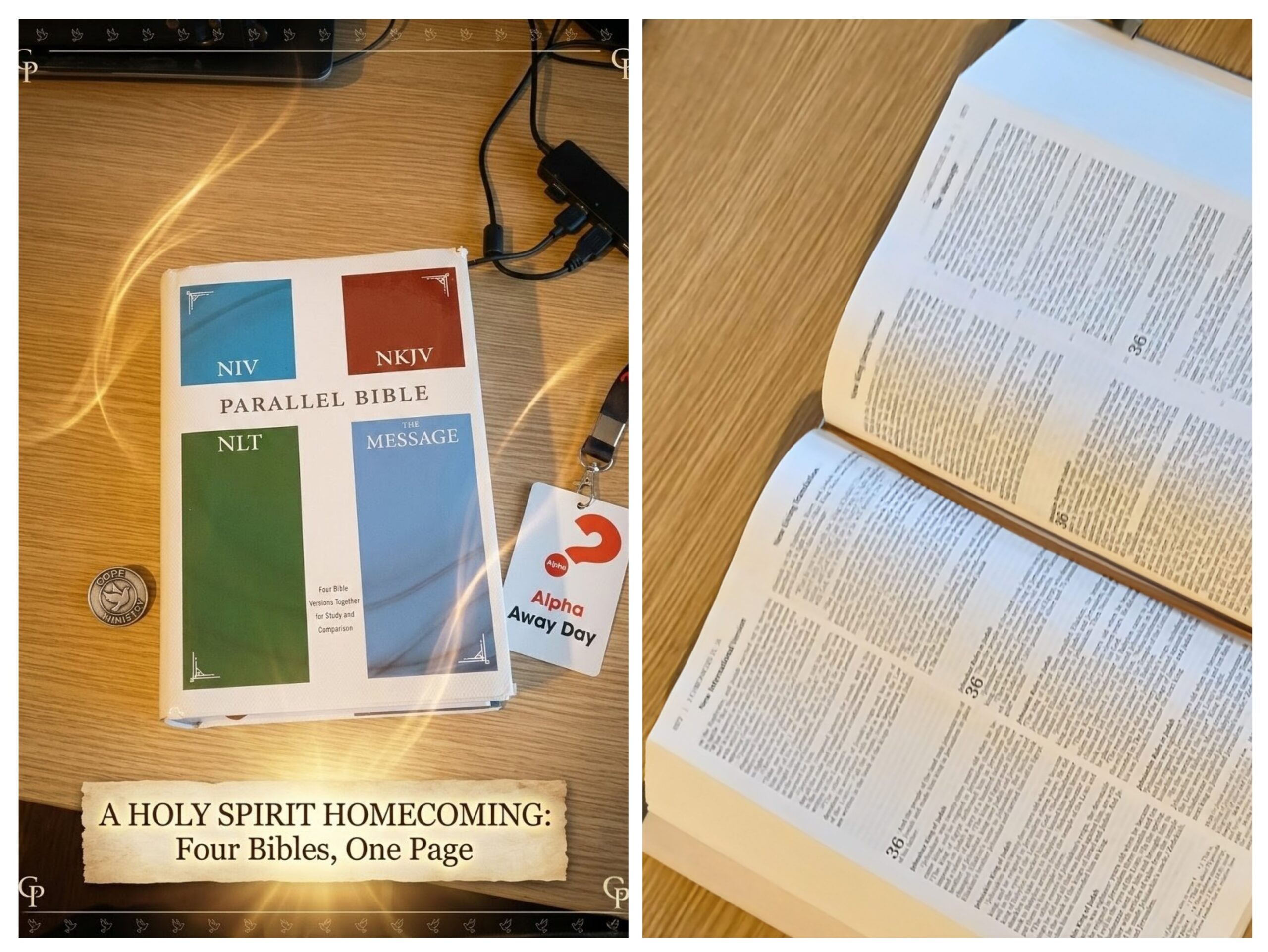
    ​After such an uplifting and spiritually charged day, I arrived home to find a package waiting for me right on the doorstep. Inside was the brand-new Parallel Bible I had been waiting to add to my collection. It felt like the perfect “amen” to a day spent in God’s presence—coming home to a tool that will help me dive even deeper into His Word.

    ​What is a Parallel Bible?

    ​Imagine having four of the most popular Bible translations open at the exact same time, on the exact same page. No more flipping through multiple books or switching tabs on an app.

    ​In this new edition, I have the NKJV, NIV, NLT, and The Message side-by-side. This allows me to see the “spectrum” of translation in real-time.

    ​Why This Matters for Our Outreach:

    ​At COPE Ministry, our mission is clear: Nobody Is Too Far Gone. Anyone Can Be Saved. To share that message effectively, I need to understand the Bible from every angle.

    • For Deep Study: I look at the NKJV to see the precise, formal structure of the original text.
    • For Teaching: I use the NIV for that perfect balance of accuracy and readability.
    • For Daily Life: I turn to the NLT to see how these ancient truths apply to our modern language.
    • For a Fresh Perspective: I read The Message to hear the heart of the story in “real-talk” idioms that resonate on the streets today.

    ​A Closer Look: 2 Chronicles 36

    ​I’ve already put it to use by spending time in 2 Chronicles 36, looking at the fall of Jerusalem and the reign of the last kings of Judah. It’s a heavy chapter about consequences, but also about God’s persistence.

    ​By comparing these four versions side-by-side, I can see how one version uses the word “rebelled” while another describes it as “stiffening his neck.” Seeing those different shades of meaning helps me prepare better notes and study guides for all of you. It makes the history feel alive and immediate.

    ​”The best Bible translation is the one you will read and understand!”

    ​Conclusion:

    ​The tools we use are meant to point us toward one thing: a deeper relationship with Jesus Christ. Whether you use a literal translation or a paraphrase, the goal is to let the Word transform your life. Between the fire of the Alpha Away Day and this new Bible, I am more excited than ever to continue building resources for our community.


  • From Church to Streets: Why Your Evangelism Needs Two Different Playbooks

    From Church to Streets: Why Your Evangelism Needs Two Different Playbooks

    Reaching Every Heart: Why Paul’s Two-Tiered Approach is Crucial for Street Evangelism Today

    ​As evangelists, our passion is to share the life-changing message of Jesus Christ. But how often do we consider who we’re speaking to and tailor our approach accordingly? In the book of Acts, we see the Apostle Paul, a master communicator, demonstrating a powerful principle: contextualization. He didn’t change the truth of the Gospel, but he brilliantly adapted his starting point and language to connect with vastly different audiences.

    ​For those of us on the streets today, whether in the bustling city centre or anywhere else, understanding Paul’s “two-tiered” approach from Acts 13 and 14 is not just helpful – it’s essential.

    ​The Synagogue Sermon (Acts 13): Connecting with the “Religious”

    ​Imagine Paul walking into the synagogue in Pisidian Antioch. His audience was predominantly Jewish, steeped in the Old Testament, familiar with the promises of a Messiah, and accustomed to a certain way of thinking about God. How did Paul engage them?

    • He started with their story: “The God of this people Israel chose our ancestors…” (Acts 13:17). He validated their history, their heritage, and their sacred texts.
    • He built on common ground: He quoted scripture, referenced the Exodus, King David, and the prophets. He spoke their spiritual language.
    • His goal was fulfillment: He showed them how Jesus was the culmination of everything they already believed and hoped for. “From this man’s descendants God has brought to Israel the Savior Jesus, as he promised.” (Acts 13:23).

    The Takeaway for Street Evangelists Today: You might encounter people who have a church background, even if they’ve strayed. They might know some Bible stories, believe in “God,” or have been to Sunday school. For these individuals:

    • Start with what they know: “Perhaps you grew up hearing about Jesus…” or “Do you remember any stories from the Bible?”
    • Connect dots: Show them how their existing understanding or questions find answers in Christ. “You know how good works are important? Jesus perfectly fulfilled them for us.”
    • Use familiar terms: Talk about sin, redemption, grace, and forgiveness, but be ready to explain them simply if needed.

    ​The Lystra Sermon (Acts 14): Reaching the “Non-Religious”

    ​Fast forward to Lystra. Here, Paul and Barnabas faced a completely different crowd: pagan Gentiles who had no concept of the God of Israel, the Old Testament, or the Messiah. When Paul healed a crippled man, the people mistook them for Greek gods! How did Paul shift his message?

    • He challenged their worldview: “We are bringing you good news, telling you to turn from these worthless things to the living God” (Acts 14:15). He directly addressed their idolatry.
    • He started with Creation: He appealed to what was universally observable – the natural world. “He has shown kindness by giving you rain from heaven and crops in their seasons; he provides you with plenty of food and fills your hearts with joy” (Acts 14:17).
    • His goal was a total paradigm shift: He wanted them to turn from false gods to the one true Creator.

    The Takeaway for Street Evangelists Today: A significant portion of people you meet on the streets may have no religious background. They might be atheist, agnostic, or simply uninterested. For these individuals:

    • Start with universal truths: Talk about purpose, love, justice, beauty, the complexity of creation, or the human longing for something more. “Have you ever looked at a sunset and wondered who made it?”
    • Point to the “Living God” in everyday life: “Where do you think genuine kindness comes from?” or “What do you think is the meaning of life, beyond just getting by?”
    • Avoid jargon: Terms like “sanctification” or “justification” will only confuse. Speak plainly about God’s love, grace, and desire for relationship.
    • Be patient and relatable: Build trust before diving into complex theological concepts.

    ​The Imperative for Today’s Evangelist

    ​The lesson from Paul is clear: one size does not fit all in evangelism. To be truly effective on the streets, we must:

    1. Listen and Observe: Before you speak, try to understand who you’re talking to. Do they have any religious background? What are their concerns?
    2. Adapt Your Bridge: Don’t assume everyone shares your starting points. Build a bridge from their current reality to the Gospel.
    3. Be Flexible, Not Compromising: The core message of Jesus Christ crucified and resurrected for our sins remains unchanging, but the path to presenting it can vary widely.

    ​By embracing Paul’s dynamic approach, we can move beyond simply speaking the Gospel to truly connecting with every heart on the streets, bringing the life-giving message of Jesus to a diverse and searching world.

  • Choosing Purpose Over Consumerism

    Choosing Purpose Over Consumerism

    Flipping the Script: From 90s Nihilism to Eternal Hope

    ​The 1990s. For many, it was an era of intense self-discovery, cultural upheaval, and a creeping sense of disillusionment. Movies of that decade often reflected a generation grappling with questions of purpose, authenticity, and freedom in a world that felt increasingly manufactured.

    ​At COPE Ministry, we believe these cultural touchstones offer us a unique opportunity to “flip the script”—to revisit those cinematic cries for meaning and point them towards an ultimate, eternal hope. Let’s take a look at three iconic films from the late 90s that asked big questions, and how we can find even bigger answers.

    1. Choose Life: Beyond the Big Television (Inspired by Trainspotting, 1996)

    ​Thirty years ago, Trainspotting burst onto the scene with its frantic opening monologue. Mark Renton, running from a life of consumerism, sarcastically listed the “hollow” checklist of jobs, careers, and big televisions. It was a raw, visceral rejection of a society that seemed to offer everything but feel like nothing.

    The Original Message: “Choose Life. Choose a job. Choose a career. Choose a family. Choose a big television…” but ultimately, “why would I want to do a thing like that?” It was a cynical dismissal of the conventional path.

    Flipping the Script with COPE Ministry:

    We understand that feeling of emptiness when worldly pursuits fall short. But what if “Choose Life” meant something truly profound? What if it meant choosing a path that leads somewhere real, a purpose that outlasts your pulse?

    ​The Bible offers a different perspective on life’s “checklist”:

    ​”Do not store up for yourselves treasures on earth, where moths and vermin destroy, and where thieves break in and steal. But store up for yourselves treasures in heaven… For where your treasure is, there your heart will be also.” — Matthew 6:19-21

    ​At COPE Ministry, we’re flipping that nihilism. We say: Choose God. Choose Grace. Choose Eternity. Choose a Bible, choose prayer, choose a community that restores your spirit. Choose the peace of a sunrise that doesn’t require a screen to be beautiful. Choose a life that builds something eternal, not just accumulates debt. Because why would you want to do anything else, when you have Grace?

    2. The Middle Children of History: Finding Your True Inheritance (Inspired by Fight Club, 1999)

    ​Tyler Durden’s voice echoed the frustrations of a generation in Fight Club: “We’re the middle children of history, man. No purpose or place… Our Great War’s a spiritual war… our Great Depression is our lives.” It was a desperate cry for meaning in a world of consumer-driven anonymity.

    The Original Message: A rebellious, nihilistic rejection of materialism, but without a clear alternative beyond chaos.

    Flipping the Script with COPE Ministry:

    Tyler Durden was right about one thing: we are in a spiritual war. But he was wrong about the depression. You weren’t born to be a “middle child” of history—you were born to be a child of the King. We work jobs we don’t like to buy things we don’t need, trying to fill a void that wasn’t meant for ‘stuff.’

    ​”For I know the plans I have for you,” declares the Lord, “plans to prosper you and not to harm you, plans to give you hope and a future.” — Jeremiah 29:11

    ​Stop trying to find yourself in the things you own. Start finding yourself in the One who owns the stars. You aren’t a byproduct of a lifestyle obsession. You are a masterpiece in progress. Don’t just survive the “spiritual war.” Win it through Grace.

    3. Red Pill or Real Life?: Unplugging from the Illusion (Inspired by The Matrix, 1999)

    The Matrix presented us with a stark choice: the blue pill for blissful ignorance in a simulated reality, or the red pill to confront the harsh truth. Morpheus asked Neo, “You take the blue pill… you wake up in your bed and believe whatever you want to believe. You take the red pill… and I show you how deep the rabbit-hole goes.”

    The Original Message: Choose between comforting illusion and painful truth.

    Flipping the Script with COPE Ministry:

    For years, we’ve lived in a world of curated feeds and filtered lives—a digital “Matrix” designed to keep us scrolling, consuming, and distracted. We’re plugged in, but are we truly alive? The world offers a choice between illusion and despair. But what if there’s a third choice? What if the “red pill” isn’t just about seeing the brokenness, but about stepping into the true reality of Redemption?

    ​”Then you will know the truth, and the truth will set you free.” — John 8:32

    ​Freedom isn’t just about escaping a system; it’s about finding a purpose that transcends it. It’s about choosing a Savior who knows your name, a love that’s unwavering, and a reality that’s more vibrant and eternal than any simulation could ever be. Don’t just break free from the Matrix. Step into the Kingdom.

    Are You Ready to Flip the Script in Your Own Life?

    ​The 90s asked profound questions about identity, purpose, and reality. Three decades later, the answers aren’t found in cynicism or rebellion, but in the timeless truth of God’s love and grace.

    ​If you’re ready to unplug from the world’s illusions, find true purpose beyond consumerism, and discover an eternal inheritance, then it’s time to Flip the Script in your own life.

    #ChooseLife #Trainspotting #FightClub #TheMatrix #COPEMinistry #FaithOverEverything #Grace #NewBeginnings #FlippingTheScript #TruthSetsYouFree