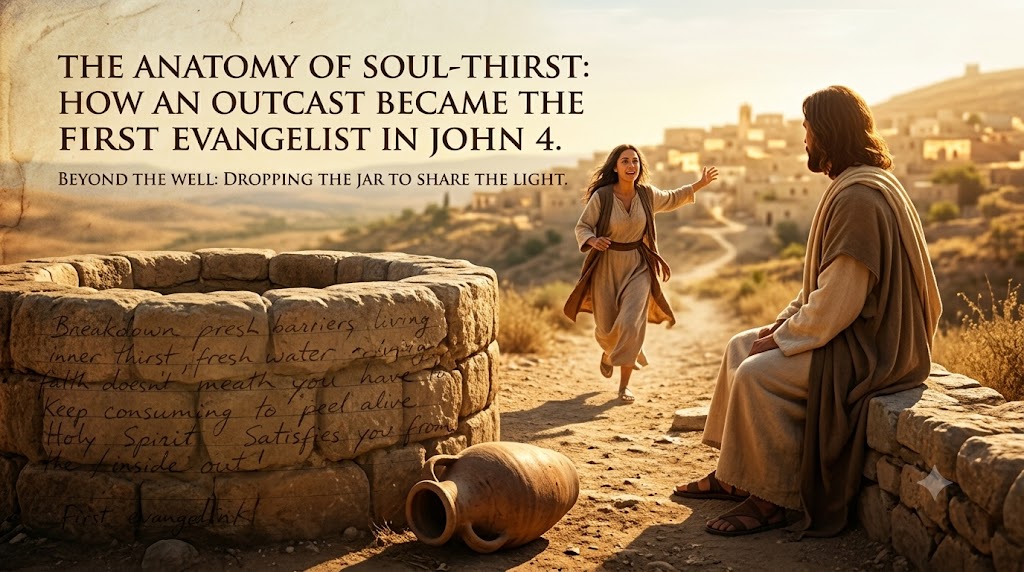
How an Outcast Became the First Evangelist in John 4
We live in a culture consumed by a relentless inner thirst. We chase success, romantic relationships, pristine reputations, and fleeting pleasures, treating them like water to quench a deep, internal ache. But the problem with these external “wells” is that they always run dry. We find ourselves constantly returning to them, exhausting ourselves just to feel alive.
In the Gospel of John, chapter 4, Jesus encounters a woman who was trapped in this exact cycle. Her story is a masterclass in how Jesus breaks down every human barrier to meet us in our brokenness, offering an internal solution to a universal problem. Ultimately, her transformation reveals a shocking truth: the very first person to evangelize an entire town for Jesus wasn’t a religious insider, but a marginalized outcast.
1. Breaking Down All Barriers of Separation
The chapter begins with a geographical and cultural shock wave: “Now he had to go through Samaria” (John 4:4).
For a 1st-century Jew, this was radical. Most Jewish travelers would cross the Jordan River to bypass Samaria entirely, adding days to their journey just to avoid “Samaritan defilement.” But Jesus had a divine appointment. He sits by Jacob’s well at noon—the hottest part of the day—and intentionally breaks down three massive barriers of separation:
- The Racial/Religious Barrier: Jews and Samaritans shared a deep, historic animosity. Jews viewed Samaritans as theological heretics.
- The Gender Barrier: Culturally, rabbis did not speak to women in public.
- The Social Barrier: The woman was fetching water alone at noon, actively isolating herself to avoid the whispers and judgment of her own community.
By asking her, “Will you give me a drink?”, Jesus shatters the status quo. He shows that no one is too far gone, too compromised, or too isolated to be reached by God.
2. The Trap of Consuming vs. The Gift of Living Water
As their conversation unfolds, Jesus diagnoses her situation by contrasting physical water with something he calls “living water.”
“Everyone who drinks this water will be thirsty again, but whoever drinks the water I give them will never thirst. Indeed, the water I give them will become in them a spring of water welling up to eternal life.” (John 4:13-14)
This is the turning point of the chapter. True faith doesn’t mean you have to keep consuming external things to feel validated, secure, or alive. When we look to relationships or success to fix our inner emptiness, we are drinking stagnant water.
Jesus offers a radical alternative: The Holy Spirit satisfies you from the inside out. Instead of constantly drawing from external wells, the believer receives an internal spring that makes them self-sustaining in joy, peace, and grace.
3. From Fully Known to Fully Transformed
To give her this living water, Jesus gently but surgically exposes her deep soul-thirst. He tells her to call her husband, prompting her to admit she has none. Jesus replies: “The fact is, you have had five husbands, and the man you now have is not your husband” (John 4:18).
Jesus didn’t expose her past to shame her; He exposed it to save her. He showed her that He saw the real her—every broken relationship, every hidden scar—and He was still sitting there offering her eternal life.
Realizing she is standing face-to-face with the Messiah, the woman experiences an immediate transformation. John includes a beautiful, symbolic detail in verse 28: she left her water jar behind. The physical jar—the symbol of her daily chore, her exhausting routine, and her social isolation—was no longer her priority. She had finally found the living water.
4. The First Evangelist in John’s Gospel
What happens next turns the religious world upside down. The woman runs back to the very town that had marginalized her and proclaims:
“Come, see a man who told me everything I ever did. Could this be the Messiah?” (John 4:29)
Think about the profound irony here. In the previous chapter, Nicodemus—a deeply respected religious elite and theological expert—walked away from Jesus in silent confusion, hiding in the dark. But this Samaritan woman steps completely into the light. She becomes the first evangelist in the Gospel of John.
Because she was willing to be vulnerable and anchor her testimony in being fully known by Jesus (“He told me everything I ever did”), her story unlocks the transformation of her entire community. The chapter ends with the townspeople declaring: “We know that this man really is the Savior of the world” (John 4:42).
Key Takeaways for Today
- Identify Your “Wells”: What are you currently consuming to try and satisfy your inner thirst? Success? Relationships? Reputation?
- Drop the Water Jar: True discipleship requires leaving behind the old tools we used to seek validation and comfort.
- Your Past is Not a Barrier: If Jesus can use a five-times-divorced Samaritan outcast to spark a revival in an entire city, He can use your story, your scars, and your vulnerability to impact the world around you.