Category: The Bible: Book by Book Summaries

The Beginning of the Story

The Book of Genesis is not just an ancient text; it is the foundational “Book of Beginnings” that sets the stage for the entire biblical narrative. In this Book of Genesis summary, we journey from the grand, cosmic scale of creation and the Garden of Eden to the intimate, personal struggles of the early patriarchs.

Whether you are exploring the “Primeval History” of humanity or the covenant-driven “Patriarchal History” of Abraham, Isaac, and Jacob, this overview provides a clear roadmap through one of history’s most influential documents. Discover how the family of Israel emerged from the ancient Near East and how their story continues to resonate in our lives today.

  • ​Moses and the Ten Commandments: A Descent into Sinai and a Gilded Crisis

    ​Moses and the Ten Commandments: A Descent into Sinai and a Gilded Crisis

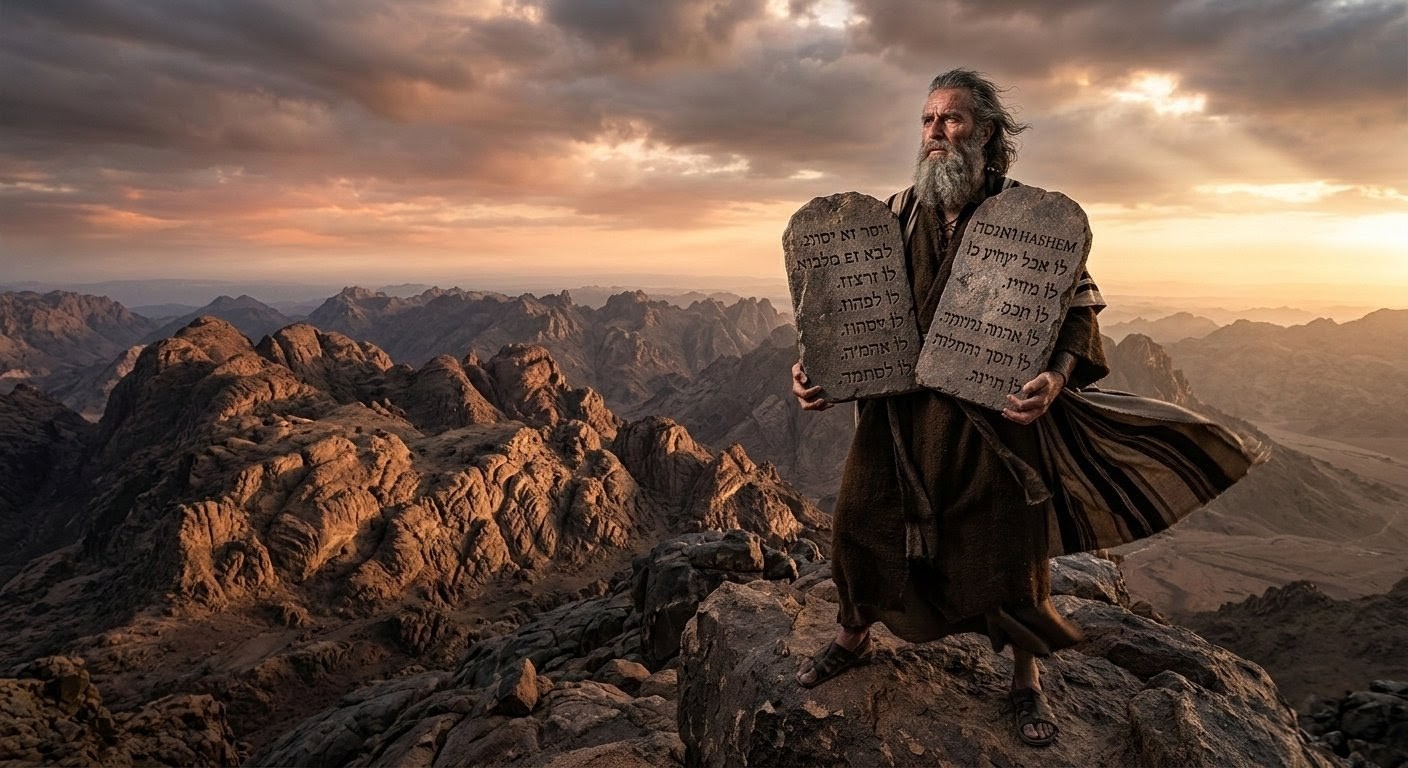
    Moses climbing Mount Sinai

    ​To receive the Ten Commandments is one of the most foundational stories in the Hebrew Bible. Revered across Judaism, Christianity, and Islam, it is a drama of faith, waiting, and a devastating breach of trust.

    ​This post delves into the length of Moses’ absence, the covenant forged on the mountain, and the explosive consequences of his descent.

    ​The Long Ascent: How Long Was Moses Gone?

    ​For the Israelites waiting in the plain below, the delay must have seemed endless. According to the Book of Exodus, after the Israelites arrived at Mount Sinai, Moses entered “into the midst of the cloud” where the presence of God descended.

    ​The Bible is specific about the duration of this spiritual encounter: “Moses was on the mountain forty days and forty nights” (Exodus 24:18).

    ​The Significance of 40 Days and 40 Nights

    ​This wasn’t a casual retreat. The phrase “forty days and forty nights” is highly symbolic in scripture. It appears in the narrative of Noah’s Ark and Jesus’ fasting in the wilderness, representing a significant period of:

    • ​Preparation and testing.
    • ​Profound divine interaction.
    • ​Intense prayer and spiritual dialogue.

    ​During this time, Moses received the “Ten Words” and the complex legal and ethical system that would define the identity of the Israelite people.

    ​The Revelation: The Ten Commandments and the Covenant

    ​The central purpose of Sinai was the reception of the Divine Law. This foundational covenant was etched onto two tablets of stone, “written with the finger of God” (Exodus 31:18).

    ​The Ten Commandments Explained

    1. No other gods before Me (Exodus 20:3): Absolute monotheism. Prioritize your spiritual relationship above all else. Don’t let money, fame, or power become your “god.”
    2. No idols (Exodus 20:4): A Ban on physical representations of divinity. Avoid worshipping physical things or “images” of success. Focus on the essence of truth rather than material symbols.
    3. Do not take the Lord’s name in vain (Exodus 20:7): Reverence for God’s name. Respect the sacred. Don’t use spiritual language or God’s name loosely, insincerely, or to justify bad behavior.
    4. Remember the Sabbath (Exodus 20:8): A dedicated day of rest and devotion for spiritual renewal. Take time for rest and reflection. Balance work with a day dedicated to spiritual and mental renewal.
    5. Honor your father and mother (Exodus 20:12): The bedrock of family and society. Show respect and care for your parents and elders, acknowledging the lineage and sacrifices that came before you
    6. You shall not murder (Exodus 20:13): The first sacredness of life. Value human life. This goes beyond the physical act; it’s a call to respect the dignity and existence of others.
    7. You shall not commit adultery (Exodus 20:14): The sanctity of marriage. Be faithful to your commitments and your partner. This is about integrity, trust, and the sanctity of the family unit.
    8. You shall not steal (Exodus 20:15): Respect for property rights. Respect the property and hard work of others. Don’t take what hasn’t been earned or given to you.
    9. No false witness (Exodus 20:16): The importance of truth and justice. Always tell the truth. Do not lie, gossip, or slander others, as honesty is the bedrock of a functioning society.
    10. You shall not covet (Exodus 20:17): Addressing internal desire and discontent. Be content with what you have. Avoid the “comparison trap” and the desire to possess what belongs to someone else.

    ​The Crisis Below: The Golden Calf and a Breach of Faith

    ​While Moses was experiencing the divine, the camp below fell into a crisis of patience. Forty days of silence led to fear and anxiety. The Israelites, recently freed from Egyptian slavery, felt abandoned and demanded a visible sign of leadership.

    ​The Sin of the Golden Calf

    ​Turning to Aaron, the people contributed their gold to fashion a molten calf. This was a blatant violation of the first and second commandments. By declaring, “These are your gods, O Israel,” they replaced the invisible God of the Exodus with a man-made object.

    ​The result was “revelry”—a festival dedicated to an idol that involved behavior the text describes as immoral “play.”

    ​The Descent: Shattered Tablets and Divine Judgment

    ​When Moses descended, the sight of the Golden Calf moved him to fury. In a powerful symbolic act, Moses broke the tablets at the foot of the mountain (Exodus 32:19). The physical shattering of the stone mirrored the spiritual breaking of the covenant.

    ​Though a severe judgment followed, this moment remains a stark reminder of:

    • ​The fragile nature of faith.
    • ​The dangers of fear-based decisions.
    • ​The enduring power of divine law to call us back to justice.
    A Deep Dive Into Faith: Exploring The Bible

  • The Apostolic Map: Paul’s Journeys

    The Apostolic Map: Paul’s Journeys

    The Apostolic Map: A Strategic Blueprint for Modern Christian Outreach

    COPE Ministry Wakefield presents an in-depth look at the missionary journeys of the Apostle Paul. Written by Fin Dalton, this study explores how Paul’s travels in the Book of Acts serve as a dynamic blueprint for evangelism today. Our mission remains clear: “Nobody Is Too Far Gone. Anyone Can Be Saved.”

    ​Understanding the Scale of Paul’s Missionary Journeys

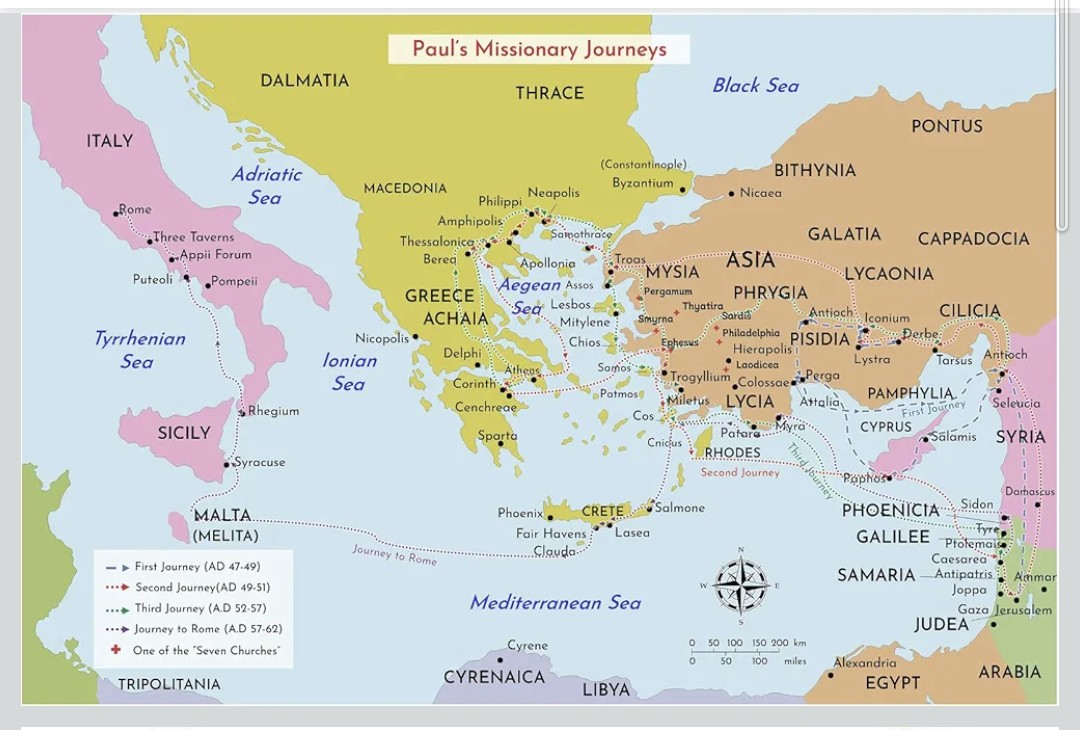
    ​To appreciate Paul’s outreach strategy, we must look at the staggering physical scale of his work between AD 47 and AD 62. Operating without modern transportation, Paul’s mission was a feat of endurance spanning approximately 15 years and covering over 10,000 miles (16,000 kilometers). His impact was monumental, resulting in over 12 major city-churches established across three continents.

    ​Paul’s ministry touched the heart of Turkey in locations like his birthplace, Tarsus, and the influential city of Ephesus. Following the “Macedonian Call,” he established churches throughout Greece, including Philippi, Thessalonica, and Corinth. His reach extended from his primary sending base in Antioch, Syria, to the islands of Cyprus and Malta, and eventually to the heart of the Roman Empire in Italy.

    ​Timeline of the Four Missionary Journeys

    ​The First Journey (AD 47–49): Focus on Cyprus and South Galatia

    ​During this initial phase, Paul and Barnabas established the first Gentile churches. This period proved that the Gospel was a universal message intended for all cultures, breaking regional barriers.

    ​The Second Journey (AD 49–51): The Entry into Europe

    ​After receiving a vision of a man from Macedonia, Paul crossed into Greece. This journey was defined by planting churches in major urban centers such as Philippi and Corinth, focusing on high-traffic cultural hubs.

    ​The Third Journey (AD 52–57): Deep Investment and Leadership

    ​Paul spent three years in Ephesus during this mission. This period emphasized leadership training and creating a central hub that influenced the entire region of Asia Minor, proving that deep roots produce lasting fruit.

    ​The Fourth Journey (AD 57–62): Reaching the Heart of the Empire

    ​Even as a prisoner, Paul used his Roman citizenship to reach the highest levels of government in Rome. His journey through the shipwreck at Malta to his house arrest in Italy demonstrates that circumstances cannot stop the Gospel message.

    ​Core Principles for Modern Evangelism and Outreach

    ​Paul’s strategy offers several key lessons for Christian outreach in Wakefield and beyond. He focused on Target Strategic Hubs to maximize reach and practiced Cultural Adaptability, tailoring his message for philosophers and merchants alike without compromising the truth. He prioritized Long-Term Investment through multi-year stays and maintained Unwavering Perseverance through trials. Most importantly, he built Genuine Relationships, proving that effective outreach is built on authentic connection.

    ​Interactive Bible Study Resources

    ​For those wishing to visualize the Roman Agoras where Paul stood, we recommend using Google Earth to search for “Ancient Ephesus” or “Philippi ruins.” Seeing these historical sites helps bridge the gap between ancient scripture and modern application.

    ​COPE Ministry provides a growing resource of Daily Study Notes on the Book of Acts, updated every Monday through Friday. Whether you are looking for a book-by-book summary or a deep dive into apostolic history, our digital library is designed to support your spiritual journey.

    Interactive Study Tip

    ​Want to see the actual streets Paul walked? Use Google Earth to search for “Ancient Ephesus” or “Philippi ruins.” Seeing the Roman Agoras (marketplaces) helps visualize where Paul stood to engage with the public.

    Interactive Study Tip: Explore Ancient Ephesus

    Want to see the actual streets Paul walked? Use the map below to explore the ruins of Ephesus, where Paul spent three years of his ministry.

    Pro Tip: Click “View larger map” to enter Street View and walk through the Roman Agora where Paul stood to engage with the public.

    Explore More with COPE Ministry:

    Daily Study Notes: Acts & Beyond.  This is a growing resource! As part of our daily study, I add a new chapter of notes every day Monday-Friday. Bookmark this page and check back daily to see the latest breakdown as we journey through the Book of Acts together until the book is complete”

    [  ✍️📖THE ACTS STUDY NOTES HERE ]

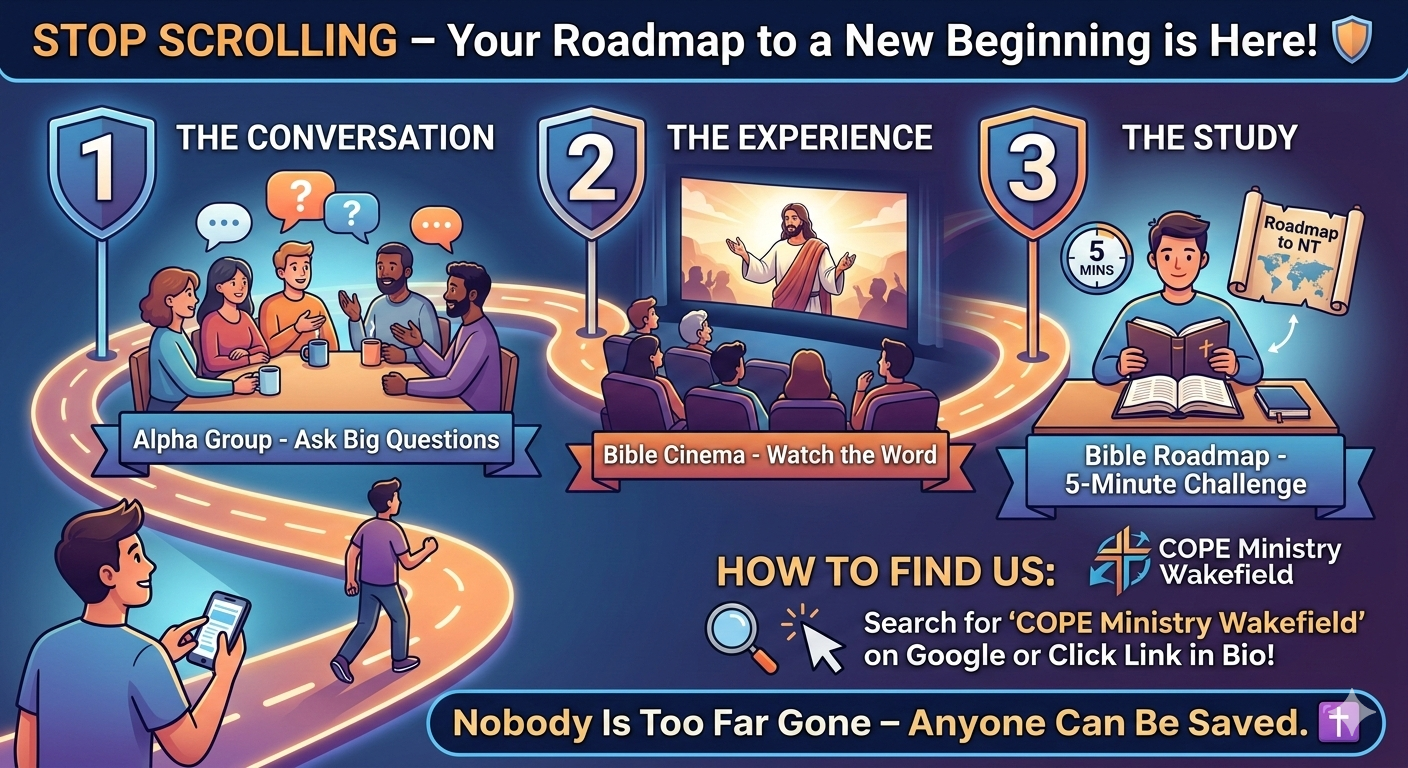
  • STOP SCROLLING

    STOP SCROLLING

    ​ – Your Roadmap to a New Beginning is Here! 🛡️

    ​Have you ever felt like you wanted to explore faith but didn’t know where to start? Or perhaps you’ve opened a Bible only to feel completely overwhelmed by its size and complexity?

    ​At COPE Ministry Wakefield, our heartbeat is simple: “Nobody Is Too Far Gone – Anyone Can Be Saved.” We know that the journey of faith can feel like a mountain climb, which is why we’ve built a clear, 3-step roadmap to help you navigate the path from “curious” to “confident.”

    ​Whether you are seeking recovery, spiritual growth, or just a little bit of hope, here is your guide to a fresh start.

    ​1️⃣ THE CONVERSATION: Alpha – Explore Life, Faith, and Meaning

    ​We all have the “big questions.” Why am I here? Is there more to life than this? Does faith even matter in the 21st century?

    ​If you’re looking for a safe, low-pressure space to get answers, Alpha is the perfect place to start. Most sessions involve a meal, a short film, and a discussion where you can say exactly what you think.

    • The Alpha Rule: No pressure. No follow-up. No charge. No judgment.
    • Find Your Group: While we aren’t hosting a group this week, we want to help you connect. Use the official [Find an Alpha] tool to enter your postcode and find a local group meeting in a cafe or community center near you.

    ​2️⃣ THE EXPERIENCE: Watch the Word at the Bible Cinema

    ​We understand that traditional reading isn’t for everyone. Some people struggle with focus, different learning styles, or simply feel overwhelmed when looking at a page of text.

    ​Our Bible Cinema brings the Word of God to life in high-definition.

    • The Verse-by-Verse Library: Experience the Gospels (Matthew, Mark, Luke, John) and the Book of Acts in cinematic, word-for-word adaptations.
    • The Narrative Collection: From the epic journey of Moses to the radical transformation of Paul, Apostle of Christ, these films capture the “Big Picture” of God’s redemption.
    • [Download Your Free Visual Study Guide]: Don’t just watch—engage. Our guide helps you reflect on what you see and apply it to your life.

    ​3️⃣ THE STUDY: The 5-Minute New Testament Challenge

    ​Once you’ve started the conversation and seen the stories, it’s time to build a personal habit. We’ve taken the guesswork out of reading with our Bible Roadmap.

    ​The math is simple: There are 260 chapters in the New Testament. If you read just one chapter a day, Monday through Friday, you will finish the entire New Testament in exactly one year.

    • Weekends are for Grace: Use Saturdays and Sundays to rest, reflect, or catch up.
    • Roadmap Summaries: We’ve provided concise summaries for every chapter to help you understand the context before you even start reading.
    • Audio Option: Prefer to listen? We feature the NIV Bible narrated by David Suchet for a masterful, immersive experience.

    ​Take the First Step Today

  • The Ultimate Guide to the Bible:

    The Ultimate Guide to the Bible:

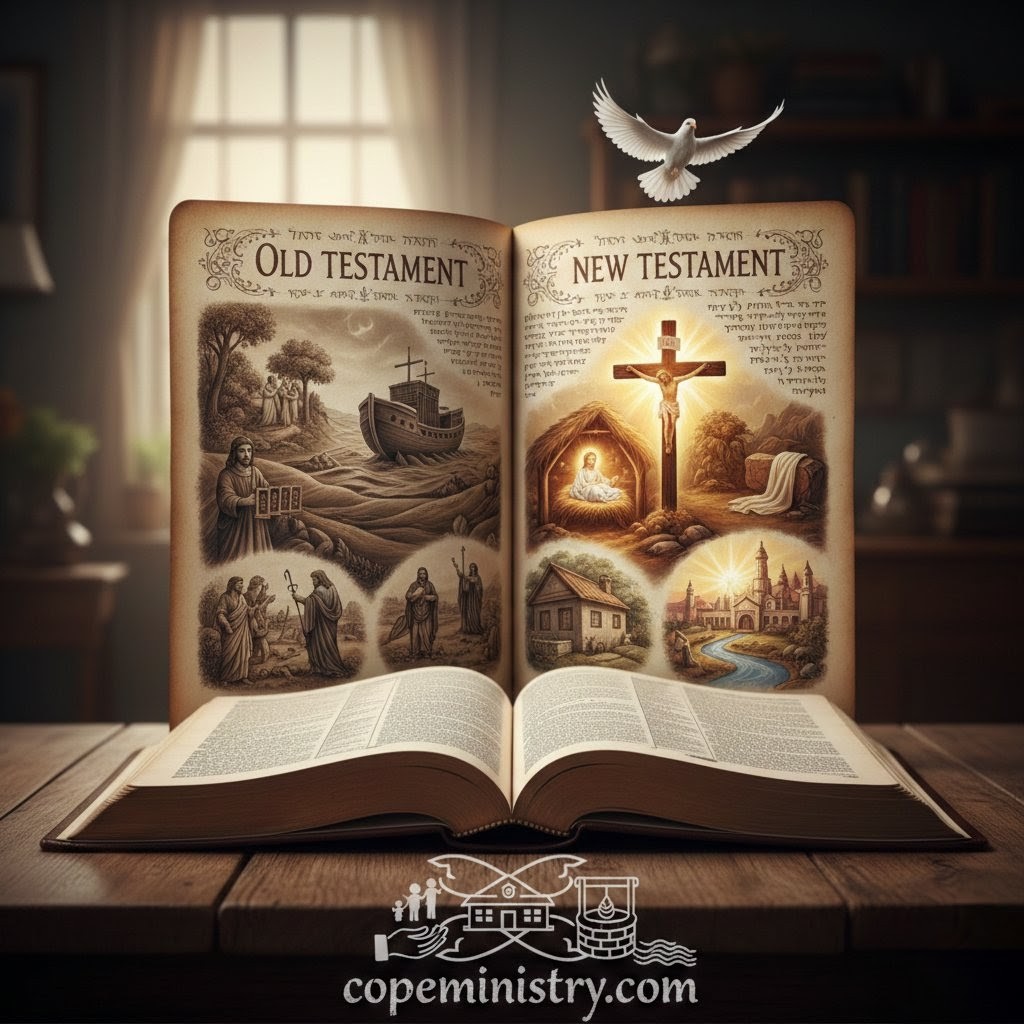
    Understanding the Old and New Testaments

    ​Have you ever opened a Bible and felt overwhelmed by its 66 different books, ancient history, and complex prophecies? Whether you are a lifelong believer or just curious about the world’s most influential book, understanding the structure of the Bible is the key to unlocking its message.

    ​In this guide, we break down the Old and New Testaments, showing how the “Story of God” flows from the first page of Genesis to the final vision of Revelation.

    The Old Testament: The Foundation of the Promise

    ​The Old Testament consists of 39 books written over a millennium. It is more than just history; it is the “DNA” of the Christian faith.

    1. The Pentateuch (The Law)

    ​The first five books (Genesis through Deuteronomy) are the “Constitution” of Israel.

    • Genesis: The origins of the universe and the promise to Abraham.
    • Exodus: The miraculous rescue from slavery.
    • Leviticus, Numbers, & Deuteronomy: The blueprint for holy living and the journey toward the Promised Land.

    2. The Historical Books

    ​From Joshua to Esther, these 12 books track the rise and fall of the nation of Israel, their kings (like David and Solomon), and their eventual exile and return.

    3. Wisdom & Poetry

    ​Books like Psalms, Proverbs, and Job provide the “heartbeat” of the Bible. They offer practical wisdom for daily life and a vocabulary for human suffering and worship.

    4. The Prophets

    ​The Prophets (Isaiah through Malachi) were God’s messengers. They called the people back to justice and mercy while pointing toward a future Messiah who would heal the world.

    The New Testament: The Fulfillment of the Hope

    ​The New Testament contains 27 books that record the arrival of that Messiah and the birth of His Church.

    1. The Gospels & Acts

    • Matthew, Mark, Luke, and John: The four eyewitness accounts of the life, death, and resurrection of Jesus.
    • Acts: The “History” book that shows how the Gospel spread from a small upper room to the entire Roman world.

    2. The Epistles (The Letters)

    ​The majority of the New Testament consists of letters written by the Apostle Paul and other leaders like Peter and John.

    • Theological Deep Dives: Romans and Hebrews explain why Jesus had to die.
    • Practical Living: James and 1 Peter explain how to live out faith during hard times.
    • Leadership Manuals: 1 & 2 Timothy and Titus provide the structure for church leadership.

    3. Revelation (The Final Victory)

    ​The Bible ends not with a “the end,” but with a “to be continued.” Revelation provides a vision of Christ’s final victory over evil and the restoration of a new heaven and a new earth.

    Why This Matters Today: The COPE Ministry Connection

    ​The Bible isn’t just a book to be studied; it is a book to be lived. This is exactly what we see at COPE Ministry (copeministry.com).

    ​In the Old Testament, God expresses a deep heart for the “marginalized and the vulnerable.” In the New Testament, Jesus commands His followers to “go into all the world.” By supporting the Pokot people in Kenya, COPE Ministry fulfills both Testaments—providing education, clean water, and the Gospel message to those who need it most.

    Conclusion: One Story, One Savior

    ​The Bible is one unified story. The Old Testament is the Promise, and the New Testament is the Fulfillment. When you read it through this lens, the “Ancient Book” becomes a living map for your life today.

    Find Out More