
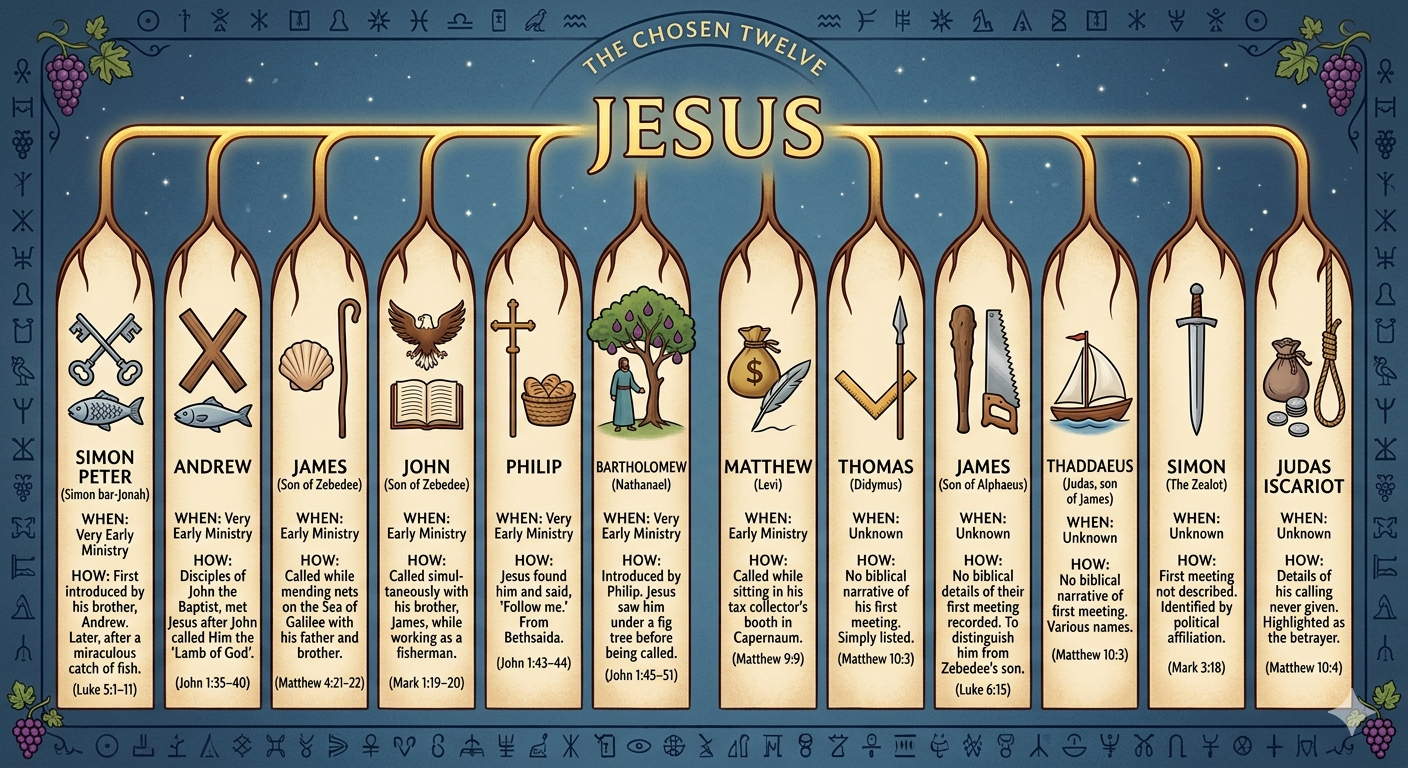
A Guide to Jesus’ Closest Followers
Have you ever wondered about the men Jesus chose to be his closest companions? The 12 disciples (also known as the 12 apostles) weren’t elite religious scholars. They were a diverse group of fishermen, tax collectors, and political radicals.
By understanding the names and stories of the 12 disciples, we see a powerful picture of how ordinary people can change the history of the world. Here is a closer look at each of the twelve apostles one by one.
1. Simon Peter (The Rock)🪨 🔑 🎣
Occupation: Fisherman
Key Trait: Boldness and Resilience
Simon Peter is perhaps the most famous of the twelve. A fisherman by trade from the village of Bethsaida, Peter was known for his impulsive personality and bold faith. He was often the first to speak up—sometimes with incredible insight, and other times with his “foot in his mouth.”
What to Know About Peter:
- The Name Change: Originally named Simon, Jesus gave him the name Cephas (Aramaic) or Petros (Greek), meaning “Rock.” Jesus declared that on this rock, He would build His church (Matthew 16:18).
- The Failure and Restoration: Though he famously denied knowing Jesus three times during the night of the crucifixion, his story didn’t end there. After the Resurrection, Jesus personally restored him, asking him three times, “Do you love me?” and charging him to “Feed my sheep.”
- His Legacy: Peter went from a fearful denier to the fearless leader of the early Church. He preached the first great sermon at Pentecost, where 3,000 people were saved. Traditionally, it is believed he was martyred in Rome, requesting to be crucified upside down because he felt unworthy to die in the same manner as his Lord.
Why He Matters Today: Peter proves that your biggest failures do not disqualify you from God’s plan. If “The Rock” could stumble and still be used to lead the Church, there is hope for every one of us.
2. Andrew (The Introducer)✖️ 🤝 🌊
Occupation: Fisherman
Key Trait: Humility and Outreach
Andrew was the brother of Simon Peter and, like him, was a fisherman from Bethsaida. Before following Jesus, Andrew was a disciple of John the Baptist. When John pointed to Jesus and said, “Behold, the Lamb of God!” Andrew didn’t hesitate—he followed immediately.
What to Know About Andrew:
- The First Disciple: Andrew is often called the Protocletus (the First-Called) because he was the very first of the twelve to follow Jesus.
- The Connector: Unlike his brother Peter, who led from the front of the crowd, Andrew led from behind the scenes. In the Gospels, we almost always see Andrew bringing someone to Jesus:
- He brought his brother Simon Peter to meet Christ (John 1:41-42).
- He brought the boy with five loaves and two fish to Jesus during the feeding of the five thousand (John 6:8-9).
- He brought a group of Greeks who wanted to meet Jesus (John 12:20-22).
- His Legacy: Tradition tells us that Andrew took the Gospel to the regions of Scythia and Greece. He was eventually martyred in Patras, Greece, on an X-shaped cross (now known as St. Andrew’s Cross), reportedly preaching to his executioners for two days until he passed away.
Why He Matters Today: Andrew shows us that you don’t have to be the loudest person in the room to make an eternal impact. His legacy is one of quiet, effective evangelism—reminding us that simply “introducing” someone to Jesus can change the world.
3. James, Son of Zebedee (The Son of Thunder)⚡ 🗡️ 🐚
Occupation: Fisherman
Key Trait: Intensity and Loyalty
James was the older brother of John and, along with Peter, formed the “Inner Circle” of Jesus’ closest friends. These three were the only disciples invited to witness private moments of Jesus’ ministry that the others didn’t see.
What to Know About James:
- The “Son of Thunder”: Jesus gave James and John the nickname Boanerges, meaning “Sons of Thunder” (Mark 3:17). This likely referred to their fiery, impulsive temperaments. In one famous instance, they even asked Jesus if they should call down fire from heaven to consume a village that rejected them (Luke 9:54).
- The Inner Circle: James was present for the most intimate moments of Jesus’ life, including the Transfiguration on the mountain and Jesus’ final hours of agony in Gethsemane before His arrest.
- The Ultimate Sacrifice: James holds a somber distinction among the twelve: he was the first apostle to be martyred. According to the Book of Acts, King Herod Agrippa I had him “put to death with the sword” (Acts 12:1-2).
- His Legacy: Because he was killed so early in the Church’s history (around AD 44), James didn’t write any New Testament books. Instead, his legacy is one of total commitment. He was the first to prove that following Jesus was worth more than life itself.
Why He Matters Today: James’ journey shows us the power of a “sanctified” temper. Jesus didn’t suppress James’ passion; He redirected it from wanting to destroy people to wanting to serve the Kingdom. James reminds us that our strongest personality traits, when given to God, can become our greatest strengths.
4. John (The Beloved Disciple)❤️ 🦅 ✍️
Occupation: Fisherman
Key Trait: Devotion and Transformation
John was the younger brother of James and the son of Zebedee. While he started as a “Son of Thunder” alongside his brother, he underwent perhaps the most profound heart transformation of all the disciples, eventually becoming known as the “Apostle of Love.”
What to Know About John:
- The “Beloved”: John refers to himself in his Gospel as “the disciple whom Jesus loved.” This wasn’t out of pride, but out of a deep, personal realization of Christ’s grace (John 13:23).
- The Only One at the Cross: When all the other disciples fled in fear during the crucifixion, John was the only one recorded as staying by Jesus’ side. It was there that Jesus entrusted the care of His mother, Mary, to John (John 19:26-27).
- The Prolific Writer: John’s influence on the Bible is massive. He is credited with writing the Gospel of John, the three letters of 1, 2, and 3 John, and the Book of Revelation.
- His Legacy: Unlike the other eleven, John is traditionally believed to be the only apostle who was not martyred. After surviving an attempt on his life in Rome, he was exiled to the island of Patmos, where he received the visions of the end times recorded in Revelation. He eventually died of old age in Ephesus, reportedly preaching “Little children, love one another” until his final breath.
Why He Matters Today: John’s life is a testament to what happens when “thunder” meets “grace.” He shows us that even the most hot-headed or ambitious person can be softened by the love of Christ. He reminds us that the goal of the Christian life is not just to know about Jesus, but to be “beloved” by Him.
5. Philip (The Practical Apostle)➕ 🍞 🧮
Occupation: Likely a fisherman (from Bethsaida)
Key Trait: Practicality and Literal-Mindedness
Philip was from the same town as Peter and Andrew and was one of the first disciples called by Jesus. While he had a heart for God, Philip often approached faith with a practical, analytical mind—he was the kind of person who wanted to see the math before he believed the miracle.
What to Know About Philip:
- The “Calculator”: When Jesus looked at the hungry crowd of five thousand, He tested Philip by asking where they could buy bread. Philip immediately started crunching the numbers, concluding that even eight months’ wages wouldn’t be enough to give everyone a single bite (John 6:5-7). He focused on the problem while Jesus was looking at the provision.
- The “Show Us” Moment: Even after years with Jesus, Philip’s literal-mindedness showed up at the Last Supper when he asked, “Lord, show us the Father, and it is enough for us.” Jesus gently corrected him, explaining that to see Him was to see the Father (John 14:8-9).
- The Quick Invitation: Despite his analytical nature, Philip was a soul-winner. When he first met Jesus, he immediately found his friend Nathanael. When Nathanael was skeptical, Philip didn’t argue—he simply said, “Come and see” (John 1:45-46).
- His Legacy: Tradition suggests that Philip traveled to North Africa and then to Asia Minor (modern-day Turkey) to preach the Gospel. He is believed to have been martyred in the city of Hierapolis for his unwavering testimony.
Why He Matters Today: Philip represents the “thinkers” among us. He reminds us that it’s okay to have questions and to look at things practically, but he also teaches us that God’s power is never limited by our bank accounts or our logic.
6. Bartholomew (Nathanael)🌳 🧐 📖
Occupation: Unknown (possibly a scholar or fisherman)
Key Trait: Integrity and Honesty
In the Gospels of Matthew, Mark, and Luke, he is listed as Bartholomew. However, in the Gospel of John, he is called Nathanael. Most scholars agree they are the same person. He was a close friend of Philip and was known for his blunt, “tell-it-like-it-is” personality.
What to Know About Bartholomew:
- The Skeptic: When Philip first told him they had found the Messiah from Nazareth, Bartholomew’s response was famously sarcastic: “Can anything good come out of Nazareth?” (John 1:46). He didn’t hide his doubts behind a religious mask; he spoke his mind.
- The Man of Integrity: When Jesus first saw him, He didn’t rebuke him for his sarcasm. Instead, He said, “Behold, an Israelite indeed, in whom there is no deceit!” (John 1:47). Jesus loved his honesty. He knew Bartholomew was a man who truly wanted the truth, even if he was grumpy about finding it.
- The “Under the Fig Tree” Moment: Jesus revealed His divinity by telling Bartholomew He saw him sitting under a fig tree before Philip even called him. This personal “God-moment” instantly turned the skeptic into a believer.
- His Legacy: After the Resurrection, tradition says Bartholomew carried the Gospel as far as India and Armenia. He is one of the most famously martyred apostles, with tradition holding that he was flayed alive for refusing to renounce Christ—a testament to the unshakable faith of a former skeptic.
Why He Matters Today: Bartholomew is the patron saint of anyone who asks hard questions. He reminds us that Jesus isn’t intimidated by our skepticism or our sarcasm. He doesn’t want “religious” performance; He wants a heart that is honest and without deceit.
7. Matthew:
(Levi the Tax Collector)💰 📝 🕊️
Occupation: Tax Collector (Publican)
Key Trait: Radical Repentance and Bridge-Building
Matthew, also called Levi, held a job that made him the most hated man in his community. As a tax collector for the Roman Empire, he was seen as a “traitor” to his own people and a “sinner” by religious leaders. He was wealthy, but he was a social and spiritual outcast.
What to Know About Matthew:
- The Immediate Response: When Jesus walked up to Matthew’s tax booth and said two words—“Follow me”—Matthew didn’t hesitate. He left his lucrative career, his table, and his old life behind instantly (Matthew 9:9).
- The “Sinner” Party: The first thing Matthew did after meeting Jesus was throw a massive banquet at his house. He invited all his “outcast” friends—other tax collectors and “sinners”—so they could meet Jesus too (Luke 5:27-32). This shows he wanted his old world to know his new Savior.
- The Gospel Writer: Matthew is the traditionally recognized author of the Gospel of Matthew. Because of his background as a record-keeper, his Gospel is highly organized. He wrote specifically to a Jewish audience, quoting the Old Testament more than any other writer to prove that Jesus was the promised Messiah.
- His Legacy: After preaching in Judea, tradition says Matthew traveled to Ethiopia and parts of Persia to spread the Gospel. While accounts vary, many believe he was martyred for his faith in Africa, refusing to compromise the Truth he had recorded so carefully.
Why He Matters Today: Matthew is the living proof of COPE Ministry’s heart: Anyone can be saved. If Jesus could take a man who was considered a “traitor” and a “thief” and turn him into an Apostle and Gospel writer, there is no past too messy for God to redeem.
8. Thomas (The Doubter)☝️ 🔍 🇮🇳
Occupation: Likely a fisherman
Key Trait: Honesty and Deep Loyalty
History remembers him as “Doubting Thomas,” but a better name might be “Thomas the Truth-Seeker.” He wasn’t a cynic; he was a man who refused to settle for a second-hand faith. He wanted to know the truth for himself.
What to Know About Thomas:
- The Courageous Devotion: Long before he doubted the Resurrection, Thomas showed incredible bravery. When the other disciples were terrified to go to Judea because people wanted to stone Jesus, it was Thomas who said, “Let us also go, that we may die with him” (John 11:16). He was prepared to die for a Master he didn’t fully understand yet.
- The Famous Doubt: Thomas wasn’t present when Jesus first appeared to the disciples after the Resurrection. When they told him the news, he famously said he wouldn’t believe it unless he could touch the wounds in Jesus’ hands and side (John 20:24-25).
- The Personal Encounter: Eight days later, Jesus appeared again—specifically for Thomas. Instead of rebuking him, Jesus invited him to touch His wounds. Thomas’ response was the most profound declaration of faith in the Gospels: “My Lord and my God!” (John 20:28).
- His Legacy: Most traditions agree that Thomas took the Gospel the furthest of all the apostles, traveling all the way to India. He is credited with founding the “Saint Thomas Christians” in Kerala, India, before being martyred by a spear for his faith.
Why He Matters Today: Thomas is the patron saint of the “struggling believer.” He proves that honest doubt is not the opposite of faith. Jesus didn’t cast Thomas out for having questions; He met him right where he was and provided the proof he needed. Thomas reminds us that it’s okay to ask “How?” as long as we are willing to hear the answer.
9. James, Son of Alphaeus (James the Less)👤 🪵 ⛪
Occupation: Unknown
Key Trait: Humility and Steadfastness
Often called “James the Less” (or “James the Younger”), he is one of the more quiet members of the twelve. This title was likely used to distinguish him from James the son of Zebedee, either because he was younger or shorter in stature.
What to Know About James:
- The Background: He was the son of Alphaeus (Matthew 10:3). Some scholars believe his mother was one of the Marys who stood at the foot of the cross and visited the tomb on Easter morning (Mark 15:40).
- The Quiet Apostle: Unlike Peter or John, James the Less is never recorded speaking a single word in the Gospels. He didn’t write a book of the Bible (the Book of James is traditionally attributed to James the brother of Jesus), and he never sought the spotlight.
- The Faithful Witness: Despite his silence in the biblical record, he was chosen by Jesus Himself. He sat at the Last Supper, witnessed the Resurrection, and was present in the Upper Room at Pentecost. He was a pillar of the early church who worked entirely behind the scenes.
- His Legacy: While details of his later life are scarce, tradition holds that he preached the Gospel in Persia (modern-day Iran) or Egypt. Most accounts agree he was eventually martyred for his faith, possibly being stoned or sawed in pieces—dying with the same quiet courage with which he lived.
Why He Matters Today: James the Less is a reminder that God uses the “unsung heroes” just as much as the famous ones. You don’t need a platform, a title, or a loud voice to be vital to God’s plan. His life proves that being “less” in the eyes of the world often means being “great” in the Kingdom of Heaven.
10. Thaddaeus (Jude)❓ ⛵ 🪓
Occupation: Unknown
Key Trait: Inquisitiveness and Sincerity
Thaddaeus is a man of many names—he is referred to as Jude (son of James) in Luke and Acts, and sometimes as Lebbaeus. He is often overshadowed by the more famous “Judas,” but his life was defined by a sincere desire to understand the heart of God’s mission.
What to Know About Thaddaeus:
- The “Other” Judas: To distinguish him from the betrayer, the Gospel of John specifically calls him “Judas (not Iscariot)” (John 14:22). This reminds us that our identity is not defined by the mistakes of those around us, but by our own relationship with Christ.
- The Seeking Heart: Thaddaeus is remembered for a profound question he asked Jesus during the Last Supper: “Lord, how is it that You will manifest Yourself to us, and not to the world?” (John 14:22). He wanted to understand how the Kingdom of God worked and how people could truly see Jesus for who He is.
- The Follower of the Way: While he didn’t seek the spotlight, he was a devoted student of Jesus’ teachings. He didn’t just follow the crowd; he listened intently and wanted to apply the truth to his life.
- His Legacy: Tradition tells us that Thaddaeus took the Gospel to Mesopotamia and Armenia. He is often credited with bringing Christianity to the Armenian people alongside Bartholomew. Like most of the others, he eventually gave his life as a martyr, reportedly being killed with an axe or arrows for refusing to stop preaching the Name of Jesus.
Why He Matters Today: Thaddaeus represents the “seeking heart” of a believer. He shows us that it is okay to ask Jesus “How?” and “Why?” He reminds us that even if the world gets our name wrong or confuses us with someone else, Jesus knows us intimately and has a specific mission for our lives.
11. Simon the Zealot🗡️ 🕊️ 🤝
Occupation: Political Revolutionary
Key Trait: Passion and Radical Transformation
Before meeting Jesus, Simon was a member of the “Zealots”—a fierce, underground political group dedicated to the violent overthrow of the Roman occupation. They were known for carrying concealed daggers and were the most radical nationalists of their day.
What to Know About Simon:
- The Radical Shift: Simon went from being a man who believed in “change through the sword” to a man who believed in “change through the Savior.” He traded his political anger for a spiritual mission.
- The Impossible Partnership: This is one of the most beautiful “hidden” stories in the Bible. Jesus chose Simon the Zealot (who hated Rome) and Matthew the Tax Collector (who worked for Rome) to be in the same small group. In the natural world, they should have been enemies. In Christ, they became brothers.
- The Power of Unity: Simon’s presence among the twelve proved that the Gospel of Jesus is the only thing powerful enough to bring people from opposite ends of the political spectrum together at the same table.
- His Legacy: After the Resurrection, tradition suggests Simon preached the Gospel in Egypt, Cyrene, and even as far as Great Britain. He is believed to have been martyred in Persia or Mesopotamia, with many accounts saying he was sawed in half for his refusal to stop preaching the “Prince of Peace.”
Why He Matters Today: Simon the Zealot is the patron saint of the “reconciled heart.” He reminds us that our primary identity is not found in our politics, our nationality, or our anger—but in Christ. He proves that the Gospel doesn’t just change our hearts; it changes how we see our “enemies.”
12. Judas Iscariot: (The Betrayer)🪙 ⛓️ 🌑
Occupation: Treasurer / Accountant
Key Trait: Greed and Spiritual Hardness
Judas Iscariot is the most tragic figure in human history. He was hand-picked by Jesus, walked with Him for three years, saw the miracles, and heard the sermons firsthand—yet his heart remained unchanged.
What to Know About Judas:
- The Trusted Insider: Judas wasn’t an outsider; he was the group’s treasurer (John 12:6). This meant the other eleven trusted him deeply with their resources. He had every opportunity to be transformed by Christ’s generosity, but he chose to steal from the money bag instead.
- The Thirty Pieces of Silver: Judas eventually betrayed Jesus to the religious leaders for thirty pieces of silver—the price of a common slave (Matthew 26:14-16). It wasn’t just a political disagreement; it was a heart consumed by greed and disillusionment.
- The Kiss of Betrayal: In the Garden of Gethsemane, Judas identified Jesus to the soldiers with a kiss—a sign of deep friendship used to commit an act of ultimate treachery (Luke 22:47-48).
- The Tragic End: After realizing the weight of his sin, Judas felt “remorse” but not “repentance.” Instead of running to Jesus for forgiveness (like Peter did), he ran away from God’s grace and took his own life (Matthew 27:3-5).
Why He Matters Today: Judas serves as a somber warning that proximity to Jesus does not guarantee a relationship with Him. You can go to church, know the Bible, and hang out with Christians, but if you don’t surrender your heart, you can still miss the Way. His story highlights the “free will” God gives us: Jesus offers the gift of life to everyone, but we must be the ones to receive it.
Why the 12 Apostles Matter Today
The 12 disciples were messy, flawed, and relatable. They struggled with doubt, ambition, and fear, yet they were the ones chosen to spread the Gospel to the ends of the earth. Their lives prove that God doesn’t call the equipped; He equips the called.
💭 Final Thought:
These 12 men weren’t perfect—they were “works in progress,” just like us. From the impulsive Peter to the skeptical Thomas and the political radical Simon, Jesus took their flaws and turned them into a foundation for the Church.
If He could use a tax collector like Matthew or a “Son of Thunder” like John, He can use you, too. At COPE Ministry, we believe that no matter your past, your profession, or your politics, Jesus is calling you to “Follow Me.”