
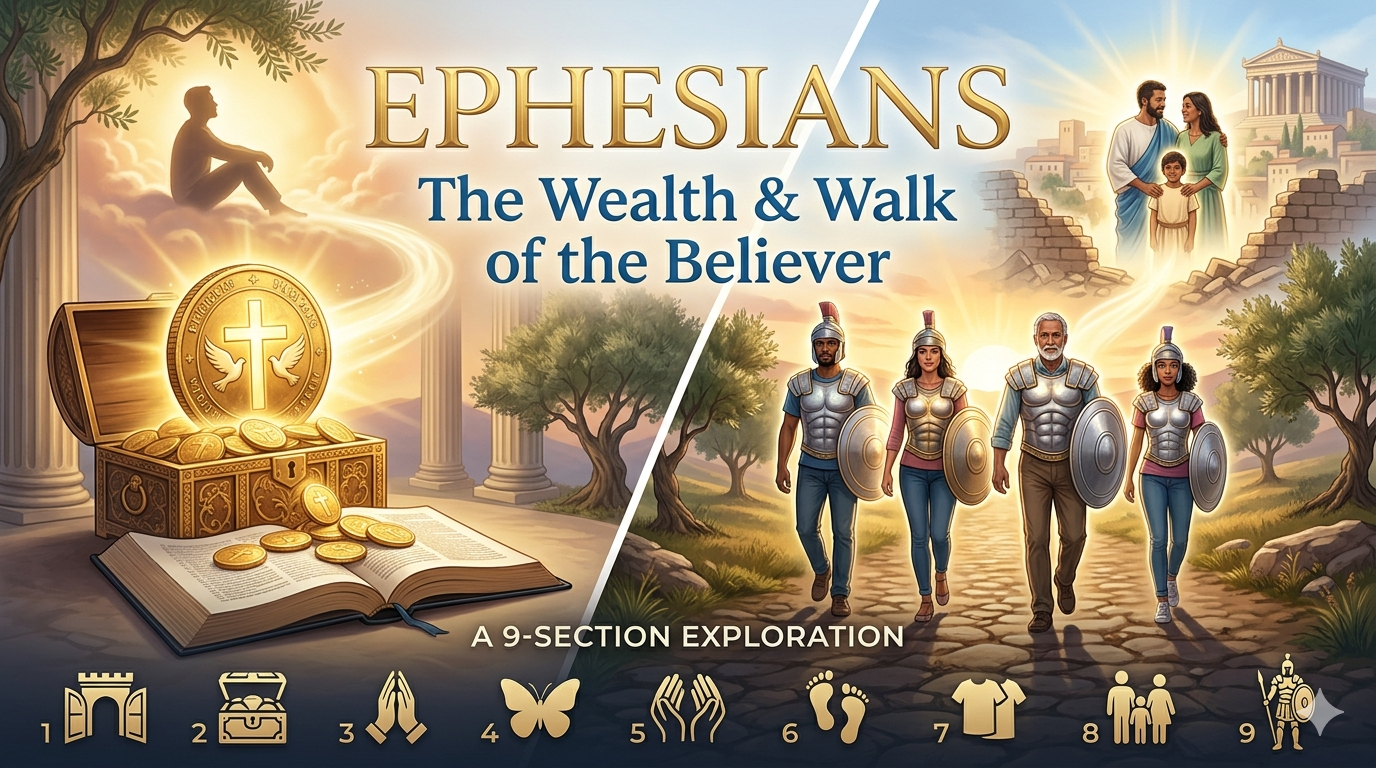
Welcome to Your Journey Through the “Grandest Letter”
Download a printable pdf version here
Welcome! You are about to dive into what many call the “crown” of Paul’s letters. Whether you are new to the faith or have been walking with the Lord for decades, the Book of Ephesians offers a profound, systematic look at who God is and who you are because of Him.
This course isn’t just about learning facts; it’s about Justification (getting right with God) and Sanctification (living right in the world). We follow the natural heartbeat of the scripture: the first three chapters show us our Wealth in Christ, and the last three show us our Walk in the Lord.
🛡️ Who Is This Course For?
This course is an advantage to anyone seeking a “solid foundation” to protect against the confusion of the modern world. It is specifically designed for:
- The Seekers: Those who want to understand the “mystery” of God’s plan for the world.
- The Practical Believer: Anyone who asks, “I know I’m saved, but how do I actually live that out in my marriage, my job, and my community?”
- The Spiritual Warrior: Those feeling the heat of spiritual battle who need to learn how to stand firm in the armor of God.
- The Church Builder: Leaders and members looking to understand the true “unity of the Spirit” and how a healthy church body functions.
⏳ Course Duration & Commitment
- Sections: 9 Comprehensive Sections.
- Pacing: This course is designed to be flexible. You can complete it as an intensive 9-day study or, for deeper reflection, a 9-week journey (one section per week).
- Weekly Commitment: Expect to spend 60–90 minutes per section. This includes time for reading the scripture, engaging with the teaching, and personal prayer/reflection.
📖 What’s Inside?
To get the most out of this, you’ll need:
- Your Bible: We will be using the text of Ephesians as our primary data.
- A Journal: For the “Walk” challenges at the end of each section.
- A Willing Heart: To not just hear the Word, but to let the Potter mold the clay.
“The worst they can say about you is not as bad as the truth… but God still loves you and still uses you.” >
As we begin, remember that you are accepted by God first, just as you are, so that He may make you into the beautiful vessel He predestined you to be.
🗺️ Course Map: The Ephesians Journey
Section 01: The City and the Letter
- Focus: Setting the stage.
- The Hook: Why Paul wrote to a city of idols and how the historical “pagan” environment of Ephesus shapes our understanding of the text.
Section 02: The Believer’s Bank Account
- Focus: Our spiritual wealth (Ephesians 1:3-14).
- The Hook: Discovering the “wealth” and eternal purpose God has for you since before the world began.
Section 03: Accessing the Power
- Focus: Paul’s first prayer (Ephesians 1:15-23).
- The Hook: Learning to pray for the specific strength and wisdom that raised Christ from the dead.
Section 04: From Death Row to Life
- Focus: Grace and Peace (Ephesians 2:1-10).
- The Hook: Understanding how grace transforms us from “objects of wrath” into God’s own “masterpieces.”
Section 05: The Mystery Revealed
- Focus: The One Body (Ephesians 2:11–3:21).
- The Hook: How the “middle wall” of partition came down to create one new, global family in Christ.
Section 06: Walking in the Spirit
- Focus: The Pilgrimage (Ephesians 4:1-16).
- The Hook: The shift from doctrine to duty—taking the first steps toward Christian maturity and unity.
Section 07: The New Wardrobe
- Focus: Integrity and Love (Ephesians 4:17–5:20).
- The Hook: Learning how to “take off” the old self and walk in a way that reflects God’s light.
Section 08: The Home Front
- Focus: Responsible Relationships (Ephesians 5:21–6:9).
- The Hook: Bringing the Gospel into the most practical areas of life: marriages, families, and the workplace.
Section 09: Standing Your Ground
- Focus: Spiritual Warfare (Ephesians 6:10-24).
- The Hook: Putting on the full armor of God and learning to stand firm when the battle gets intense.
Section 01: The City and the Letter
The Scriptural Foundation:
Ephesians 1:1-2
Welcome to the start of your journey. To understand the message of Ephesians, we first have to understand the world into which it was sent. This wasn’t just a religious essay; it was a “clear exposition of Christian belief” sent to a people living in a very complicated environment.
🏛️ The Setting: Why Ephesus?
In the first century, Ephesus was the “intersection of the world”—a massive port city where East met West. It was a center of commerce, finance, and most importantly, pagan religion.
- The Temple of Diana: The city was home to one of the Seven Wonders of the Ancient World—a temple 420 feet square dedicated to a black meteorite known as the goddess Diana.
- The Atmosphere: Imagine a city where trade and tourism revolved around selling silver idols. When the Gospel arrived, it didn’t just change hearts; it crashed the local economy because people stopped buying idols.
- The Defense: Paul wrote this letter while in prison. He knew that the best defense against the “mixture” of pagan ideas and the Gospel was solid, good teaching.
✉️ The Nature of the Letter
Unlike Paul’s letters to the Galatians or Corinthians, this letter doesn’t address specific “problems” or arguments.
- A General Message: The earliest copies of this letter don’t even include the words “at Ephesus.” It was a circular letter intended to be passed from church to church.
- A Systematic Summary: This is the nearest Paul ever gets to a full statement of his Gospel. It covers the two essential halves of the Christian life:
- Belief: Who God is and what He has done for us.
- Behavior: How we should act in response.
📖 Scripture Study: The Greeting
“Paul, an apostle of Christ Jesus by the will of God, to the saints who are in Ephesus, and are faithful in Christ Jesus: Grace to you and peace from God our Father and the Lord Jesus Christ.” (Ephesians 1:1-2)
Key Observations:
- “By the Will of God”: Paul isn’t an apostle because he chose it; he was “predestined” for this service.
- “Saints”: This doesn’t mean “perfect people.” It means people who have been set apart for God’s use.
- “Grace and Peace”: Notice the order. You cannot have the peace of God until you have experienced the grace of God. Grace is the root; peace is the fruit.
🚶 The “Walk” Challenge
Reflect and Journal:
Paul wrote this letter to give believers a “solid foundation” so they wouldn’t be swayed by the culture around them.
- What are the “idols” or “pressures” in your current environment (work, social media, culture) that try to pull you away from a simple focus on Christ?
- How would having a “solid foundation” of doctrine change how you respond to those pressures this week?
Next Steps:
In Section 02: The Believer’s Bank Account, we will dive into the “Wealth” mentioned in the first half of Chapter 1. We’ll look at the incredible spiritual inheritance that has been waiting for you since before the world began.
Section 02: The Believer’s Bank Account
The Scriptural Foundation: Ephesians 1:3-14
In this section, we move from the history of the city to the “Wealth” of the believer. Often called this section a “Hymn of Praise.” In the original Greek, verses 3 through 14 are one long, breathless sentence. Paul is so overwhelmed by God’s generosity that he doesn’t even stop for a period!
💰 The Wealth: What is in your Account?
Before we are told to do anything for God, Paul tells us what God has done for us. You cannot spend what you don’t know you have.
- Every Spiritual Blessing: Note that Paul says “every,” not “some.” You aren’t waiting for a second installment of grace; you have been given the full keys to the kingdom.
- The “Before” Factor: You were chosen in Him before the foundation of the world. This means God’s love for you isn’t a “Plan B.” It was His original intention.
- The Seal of the Spirit: In the ancient world, a seal showed ownership and authenticity. The Holy Spirit is God’s “deposit” in your life—a guarantee that He will finish what He started.
🏺 The Potter and the Clay: Understanding Predestination
A major theme here is being “predestined.” While this word can be confusing, think of it through the lens of a dynamic relationship:
- The Destiny Planned: Like a father planning a future for his child before the child is even born, God decided a destiny for you.
- The Response Required: Predestination is not about God treating us like robots. It is about God’s “pre-arranged” love. We enter into that destiny when we respond to His grace and “accept His acceptance” of us.
📖 Scripture Study: The Trinity at Work
Notice how the “Wealth” is distributed by all three persons of the Trinity:
- The Father chose us (v. 4).
- The Son redeemed us through His blood (v. 7).
- The Spirit sealed us (v. 13).
🚶 The “Walk” Challenge (For Individuals)
- Inventory Check: Read verses 3-14 slowly. List every “blessing” you see mentioned (e.g., adoption, forgiveness, inheritance).
- Reflection: Which of these blessings do you find hardest to believe is actually yours? Why?
🗣️ Group Dialogue (For Small Groups)
- Icebreaker: If you suddenly inherited a million pounds/dollars from a relative you never met, what is the first thing you would do?
- Discussion Question: Paul says we are “accepted in the Beloved.” In a world where we often feel we have to “perform” to be liked, how does it feel to know God accepted you before you ever did a “good deed”?
- The “Potter” Talk: Discuss the idea of the clay and the potter. How does it change your view of God to know He wants to make you a “beautiful vessel” rather than an “ugly one”? (See Jeremiah 18).
Next Steps:
Now that we know what is in our “Bank Account,” we need the wisdom to use it. In Section 03: Accessing the Power, we will look at Paul’s prayer for us to truly understand the immense power available to those who believe.
Section 03: Accessing the Power
The Scriptural Foundation: Ephesians 1:15-23
In Section 2, we looked at the “Bank Account” (our Wealth). In Section 3, we look at the “Power Grid.” Paul transitions from praising God for what He has given us to praying that we would actually have the eyes to see it and the power to use it.
⚡ The “Incomparably Great” Power
Paul uses four different Greek words for “power” in verse 19 because one word wasn’t enough to describe it.
- Not Personal Effort: This isn’t “willpower” or “positive thinking.” It is the same power that physically raised Jesus from the dead and seated Him in the heavenly places.
- Available to You: Paul prays that you would know this power. It is a current, active force available to the believer right now.
- The Goal of the Power: It isn’t for our own fame or comfort; it is to bring everything under the “Headship” of Christ.
👁️ The “Eyes of the Heart”
Paul prays that the “eyes of your heart may be enlightened.”
- Beyond Logic: You can know the facts of the Bible with your brain, but Paul wants you to know the truth with your heart.
- The Perspective Shift: When the eyes of your heart are open, you start to see your problems from the “Heavenly Places” looking down, rather than from the earth looking up.
🚶 The “Walk” Challenge (For Individuals)
- The Power Audit: Identify one area of your life where you feel “powerless” (a habit, a relationship, a fear).
- The Prayer: Instead of praying for the problem to go away, pray Paul’s prayer in verses 17-19 over yourself. Ask God to show you His power in that specific area.
🗣️ Group Dialogue (For Small Groups)
- Discussion: Why do you think many Christians feel “powerless” even though they have the “Wealth” we discussed in Section 2?
- Avoiding “One Way”: Paul prays for wisdom and revelation. Discuss as a group: Is it possible to have “Knowledge” of the Bible without “Wisdom”? How can we keep each other from becoming “puffed up” with doctrine while missing the Spirit’s power?
- Activity: Read verses 20-23. If Christ is “far above all rule and authority,” what does that mean for the “powers” we see in the world today (politics, media, spiritual darkness)?
Section 03: Accessing the Power
The Scriptural Foundation: Ephesians 1:15-23
In Section 2, we looked at the “Bank Account” (our Wealth). In Section 3, we look at the “Power Grid.” Paul transitions from praising God for what He has given us to praying that we would actually have the eyes to see it and the power to use it.
⚡ The “Incomparably Great” Power
Paul uses four different Greek words for “power” in verse 19 because one word wasn’t enough to describe it.
- Not Personal Effort: This isn’t “willpower” or “positive thinking.” It is the same power that physically raised Jesus from the dead and seated Him in the heavenly places.
- Available to You: Paul prays that you would know this power. It is a current, active force available to the believer right now.
- The Goal of the Power: It isn’t for our own fame or comfort; it is to bring everything under the “Headship” of Christ.
👁️ The “Eyes of the Heart”
Paul prays that the “eyes of your heart may be enlightened.”
- Beyond Logic: You can know the facts of the Bible with your brain, but Paul wants you to know the truth with your heart.
- The Perspective Shift: When the eyes of your heart are open, you start to see your problems from the “Heavenly Places” looking down, rather than from the earth looking up.
🚶 The “Walk” Challenge (For Individuals)
- The Power Audit: Identify one area of your life where you feel “powerless” (a habit, a relationship, a fear).
- The Prayer: Instead of praying for the problem to go away, pray Paul’s prayer in verses 17-19 over yourself. Ask God to show you His power in that specific area.
🗣️ Group Dialogue (For Small Groups)
- Discussion: Why do you think many Christians feel “powerless” even though they have the “Wealth” we discussed in Section 2?
- Avoiding “One Way”: Paul prays for wisdom and revelation. Discuss as a group: Is it possible to have “Knowledge” of the Bible without “Wisdom”? How can we keep each other from becoming “puffed up” with doctrine while missing the Spirit’s power?
- Activity: Read verses 20-23. If Christ is “far above all rule and authority,” what does that mean for the “powers” we see in the world today (politics, media, spiritual darkness)?
Section 04: From Death Row to Life
The Scriptural Foundation: Ephesians 2:1-10
In the previous sections, we looked at God’s grand plan and His immense power. Now, Paul brings it home to our personal history. This section is the “Great Transition”—moving from our past condition to our present position.
⚖️ The Balance: Where We Were vs. Where We Are
To keep from falling into a “one-sided” way of thinking, we must look at both the reality of human nature and the reality of God’s grace.
- The Reality of “Dead”: Paul describes us as “dead in transgressions.” A dead person cannot help themselves; they cannot “choose” to be alive on their own. This humbles us and removes any room for pride.
- The “But God” Moment: Verse 4 contains two of the most important words in the Bible: “But God.” Our life isn’t a result of our effort to get better, but of God’s effort to reach down.
- Masterpieces, not Robots: Verse 10 says we are God’s “handiwork” (the Greek word is poiēma, where we get the word poem). We aren’t mass-produced robots; we are individually crafted masterpieces.
🛠️ The Purpose: Saved By vs. Saved For
This is a crucial distinction to avoid confusion:
- Saved BY Grace through Faith: It is a gift. You didn’t earn it, and you can’t buy it.
- Saved FOR Good Works: While works don’t save us, they are the evidence that we are saved. As the saying goes: “Faith alone saves, but the faith that saves is never alone.”
🚶 The “Walk” Challenge (For Individuals)
- Reflect on the Transition: Think back to your life before you understood the Gospel. What were the “cravings” or “patterns” that dominated your thinking?
- Identify the Work: Verse 10 says God prepared good works for you “in advance.” Ask God today: “What is the ‘good work’ you have prepared for me to walk in this afternoon?”
🗣️ Group Dialogue (For Small Groups)
- The “Dead Man” Discussion: Paul says we were “dead.” Discuss as a group: If we were dead, how does that change the way we look at people who don’t know Christ yet? (Does it lead to more judgment or more compassion?)
- The “Gift” vs. “Reward”: Talk about the difference between a gift (something given freely) and a reward (something earned). Why is it so hard for us to accept God’s grace as a pure gift without trying to “pay Him back”?
- Avoiding the Tunnel: Discuss the idea that “I am being saved.” If salvation is a process, how can we support each other when someone “trips” in their walk without questioning their entire salvation?
Next Steps:
We have seen how God saves the individual. In Section 05: The Mystery Revealed, we will see how He brings these individuals together into one massive, global family, breaking down every wall of prejudice.
Section 05: The Mystery Revealed
The Scriptural Foundation: Ephesians 2:11–3:21
In Section 4, we saw how God rescues the individual “from death to life.” Now, Paul expands the view. He shows that God isn’t just saving isolated people; He is building a new humanity. This section is about the “Mystery”—the secret plan of God that was finally made public.
🧱 The “Middle Wall” of Partition
To understand this section, we have to look at the physical world Paul lived in.
- The Warning Stone: In the Temple in Jerusalem, there was a physical stone wall that separated the Jews from the Gentiles (non-Jews). A sign on that wall threatened death to any Gentile who crossed it.
- The Spiritual Demolition: Paul declares that in Christ, this wall has been smashed. The hostility between different races, cultures, and backgrounds is “put to death” at the Cross.
- One New Man: God’s goal wasn’t to make Gentiles become Jews, or Jews become Gentiles. It was to create “One New Man”—a third category called the Church.
🕵️ The Mystery Defined
In the Bible, a “mystery” isn’t a puzzle to be solved; it’s a truth that was hidden in the past but is now revealed.
- The Secret: That the Gentiles are “heirs together” with Israel.
- The Purpose of the Church: The Church is God’s “multi-colored” wisdom. When we live in unity despite our differences, we are actually preaching a sermon to the “principalities and powers” in the heavenly places.
🚶 The “Walk” Challenge (For Individuals)
- The “Wall” Audit: Are there groups of people or individuals you find it hard to “fellowship” with because of their background, politics, or past?
- The Prayer: Read Paul’s second prayer (Ephesians 3:14-21). Ask God to “root and ground” you in love so that you can see others through His eyes rather than your own prejudices.
🗣️ Group Dialogue (For Small Groups)
- Icebreaker: What is a “wall” or “boundary” you remember from your childhood (a fence, a “keep out” sign, or a social rule)? How did it feel to be on either side of it?
- Discussion Question: Paul says the Church should show God’s “manifold wisdom.” How does a local church that is diverse (different ages, races, and classes) prove the Gospel is real more than a church where everyone is the same?
- The “Both/And” of Unity: We often hear about “Unity.” Discuss the difference between Unity (being one in Spirit) and Uniformity (everyone looking and acting exactly the same). Why is the Spirit’s unity more powerful than human agreement?
🛡️ Avoiding “One Way” Thinking:
As you discuss Section 5, remember that Paul is writing to people who were “far off.”
A Note on Fellowship: The basis for our unity is the One Spirit, not the fact that we have already mastered every doctrine. We maintain the unity of the Spirit while we grow toward the unity of the faith.
Next Steps:
We have reached the end of the “Wealth” half of the book (Chapters 1–3). We have seen our position in the heavenly places. Now, we prepare to put our feet on the ground.
Section 06: Walking in the Spirit
The Scriptural Foundation: Ephesians 4:1-16
We have now reached the great “Pivot Point” of the course. For the first three sections, we focused on Doctrine (our wealth in Christ). Now, we move into Duty (our walk in the Lord). As noted, the first half is “salvation worked in,” and this half is “salvation worked out”.
🚶 The Nature of the “Walk”
Paul uses the word “walk” to describe the Christian life because it is practical and steady.
- Not Spectacular, but Consistent: Walking isn’t as exciting as leaping or jumping, but it’s how you get to a destination—one step at a time in the right direction.
- The “Worthiness” Balance: Paul tells us to “walk worthy of the calling.” This doesn’t mean we walk to earn the calling, but to reflect the calling we already received in the first three chapters.
🧩 Unity vs. Maturity
A healthy walk requires a healthy Body. Paul highlights a dynamic tension here:
- The Starting Point (Unity of the Spirit): We start by “maintaining” the unity we already have because of the One Spirit. You don’t “create” this unity; you simply protect it.
- The Goal (Unity of the Faith): We grow toward believing the same things. We shouldn’t expect everyone to have perfect doctrine on day one. Fellowship is based on the Spirit; maturity is a journey we take together.
- The Tools for Growth: God gives “gifts” to the church (Apostles, Prophets, Evangelists, Pastors, and Teachers). Their job isn’t to do all the work, but to equip the saints to do the work of ministry.
🚶 The “Walk” Challenge (For Individuals)
- The Humility Check: Paul says the secret to unity is humility (v. 2). Reflect on a recent disagreement. Did you prioritize being “right” (pride) or being “one” (humility)?
- Identify Your Gift: You are a “joint” in the Body (v. 16). What is the specific “work” or “supply” you bring to your local community of believers?
🗣️ Group Dialogue (For Small Groups)
- Discussion Question: Why is “walking” a better metaphor for the Christian life than “running a race” or “climbing a mountain”? How does this help us when we feel like we aren’t making “spectacular” progress?
- The “Equipping” Talk: Verse 12 says leaders are there to equip everyone else for the work of ministry. If every member of your group realized they were “ministers,” how would your local church change?
- Handling Disagreement: Discuss the point: “The basis for fellowship is not unity of the faith, but unity of the Spirit”. How can we stay in fellowship with someone we disagree with doctrinally?
🛡️ Avoiding “One Way” Thinking:
In this section, it’s easy to become legalistic about “the rules.”
Remember: We walk because we are loved, not so that we will be loved. Christian behavior is built on Christian belief; the “Duty” always flows from the “Doctrine”.
Next Steps:
Walking together requires a change of clothes. In Section 07: The New Wardrobe, we will look at how to strip off the “old self” and put on the “new self” that reflects the heart of God.
Section 07: The New Wardrobe
The Scriptural Foundation: Ephesians 4:17–5:20
Now that we are walking in the same direction, Paul talks about what we are “wearing.” In the ancient world, as in ours, your clothes often signaled your identity. Paul uses the metaphor of a wardrobe to describe the transformation of our character: taking off the “old self” and putting on the “new.”
👕 Taking Off and Putting On
This isn’t just about stopping bad habits; it’s about replacing them with something better. It is a “metabolic” change in how we live.
- The Mindset Shift: Paul says the “old self” is corrupted by deceitful desires. The “new self” is created to be like God in true righteousness and holiness.
- The Exchange List: Paul gives very practical examples of this “wardrobe change”:
- Off with Lies → On with Truth. * Off with Stealing → On with Generosity (working to give to those in need).
- Off with Bitterness → On with Kindness and Forgiveness.
💡 Walking in the Light
Paul warns that our “talk” matters. He specifically mentions avoiding “crude joking” or “empty words”. Instead, our lives should be “fragrant”—a sacrifice that is pleasing to God.
- Don’t Grieve the Spirit: Our behavior affects our relationship with the Holy Spirit. He is a person, and He can be saddened by how we treat one another.
- Be Filled with the Spirit: Paul compares being drunk with wine to being filled with the Spirit. One leads to “excess” and loss of control; the other leads to “singing in your heart” and constant gratitude.
🚶 The “Walk” Challenge (For Individuals)
- The Wardrobe Audit: Look at the “Exchange List” in Ephesians 4:25-32. Is there an old “garment” (an old habit or way of speaking) you’ve been trying to wear over your new life?
- The Replacement: This week, don’t just try to stop a negative behavior. Practice its positive replacement. If you struggle with critical speech, consciously look for opportunities to give “grace to those who hear” (v. 29).
🗣️ Group Dialogue (For Small Groups)
- Icebreaker: What is the most uncomfortable or “wrong” thing you’ve ever worn to an event (e.g., wearing a tracksuit to a wedding)? How does that feeling of being “out of place” relate to a Christian acting like the “old self”?
- Discussion Question: Verse 32 says to forgive “just as in Christ God forgave you.” Why is it easier to forgive others when we remember our own “Wealth” from Section 2?
- The “Spirit-Filled” Life: Discuss the difference between a one-time experience and the “continuous filling” Paul mentions in 5:18. How can we help “fill” each other through the “psalms, hymns, and spiritual songs” mentioned in verse 19?
🛡️ Avoiding “One Way” Thinking:
As we look at these “rules,” we must avoid falling into False Modesty or Legalism.
Remember: Real humility is not saying “I am nothing”; it is saying “What I am, I am by the grace of God”. We don’t change our clothes to get into the house; we change them because we are already home.
Next Steps:
A changed character eventually affects the people closest to us. In Section 08: The Home Front, we will see how the “New Wardrobe” looks in our marriages, our families, and our work.
Section 08: The Home Front
The Scriptural Foundation: Ephesians 5:21–6:9
In Section 7, we discussed the “New Wardrobe” of character. Now, Paul shows us what those clothes look like in the most difficult “fitting room” of all: our private lives. If the Gospel doesn’t work at home and at work, it doesn’t work anywhere.
🤝 The Golden Rule: Mutual Submission
Before Paul gives specific instructions to wives, husbands, or children, he gives a “master key” in verse 21: “Submit to one another out of reverence for Christ.” * The Voluntary Choice: Submission in the Bible isn’t about being “lesser” than someone else. It is a voluntary choice to put someone else’s needs before your own—exactly what Jesus did for us.
- The “Lord” Factor: In our relationships, Christ is “the Boss”. We don’t just treat others well because they deserve it; we do it because we want to honor the Lord.
🏡 Relationships under the Microscope
Paul focuses on three “pairs” of relationships:
- Husbands and Wives: Paul gives husbands a staggering responsibility: “Love your wives, just as Christ loved the church.” This isn’t a call to “rule,” but a call to sacrifice.
- Parents and Children: Children are called to honor their parents, but parents are warned not to “exasperate” or “provoke” their children. It is a two-way street of respect.
- Work (Masters and Slaves): In a modern context, this applies to our workplace. Employees should work as if they are working for Christ Himself, and employers (“masters”) should treat staff with integrity, remembering they have the same Master in Heaven.
🚶 The “Walk” Challenge (For Individuals)
- The Role Check: Identify your primary role this week (Husband, Wife, Parent, Child, Employee, or Boss).
- Reflection: Read the specific verses for that role. Where is the “gap” between how you currently act and how Paul describes the role?
- The “Submission” Test: Try to “submit” (put the other person’s needs first) in one specific interaction today without drawing attention to it.
🗣️ Group Dialogue (For Small Groups)
- Icebreaker: What was the first “job” or “responsibility” you ever had? How did you feel about the person in authority over you?
- Discussion Question: Some say, “When you submit to Christ, I’m happy to submit to you”. How does our relationship with God affect our ability to get along with our family or colleagues?
- The Challenge of Love: Why do you think Paul tells husbands to love their wives and wives to respect their husbands? How do these two things work together to create a healthy home?
- Work Ethic: If you worked every day as if Jesus was your direct supervisor, how would your attitude toward your “to-do list” change?
🛡️ Avoiding “One Way” Thinking:
This section has often been used to “boss people around,” but that misses Paul’s point entirely.
The Balance: Submission is never about “inferiority.” It is about Responsibility. Every person in the home or workplace has a responsibility to the other, and all are equally valued in the eyes of God.
Next Steps:
Living out the Gospel at home and at work will naturally cause “friction” with the world and spiritual forces. In our final section, Section 09: Standing Your Ground, we will learn how to put on the armor and survive the battle.
Section 09: Standing Your Ground
The Scriptural Foundation: Ephesians 6:10-24
We have reached the final stage of our journey. We have looked at our Wealth (Chapters 1-3) and our Walk (Chapters 4-6). Now, Paul warns us that a believer who knows their wealth and walks their walk will inevitably face opposition. This section is about Warfare.
🛡️ The Nature of the Fight
Before we look at the armor, we must understand the “Rules of Engagement”:
- The Enemy: We are not wrestling against flesh and blood (other people). Our true battle is against “principalities and powers” in the heavenly places.
- The Location: Interestingly, we fight from the same place we are seated—the “heavenly places.” The closer you get to God, the more the enemy notices.
- The Objective: Paul doesn’t tell us to “attack” or “conquer.” Three times he tells us to “Stand.” We aren’t fighting for victory; we are fighting from the victory Christ already won.
⚔️ The Armor of God
Paul likely looked at the Roman soldier guarding him in prison and saw a spiritual parallel for every piece of equipment:
- The Belt of Truth: To hold everything together. Without truth, the rest of the armor falls off.
- The Breastplate of Righteousness: Protecting the heart. Not our own “goodness,” but Christ’s righteousness.
- Feet fitted with Peace: Giving us firm “footing” so we don’t slip when things get difficult.
- The Shield of Faith: A “soaking” shield. In the ancient world, these were often wood covered in hide; when soaked in water, they extinguished “fiery darts”.
- The Helmet of Salvation: Protecting our minds and our assurance.
- The Sword of the Spirit: The only offensive weapon—the Word of God.
Note: There is no armor for your back. In this warfare, we never retreat.
🚶 The “Walk” Challenge (For Individuals)
- Identify the Dart: What “fiery dart” (a doubt, a temptation, or a discouragement) has been hitting you lately?
- Equip Yourself: Which specific piece of armor do you need to “tighten” this week? If you feel anxious, focus on the Shoes of Peace. If you feel accused, reach for the Breastplate of Righteousness.
🗣️ Group Dialogue (For Small Groups)
- Discussion Question: Why do you think Paul ends a letter about “Love” and “Unity” with a section on “Warfare”? Can you have one without the other?
- The Power of Prayer: Paul ends the list of armor by mentioning “praying in the Spirit” (v. 18). How is prayer the “breath” that makes the armor move?
- Closing Reflection: Look back at the whole course. We started with “Wealth” (what God did) and ended with “Warfare” (how we stand). How does knowing your “Bank Account” in Section 2 help you “Stand your Ground” in Section 9?
🛡️ Avoiding “One Way” Thinking:
As we conclude, remember the dynamic balance emphasized:
The Final Balance: We are not robots being moved across a board. We are “co-workers” with God. He provides the armor, but you must put it on. He provides the power, but you must choose to stand.