
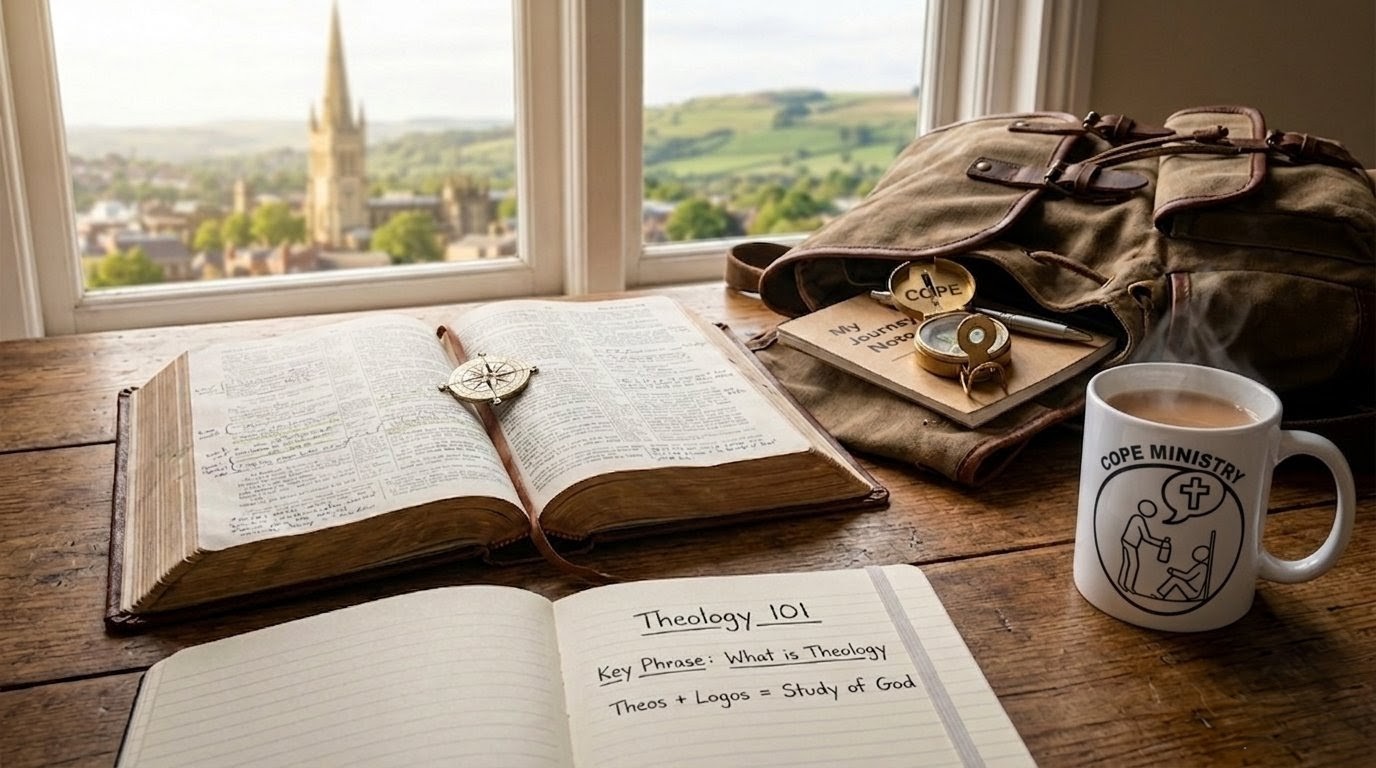
Theology 101: What It Is, What It Is Not, and Why It’s Your Absolute Spiritual Compass
Have you ever heard the word “Theology” and immediately imagined a dusty library, a complicated debate, or a seminar meant only for professors with ten letters after their name?
If so, you aren’t alone. For many people—especially new believers or those focused on daily recovery—the word “theology” feels intimidating, irrelevant, and boring.
But here is the truth we believe at COPE Ministry Wakefield: Theology isn’t just for academics in ivory towers. It is for the person standing at the crossroads of a new life. It is for the person in recovery needing an anchor. It is for anyone who has ever asked, “Who is God, and what does He have to do with me?”
Think of your Bible as the complete “Map” for your life. If the Bible is the map, then Theology is your Compass. It doesn’t replace the map; it helps you read it correctly so you don’t get lost in the “difficult bits.”
What is Theology? A Simple Definition (Theos + Logos)
Let’s strip away the intimidation and look at the actual word. The word “theology” comes from two simple Greek roots:
- Theos = God
- Logos = Word, Study, or Reasoned Speech
Therefore, a simple definition of theology is “The Study of God.”
It’s that simple. If you have ever thought about God, asked a question about His character, or discussed a Bible verse with a friend, you have already done theology. You are a theologian.
The classic definition, made famous by a theologian named Anselm of Canterbury, is even better: “Faith seeking understanding.” It’s the process of taking the faith you already have and using your mind to understand it more deeply.
The Myth: Why People Avoid “Beginner Theology”
The enemy wants you to believe that theology is only about rules, arguments, and boring history. This is a myth designed to keep you from using your spiritual compass.
Here is the difference between the myth and the reality:
- THE MYTH: Theology is about winning debates.
- THE REALITY: Theology is about knowing God’s heart.
- THE MYTH: Theology is confusing and contradictory.
- THE REALITY: Theology is about organizing the truth so you can stand firm when life gets chaotic.
- THE MYTH: Theology is only for “super-Christians.”
- THE REALITY: Theology is a necessity for all Christians, especially those who feel “brokenhearted” (Psalm 34:18).
At COPE Ministry, we don’t study theology just to get smarter—we study it to get closer to the One who saved us. We don’t want a “stuffy head”; we want a “healthy heart.”
Why Study Theology? The Spiritual Rucksack Essential
If you have explored our Bible Study Roadmap Wakefield, you know we talk about packing your “Spiritual Rucksack.” This is the essential gear you need for sustainable spiritual growth.
So why is “Simple Theology” such an essential item in that rucksack? Why bother studying it at all?
1. Good Theology Protects You from Error
The world (and even some churches) is full of ideas that sound good but are spiritually toxic. If you don’t know who God actually is (based on the whole “Map” of the Bible), you are vulnerable. Good theology acts like a “filter,” allowing you to test every teaching against the truth of God’s character.
2. Theology gives you Stability in the Storm
When life falls apart—when a craving hits, when a relationship breaks, or when the future feels uncertain—you don’t need an emotional “high.” You need rock-solid facts. Theology (what you believe about God’s sovereignty, His love, and His promises) is the anchor that holds you in the storm.
3. Theology Fuels True Worship
You cannot truly love or trust someone you do not know. As your theological understanding of God grows (His power, His patience, His grace), your worship will automatically shift from being a duty to being a delight.
4. Theology is the Foundation of Recovery
Our founder, Fin Dalton, often says that recovery requires a “rock-solid foundation,” not a “quick fix.”
If your theology says “God is an angry judge waiting for me to fail,” your recovery will be rooted in fear. But if your theology says “God is a loving Father who meets me where I am” (Luke 15), your recovery will be rooted in hope.
Your view of God determines your path in life.
How to Start Learning Theology (The Simple Approach)
You don’t need a seminary degree to start. You just need curiosity and the right approach.
- Start with the Source (The Bible): All good theology must come from the 66 books of the Bible. Any “theology” that contradicts the Bible is bad theology.
- Focus on the Core Doctrines (The “Theology 101” Essentials):
1. Theology Proper (The Father)
“The Lord is compassionate and gracious, slow to anger, abounding in love.” — Psalm 103:8
This focuses on the nature and existence of God. It explores the tension between His transcendence (He is above and separate from creation) and His immanence (He is personally involved in the world).
- Attributes: Categorized as Incommunicable (qualities only God has, like being eternal and unchanging) and Communicable (qualities humans can reflect, like love, justice, and mercy).
- The Trinity: The foundational belief in one God existing in three distinct, co-equal persons.
2. Christology (The Son)
“The Word became flesh and made his dwelling among us. We have seen his glory, the glory of the one and only Son, who came from the Father, full of grace and truth.” — John 1:14
This is the study of the person and work of Jesus Christ. The central mystery here is the Hypostatic Union: the reality that Jesus is 100% God and 100% man.
- The Incarnation: God taking on human flesh.
- The Atonement: The various ways theologians explain how Jesus’ death reconciled humanity to God (e.g., Substitutionary Atonement).
3. Pneumatology (The Holy Spirit)
“But the Advocate, the Holy Spirit, whom the Father will send in my name, will teach you all things and will remind you of everything I have said to you.” — John 14:26
Often the most misunderstood area, this looks at the Spirit not as a “force,” but as a Person.
- The Helper: His role in convicting the world of sin and comforting the believer.
- Sanctification: The ongoing process where the Spirit works within a person to make them more like Christ.
4. Soteriology (Salvation)
“For it is by grace you have been saved, through faith—and this is not from yourselves, it is the gift of God—not by works, so that no one can boast.” — Ephesians 2:8-9
This addresses the “How” of restoration. It navigates the relationship between God’s sovereignty and human responsibility.
- Grace vs. Works: The doctrine that salvation is a gift (Sola Gratia) received through faith, not earned through moral performance.
- Justification: Being declared “righteous” before God, legally and spiritually.
5. Bibliology (The Word)
“Your word is a lamp for my feet, a light on my path.” — Psalm 119:105
This explores the “Word of God” and how it reached us.
- Inspiration: The belief that “all Scripture is God-breathed,” written by humans under the guidance of the Spirit.
- Canonization: The historical process of how the 66 books were recognized and compiled as the authoritative standard for faith.
Read Great Tools: You don’t have to “reinvent the wheel.” Christians have been organizing these truths for 2,000 years.
Take Your Next Step with COPE Ministry Wakefield
We want to help you unpack this “Spiritual Compass.” We’ve done the heavy lifting of organizing the data so you don’t have to feel overwhelmed.
If you are ready to move from “just reading” the Bible to truly understanding the character of the One who wrote it, explore these curated sections in our Spiritual Rucksack:
- Understanding The Holy Trinity – Discovering the Father’s love, the Son’s freedom, and the Holy Spirit’s power.
- Calvinism vs. Arminianism – Exploring God’s sovereignty and the invitation of grace.
- The Gift of Life – Understanding the foundation of salvation and your new start.
- The Pillars of Faith – A chronological journey through the lives of the men and women who shaped the Bible.
Remember: Nobody is ever too far gone. Your past doesn’t define you, and your intellect doesn’t limit you. If you have “faith seeking understanding,” you are ready.