
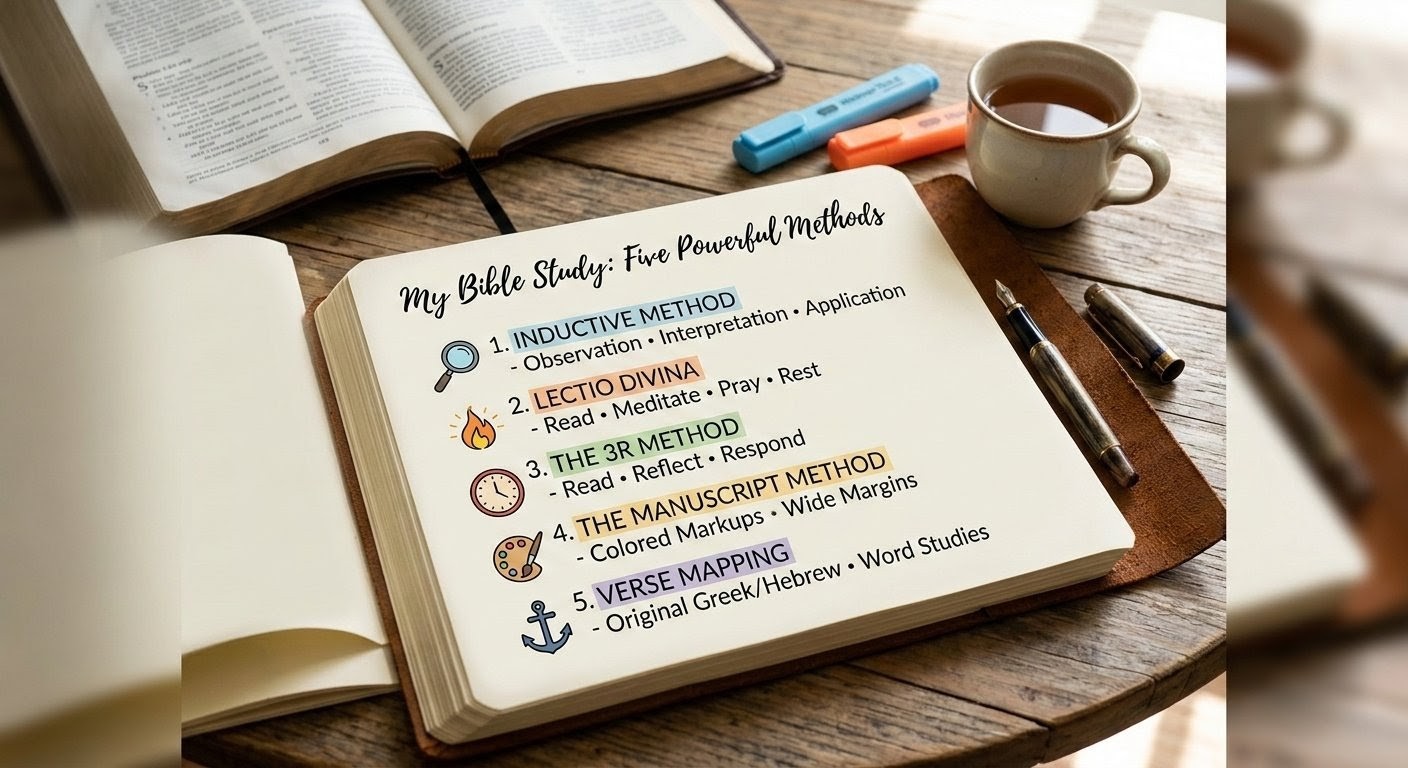
5 Life-Changing Frameworks
Have you ever opened your Bible, read a chapter, and closed it five minutes later realizing you didn’t actually process a single word? You aren’t alone. Reading the Bible is a spiritual discipline, but without a Bible study method, it can often feel like a chore rather than a conversation.
Why Use a Bible Study Method in the First Place?
Think of a study method as a scaffold for your spiritual life. Just as a map helps you navigate a new city, a method provides:
- Focus: It stops your mind from wandering to your “to-do” list.
- Depth: It forces you to look past the surface level and ask why a passage matters.
- Consistency: It gives you a “game plan” so you never have to ask, “What do I do now?”
- Retention: Writing things down helps move the Word from the page into your heart.
Using a framework like H.E.A.R. (Highlight, Explain, Apply, Respond) or SOAP (Scripture, Observation, Application, Prayer) transforms passive reading into active engagement. But if those feel “stale,” here are four other powerful methods to revitalize your quiet time.
1. The Inductive Method (The Detective’s Approach)
The Inductive Method is the “gold standard” for those who want to understand the Bible’s original meaning. It relies on three pillars: Observation, Interpretation, and Application.
- Pros: It prevents “cherry-picking” verses out of context and builds deep biblical literacy.
- Cons: It is time-consuming. You might spend 45 minutes on just a few verses.
- Best For: Students of the Word who want a “deep dive” into theology and history.
2. Lectio Divina (The Soul-Care Approach)
An ancient practice meaning “Divine Reading,” this method isn’t about finishing a chapter; it’s about “tasting” the Word through four movements: Read, Meditate, Pray, and Rest.
- Pros: It’s incredibly peaceful and focuses on emotional intimacy with God.
- Cons: It can feel “unstructured” for those who prefer logical, bulleted lists.
- Best For: When you feel spiritually exhausted, anxious, or need to hear God’s voice personally.
3. The 3R Method (The Busy Person’s Approach)
Simplicity is the key to consistency. The 3R method (Read, Reflect, Respond) is a streamlined version of more complex frameworks.
- Pros: You can complete it in 10 minutes, making it perfect for a lunch break or a busy morning.
- Cons: You may miss the historical nuances that a deeper study would reveal.
- Best For: Beginners or anyone in a season of life where time is a luxury.
4. The Manuscript Method (The Visual Approach)
This involves printing out a passage with wide margins and no verse numbers, then marking it up with pens and highlighters like a work of art.
- Pros: It’s tactile and visual, helping you see patterns and connections you’d miss in a standard Bible.
- Cons: Requires a printer or a specific “Journaling Bible” and can get a bit messy.
- Best For: Visual learners and “doodlers” who process information through color and symbols.
5. The Verse Mapping Method (The Deep-Dive Approach)
Verse Mapping is for when a single sentence stops you in your tracks. You pick one verse and “map” it out by looking up the original Greek or Hebrew words, comparing different translations, and finding related cross-references.
- Pros: It provides incredible “Aha!” moments by uncovering the hidden riches of specific words.
- Cons: It requires external tools (like a Concordance or a Bible app).
- Best For: People who love word studies and want to understand the “mechanics” of Scripture.
Summary: Which Method Should You Use?
There is no “perfect” way to study the Bible, only the way that helps you encounter God today. If you want to learn, try Inductive. If you need to feel, try Lectio Divina. If you’re in a rush, use the 3Rs.
The goal isn’t to master the method—it’s to let the Word master you