If you caught my recent post, “Finding Your Perfect Bible,” you know we took a deep dive into the “Translation Spectrum”—from literal word-for-word versions to modern paraphrases. Well, my own journey with the Word just took a major step forward with a perfectly timed delivery.
A Holy Spirit Encounter & A New Tool
This weekend was incredibly powerful. I was attending the Alpha Away Day, and it was truly a Holy Spirit-filled day of prayer, fellowship, and renewal. There is nothing like stepping away from the noise to focus entirely on what God is doing in our lives.
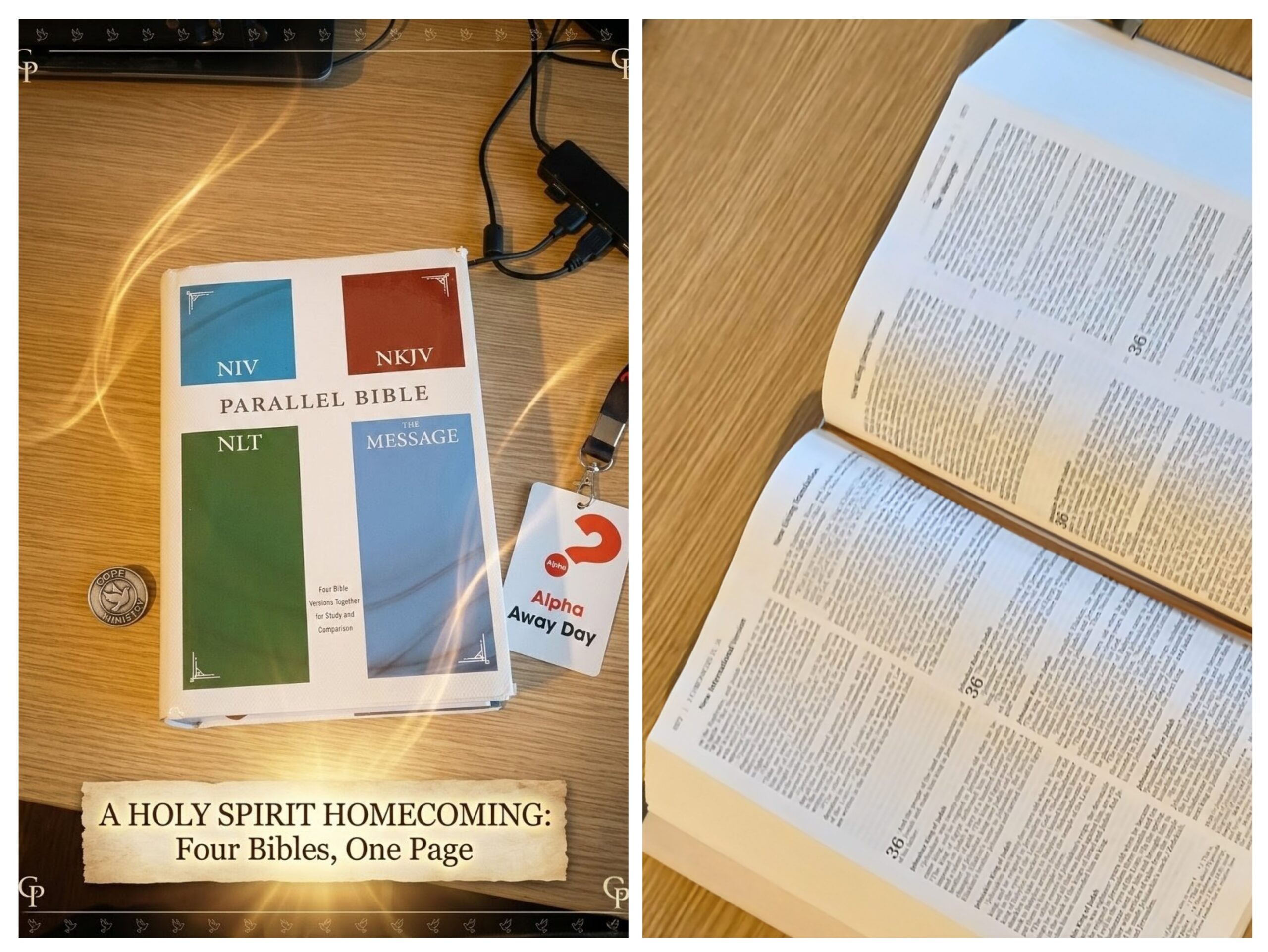
After such an uplifting and spiritually charged day, I arrived home to find a package waiting for me right on the doorstep. Inside was the brand-new Parallel Bible I had been waiting to add to my collection. It felt like the perfect “amen” to a day spent in God’s presence—coming home to a tool that will help me dive even deeper into His Word.
What is a Parallel Bible?
Imagine having four of the most popular Bible translations open at the exact same time, on the exact same page. No more flipping through multiple books or switching tabs on an app.
In this new edition, I have the NKJV, NIV, NLT, and The Message side-by-side. This allows me to see the “spectrum” of translation in real-time.
Why This Matters for Our Outreach:
At COPE Ministry, our mission is clear: Nobody Is Too Far Gone. Anyone Can Be Saved. To share that message effectively, I need to understand the Bible from every angle.
For Deep Study: I look at the NKJV to see the precise, formal structure of the original text.
For Teaching: I use the NIV for that perfect balance of accuracy and readability.
For Daily Life: I turn to the NLT to see how these ancient truths apply to our modern language.
For a Fresh Perspective: I read The Message to hear the heart of the story in “real-talk” idioms that resonate on the streets today.
A Closer Look: 2 Chronicles 36
I’ve already put it to use by spending time in 2 Chronicles 36, looking at the fall of Jerusalem and the reign of the last kings of Judah. It’s a heavy chapter about consequences, but also about God’s persistence.
By comparing these four versions side-by-side, I can see how one version uses the word “rebelled” while another describes it as “stiffening his neck.” Seeing those different shades of meaning helps me prepare better notes and study guides for all of you. It makes the history feel alive and immediate.
”The best Bible translation is the one you will read and understand!”
Conclusion:
The tools we use are meant to point us toward one thing: a deeper relationship with Jesus Christ. Whether you use a literal translation or a paraphrase, the goal is to let the Word transform your life. Between the fire of the Alpha Away Day and this new Bible, I am more excited than ever to continue building resources for our community.
Understanding Christian Denominations in the UK: A Guide for Outreach
At Copeministry.com, our evangelism and outreach work takes us into the heart of diverse communities across the UK. To effectively share the Gospel, it is helpful to understand the rich tapestry of the UK’s Christian denominations.
While we operate as a Pentecostal outreach ministry, we recognize that the Body of Christ is made up of many different traditions. Here is an overview of the major Christian branches you will find in Britain today.
The Pentecostal Movement: Fire, Faith, and Growth
Pentecostalism is one of the most dynamic and fastest-growing sectors of the UK church. It is characterized by an emphasis on a personal “Book of Acts” experience—the belief that the Holy Spirit is just as active today as He was in the early church.
In the UK, this movement includes well-known fellowships like the Assemblies of God (AoG) and the Elim Pentecostal Church, alongside many independent charismatic congregations. These churches are known for:
Contemporary Worship: Passionate, modern music and praise.
Spiritual Gifts: A focus on healing, prophecy, and the baptism of the Holy Spirit.
Biblical Authority: A strong commitment to the Bible as the inspired Word of God.
The Established Path: The Church of England (Anglican)
The Church of England is the “established” church of the land. Through its parish system, it maintains a presence in nearly every community, from historic landmarks like Wakefield Cathedral to small village chapels.
As a “broad church,” Anglicanism houses a wide range of styles, from “High Church” liturgical services to “Low Church” evangelical gatherings. It remains a primary spiritual anchor for many in the UK.
The Ancient Traditions: Catholic and Orthodox
The Roman Catholic Church has a significant and historic presence in the UK. Their faith is centered on the sacraments, the liturgy of the Mass, and a deep reverence for church tradition and apostolic authority.
Alongside them are the Eastern Orthodox churches (including Greek, Russian, and Coptic Orthodox). these communities offer a mystical worship experience that has remained largely unchanged for centuries, focusing heavily on icons and the mystery of God’s presence.
The Free Church Tradition: Baptist, Methodist, and Reformed
The UK has a long history of “Non-Conformist” churches—those that developed independently of the Church of England.
The Methodist Church: Founded during the 18th-century revivals of John Wesley, Methodists are known for their commitment to social holiness and serving the marginalized.
Baptist Churches: These are defined by “believer’s baptism” (baptism by immersion) and the autonomy of the local congregation.
Presbyterian & United Reformed: These churches follow a structured, elder-led leadership model and emphasize the sovereignty of God in all areas of life.
Unity in the Mission: Outreach in Wakefield and Beyond
While worship styles and church governments differ, the core mission remains the same: the Gospel of Jesus Christ.
At COPE Ministry, we do not stress which denomination you choose to join. Our primary heart and concern is that you build a genuine, personal relationship with Jesus Christ. We believe that religion doesn’t save—only Jesus does. As it says in the Bible:
“Jesus answered, ‘I am the way and the truth and the life. No one comes to the Father except through me.’” — John 14:6
As we engage in community outreach through Copeministry, we see these various denominations as different parts of the same Body. Whether a church is liturgical and traditional or contemporary and Pentecostal, our shared goal is to see the UK transformed by the love of God.
Have you ever felt like you wanted to explore faith but didn’t know where to start? Or perhaps you’ve opened a Bible only to feel completely overwhelmed by its size and complexity?
At COPE Ministry Wakefield, our heartbeat is simple: “Nobody Is Too Far Gone – Anyone Can Be Saved.” We know that the journey of faith can feel like a mountain climb, which is why we’ve built a clear, 3-step roadmap to help you navigate the path from “curious” to “confident.”
Whether you are seeking recovery, spiritual growth, or just a little bit of hope, here is your guide to a fresh start.
1️⃣ THE CONVERSATION: Alpha – Explore Life, Faith, and Meaning
We all have the “big questions.” Why am I here? Is there more to life than this? Does faith even matter in the 21st century?
If you’re looking for a safe, low-pressure space to get answers, Alpha is the perfect place to start. Most sessions involve a meal, a short film, and a discussion where you can say exactly what you think.
The Alpha Rule: No pressure. No follow-up. No charge. No judgment.
Find Your Group: While we aren’t hosting a group this week, we want to help you connect. Use the official [Find an Alpha] tool to enter your postcode and find a local group meeting in a cafe or community center near you.
2️⃣ THE EXPERIENCE: Watch the Word at the Bible Cinema
We understand that traditional reading isn’t for everyone. Some people struggle with focus, different learning styles, or simply feel overwhelmed when looking at a page of text.
OurBible Cinema brings the Word of God to life in high-definition.
The Verse-by-Verse Library: Experience the Gospels (Matthew, Mark, Luke, John) and the Book of Acts in cinematic, word-for-word adaptations.
The Narrative Collection: From the epic journey of Moses to the radical transformation of Paul, Apostle of Christ, these films capture the “Big Picture” of God’s redemption.
[Download Your Free Visual Study Guide]: Don’t just watch—engage. Our guide helps you reflect on what you see and apply it to your life.
3️⃣ THE STUDY: The 5-Minute New Testament Challenge
Once you’ve started the conversation and seen the stories, it’s time to build a personal habit. We’ve taken the guesswork out of reading with our Bible Roadmap.
The math is simple: There are 260 chapters in the New Testament. If you read just one chapter a day, Monday through Friday, you will finish the entire New Testament in exactly one year.
Weekends are for Grace: Use Saturdays and Sundays to rest, reflect, or catch up.
Roadmap Summaries: We’ve provided concise summaries for every chapter to help you understand the context before you even start reading.
Audio Option: Prefer to listen? We feature the NIV Bible narrated by David Suchet for a masterful, immersive experience.
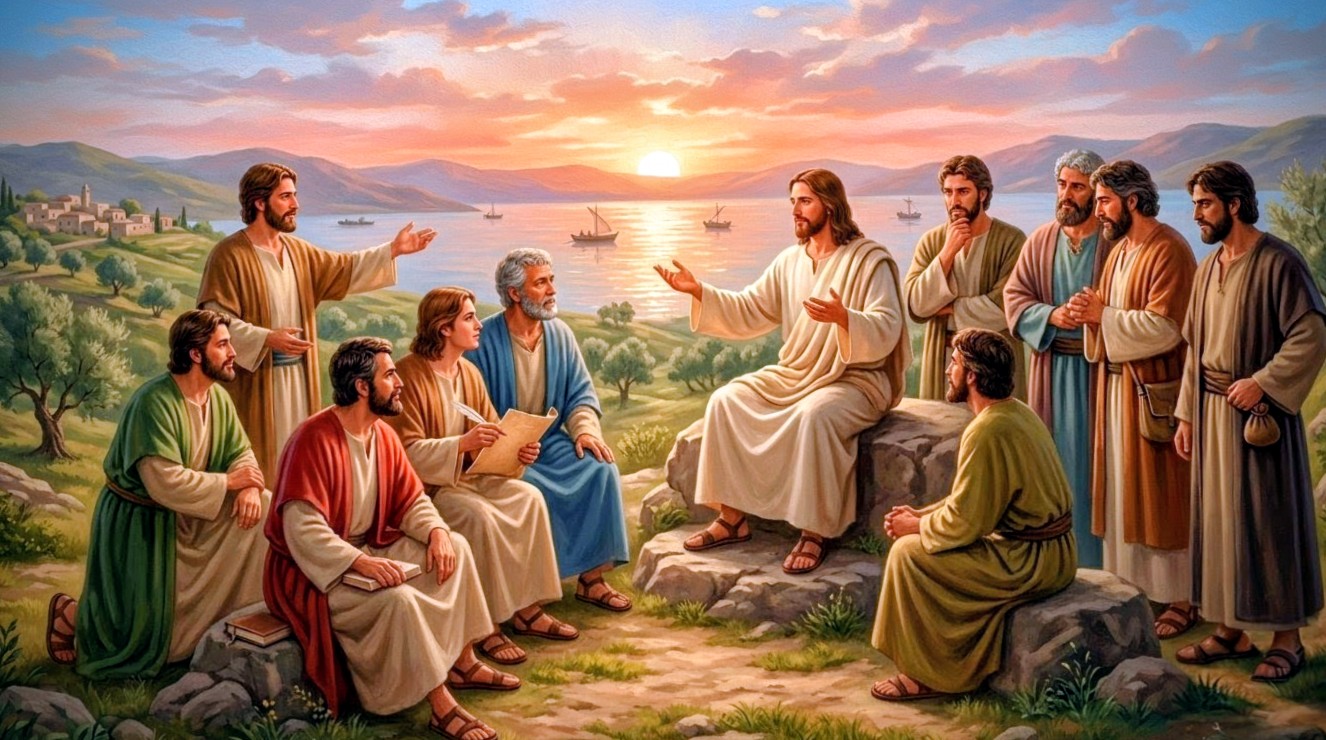
Have you ever wondered about the men Jesus chose to be his closest companions? The 12 disciples (also known as the 12 apostles) weren’t elite religious scholars. They were a diverse group of fishermen, tax collectors, and political radicals.
By understanding the names and stories of the 12 disciples, we see a powerful picture of how ordinary people can change the history of the world. Here is a closer look at each of the twelve apostles one by one.
1. Simon Peter (The Rock)
Simon Peter is perhaps the most famous of the twelve. A fisherman by trade, Peter was known for his impulsive personality and bold faith. Though he famously denied Jesus three times, he was later restored and became the “rock” upon which the early church was built. His journey from a humble fisherman to a courageous leader in Rome is a central theme of the New Testament.
2. Andrew (The Introducer)
Andrew was Peter’s brother and also a fisherman. In the Gospels, Andrew is often seen bringing people to Jesus, including his own brother and the boy with the five loaves and two fish. Andrew’s legacy is one of quiet, effective evangelism and a heart for introducing others to the Messiah.
3. James, Son of Zebedee (The Son of Thunder)
James and his brother John were known as the “Sons of Thunder” due to their fiery temperaments. As part of Jesus’ inner circle, James witnessed the Transfiguration and the agony in Gethsemane. He holds the distinction of being the first apostle to be martyred for his faith, showing the ultimate cost of discipleship.
4. John (The Beloved Disciple)
Traditionally identified as the author of the Gospel of John, this “beloved disciple” underwent a massive transformation. Once a “Son of Thunder,” he became the “Apostle of Love.” John was the only disciple present at the crucifixion, where Jesus entrusted him with the care of his mother, Mary.
5. Philip (The Practical Apostle)
Philip was from Bethsaida and often approached faith with a practical, analytical mind. When Jesus fed the five thousand, it was Philip who calculated the cost. Despite his literal-mindedness, he was quick to invite others to “come and see” the truth of who Jesus was.
6. Bartholomew (Nathanael)
Most scholars identify Bartholomew as Nathanael. He was initially a skeptic, famously asking if anything good could come from Nazareth. However, after a personal encounter with Jesus, he became a devoted follower. He is remembered for his integrity and honest search for the truth.
7. Matthew (Levi the Tax Collector)
Matthew’s calling is one of the most radical. As a tax collector for Rome, he was considered a social outcast and a traitor by his fellow Jews. When Jesus said, “Follow me,” Matthew left his wealth behind. He is traditionally credited with writing the Gospel of Matthew, bridge-building between Jewish prophecy and the life of Christ.
8. Thomas (The Doubter)
History remembers him as “Doubting Thomas” because he demanded physical proof of the Resurrection. However, once he saw the risen Christ, his confession—”My Lord and my God”—became one of the most profound declarations of faith in the Bible. Thomas’ story encourages anyone who has ever struggled with honest questions.
9. James, Son of Alphaeus (James the Less)
Often called “James the Less” to distinguish him from the son of Zebedee, he is one of the more quiet members of the twelve. While the Bible provides few details about his life, his inclusion reminds us that every follower of Christ plays a vital role, even those who work behind the scenes.
10. Thaddaeus (Jude)
Thaddaeus, also known as Jude or Lebbaeus, is often remembered for asking Jesus how He would manifest Himself to the disciples and not to the world. His life represents the seeking heart of a believer who wants to understand the deeper mysteries of God’s plan.
11. Simon the Zealot
Before following Jesus, Simon was likely part of the Zealots, a political group that sought to overthrow Roman rule by force. His transformation from a political revolutionary to a fisher of men shows that the Gospel is powerful enough to unite people from any political or social background.
12. Judas Iscariot (The Betrayer)
The most tragic figure of the twelve, Judas served as the group’s treasurer but eventually betrayed Jesus for thirty pieces of silver. His story serves as a somber warning about the dangers of greed and the reality that proximity to Jesus does not always guarantee a surrendered heart.
Why the 12 Apostles Matter Today
The 12 disciples were messy, flawed, and relatable. They struggled with doubt, ambition, and fear, yet they were the ones chosen to spread the Gospel to the ends of the earth. Their lives prove that God doesn’t call the equipped; He equips the called.
Have you ever opened your Bible, read a chapter, and closed it five minutes later realizing you didn’t actually process a single word? You aren’t alone. Reading the Bible is a spiritual discipline, but without a Bible study method, it can often feel like a chore rather than a conversation.
Why Use a Bible Study Method in the First Place?
Think of a study method as a scaffold for your spiritual life. Just as a map helps you navigate a new city, a method provides:
Focus: It stops your mind from wandering to your “to-do” list.
Depth: It forces you to look past the surface level and ask why a passage matters.
Consistency: It gives you a “game plan” so you never have to ask, “What do I do now?”
Retention: Writing things down helps move the Word from the page into your heart.
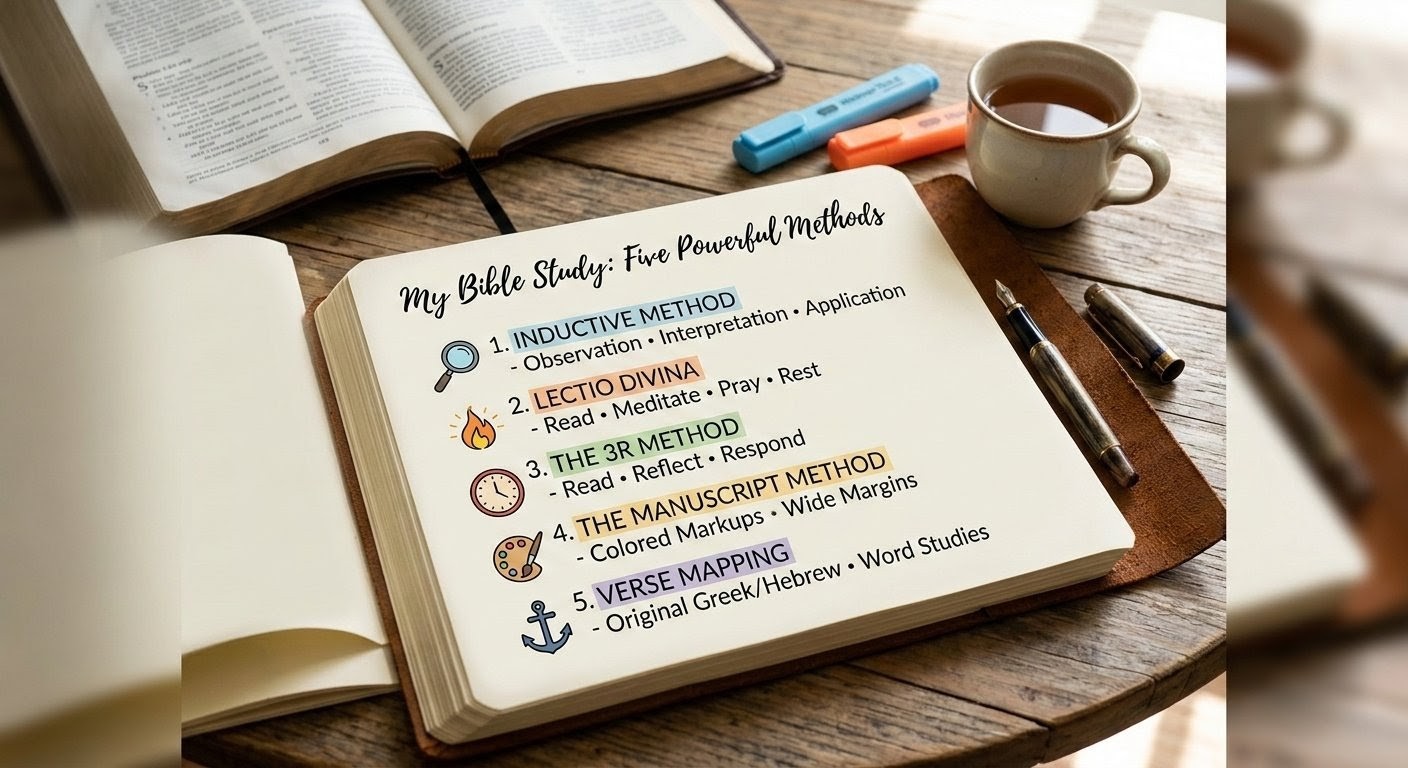
Using a framework like H.E.A.R. (Highlight, Explain, Apply, Respond) or SOAP (Scripture, Observation, Application, Prayer) transforms passive reading into active engagement. But if those feel “stale,” here are four other powerful methods to revitalize your quiet time.
1. The Inductive Method (The Detective’s Approach)
The Inductive Method is the “gold standard” for those who want to understand the Bible’s original meaning. It relies on three pillars: Observation, Interpretation, and Application.
Pros: It prevents “cherry-picking” verses out of context and builds deep biblical literacy.
Cons: It is time-consuming. You might spend 45 minutes on just a few verses.
Best For: Students of the Word who want a “deep dive” into theology and history.
2. Lectio Divina (The Soul-Care Approach)
An ancient practice meaning “Divine Reading,” this method isn’t about finishing a chapter; it’s about “tasting” the Word through four movements: Read, Meditate, Pray, and Rest.
Pros: It’s incredibly peaceful and focuses on emotional intimacy with God.
Cons: It can feel “unstructured” for those who prefer logical, bulleted lists.
Best For: When you feel spiritually exhausted, anxious, or need to hear God’s voice personally.
3. The 3R Method (The Busy Person’s Approach)
Simplicity is the key to consistency. The 3R method (Read, Reflect, Respond) is a streamlined version of more complex frameworks.
Pros: You can complete it in 10 minutes, making it perfect for a lunch break or a busy morning.
Cons: You may miss the historical nuances that a deeper study would reveal.
Best For: Beginners or anyone in a season of life where time is a luxury.
4. The Manuscript Method (The Visual Approach)
This involves printing out a passage with wide margins and no verse numbers, then marking it up with pens and highlighters like a work of art.
Pros: It’s tactile and visual, helping you see patterns and connections you’d miss in a standard Bible.
Cons: Requires a printer or a specific “Journaling Bible” and can get a bit messy.
Best For: Visual learners and “doodlers” who process information through color and symbols.
5. The Verse Mapping Method (The Deep-Dive Approach)
Verse Mapping is for when a single sentence stops you in your tracks. You pick one verse and “map” it out by looking up the original Greek or Hebrew words, comparing different translations, and finding related cross-references.
Pros: It provides incredible “Aha!” moments by uncovering the hidden riches of specific words.
Cons: It requires external tools (like a Concordance or a Bible app).
Best For: People who love word studies and want to understand the “mechanics” of Scripture.
Summary: Which Method Should You Use?
There is no “perfect” way to study the Bible, only the way that helps you encounter God today. If you want to learn, try Inductive. If you need to feel, try Lectio Divina. If you’re in a rush, use the 3Rs.
The goal isn’t to master the method—it’s to let the Word master you
Is Anyone Truly Too Far Gone? Calvinism, Arminianism, and the Reach of God
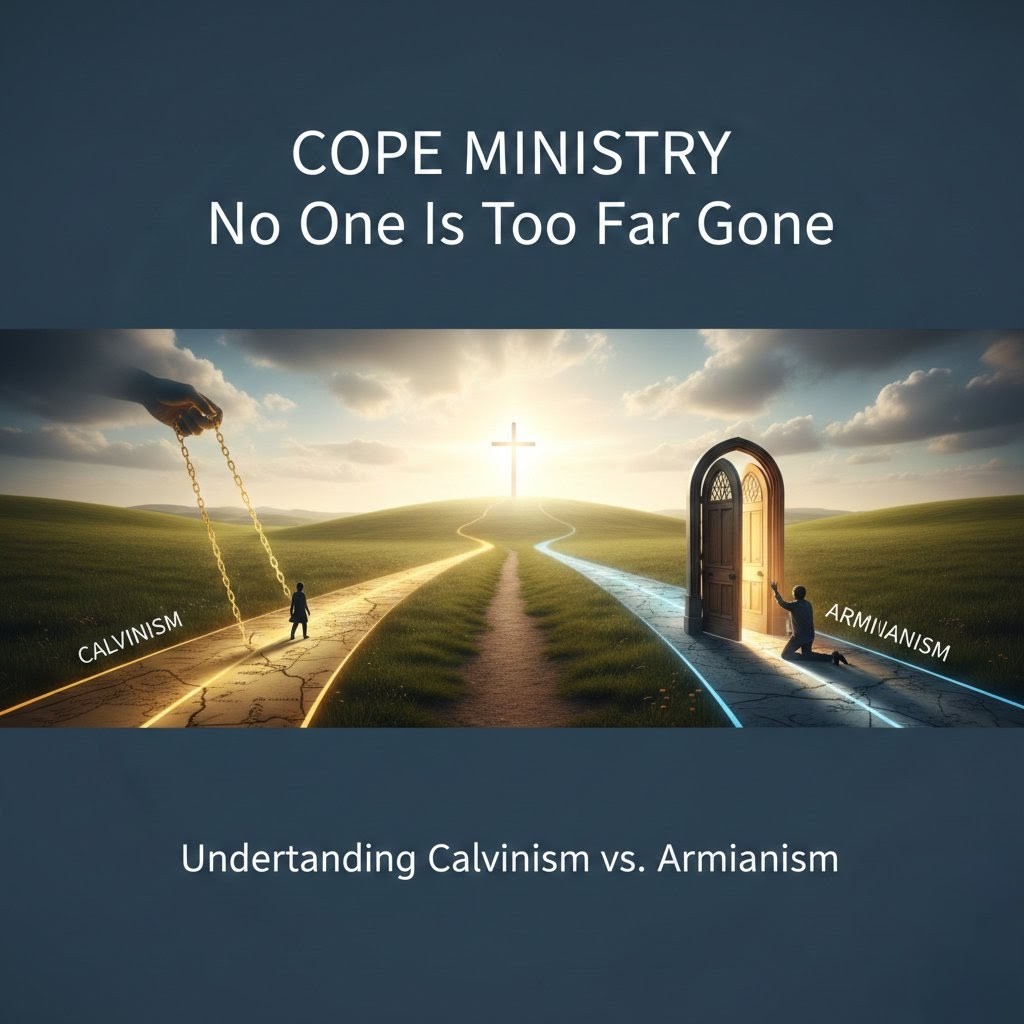
At COPE Ministry, we live by a simple truth: “No one is too far gone. Anyone can be saved.” But when we dive into the Bible, we find a centuries-old conversation about how that salvation actually works.
If you’ve ever felt like your past is too dark or your heart is too hard for God to reach, understanding these two perspectives—Calvinism and Arminianism—can offer you incredible hope. Let’s break down these two “maps” of grace.
Understanding Calvinism: The Sovereignty of Grace
Calvinism, named after John Calvin, focuses on the absolute power and sovereignty of God. It suggests that if salvation depended on us, we’d be in trouble! Instead, it teaches that God is the one who initiates, sustains, and completes our rescue.
The core of Calvinism is often explained through the TULIP acronym:
Total Depravity: Sin has affected every part of us—our minds, hearts, and wills. Without God’s help, we are spiritually “dead” and cannot choose Him on our own.
Unconditional Election: God chooses to save us based on His own mercy and love, not because of anything good we have done or any “potential” He sees in us.
Limited Atonement: This view suggests that Jesus’ sacrifice on the cross was a specific, guaranteed payment for the sins of His people.
Irresistible Grace: When the Holy Spirit calls a person, His love is so beautiful and powerful that the person eventually, and freely, says “Yes” to God.
Perseverance of the Saints: Because salvation is God’s work, He won’t let you go. You are secure in His hands forever.
Understanding Arminianism: The Invitation of Grace
Arminianism, named after Jacobus Arminius, focuses on God’s desire for a genuine, two-way relationship with every human being. It emphasizes that God has opened the door for everyone, but He gives us the dignity of choosing to walk through it.
The Arminian perspective is often viewed through these key points:
Prevenient Grace: While we are sinful, God gives everyone a “leading grace” that empowers our free will, allowing us to respond to the Gospel.
Conditional Election: God chooses those who choose Him. He foresees who will put their faith in Jesus and welcomes them into His family.
Unlimited Atonement: Jesus died for every single person who has ever lived. His gift is available to all, though it is only received by those who believe.
Resistible Grace: God is a gentleman; He offers His love and salvation to everyone, but He does not force His grace upon those who are determined to reject it.
Assurance of Salvation: While we can have peace in our relationship with God, there is an emphasis on “abiding in the vine” and remaining faithful to the end.
The Big Comparison: How Do They Differ?
Who takes the first step?
In Calvinism, God takes the first step by bringing a spiritually dead heart back to life so they can believe. In Arminianism, God takes the first step by giving everyone enough grace to choose whether to believe.
Is salvation a guarantee?
Calvinists believe that if you are truly saved, you can never be lost because God is the one holding onto you. Arminians emphasize that we must continue to walk with God and stay connected to Christ to remain in that salvation.
Who can be saved?
Both views agree: Anyone! * Calvinism says anyone can be saved because God’s power is greater than any sin.
Arminianism says anyone can be saved because God has made the offer available to every person on earth.
Why This Matters for the “Too Far Gone”
At COPE Ministry Wakefield, we don’t get hung up on the labels. We get excited about the Result.
If you feel “too far gone” today, remember this:
If the Calvinists are right, your “dead heart” is exactly what God specializes in bringing back to life.
If the Arminians are right, God is standing at your heart’s door right now, knocking and waiting for you to simply say “Yes.”
The bottom line is Jesus. As we see in the Book of Acts, the Holy Spirit isn’t restricted by our theological boxes. He is active, He is moving, and He is looking for you.
There is something magnetic about a well-told story. We remember the underdog who overcomes the odds, the lost traveler who finds their way, and the sudden twist we never saw coming.
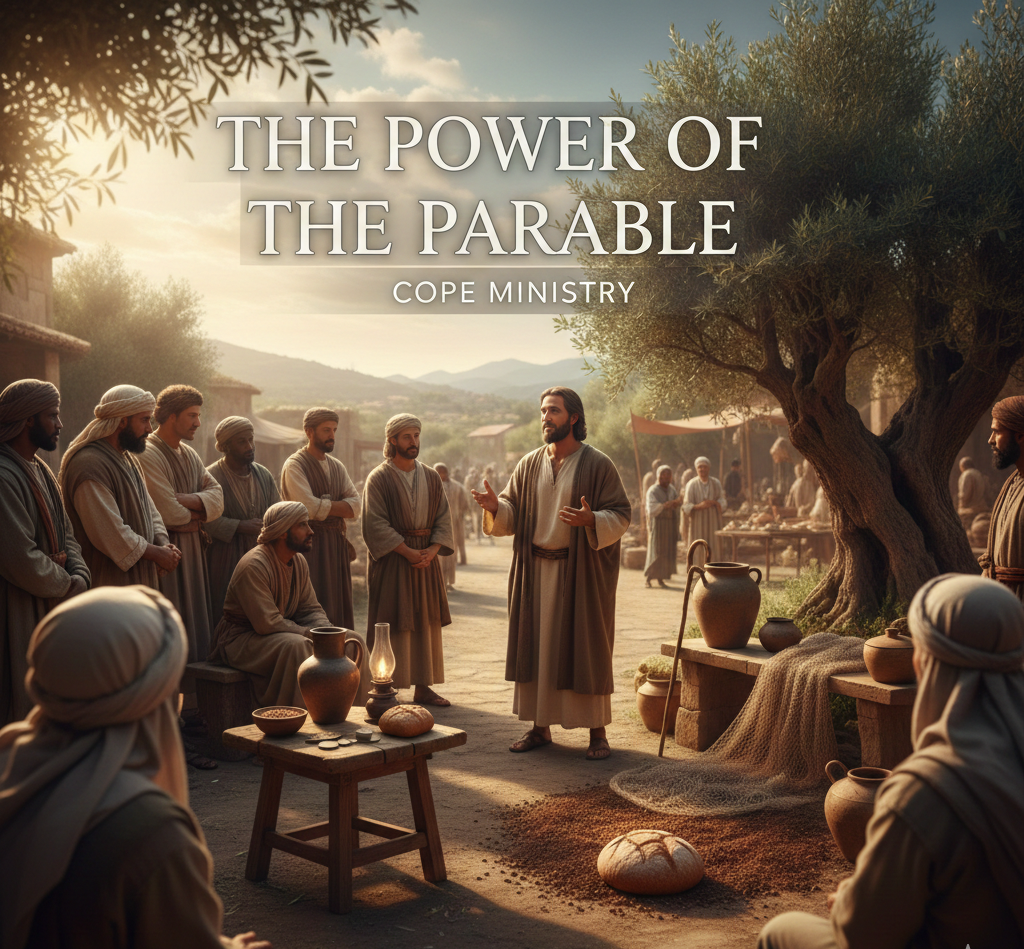
When Jesus began His earthly ministry, He didn’t just hand out a list of dry systematic doctrines or complex legal codes. Instead, He pointed to the world around Him—to the farmer tossing seeds, the woman baking bread, and the shepherd searching the hills. He spoke in parables.
At COPE Ministry, we believe that understanding these stories is key to navigating our modern lives with faith and clarity. But just how many are there, and what do they cover?
What is a Parable?
The word “parable” comes from the Greek parabolē, meaning “to cast alongside.” It’s the act of placing a spiritual truth right next to an everyday occurrence so we can see the connection. Jesus used them to both reveal truth to the hungry heart and conceal it from those who weren’t yet ready to listen.
While scholars debate the exact count (as some are short metaphors and others are long narratives), there are generally recognized to be about 35 to 40 primary parables.
The Complete Catalog of Jesus’ Parables
To help you in your personal study, we have categorized the parables based on where they appear in the Gospels. Some were so vital they were recorded by three different authors, while others are unique “hidden gems” found in only one book.
Found in Matthew, Mark, and Luke (The Synoptic Parables)
These core stories are found across the three “synoptic” Gospels, highlighting their central importance to Jesus’ message:
The Sower and the Soils: (Matt 13, Mark 4, Luke 8)
The Four Soils of the Heart 1. The Path (The Hard Heart) Some seed falls on the packed-down path. Before it can even sink in, the birds swoop down and devour it. The Meaning: This represents someone who hears the message but doesn’t understand or value it. Because the heart is hardened—perhaps by bitterness or pride—the enemy quickly snatches the truth away. 2. The Rocky Ground (The Shallow Heart) This soil is thin. The seed springs up quickly, but because there is no depth, the sun scorches the plant and it withers. The Meaning: This is the “emotional” hearer. They receive the Word with joy, but their faith lacks deep roots. When life gets difficult or “heat” (persecution) arrives, they abandon their faith. 3. The Thorny Ground (The Crowded Heart) The seed grows, but it’s surrounded by weeds that compete for nutrients, eventually choking the life out of the plant. The Meaning: This represents a heart distracted by the “cares of this world and the deceitfulness of riches.” It isn’t that the person rejects God; it’s that they are too busy and worried to let Him be first. 4. The Good Soil (The Fruitful Heart) Finally, some seed falls on rich, prepared earth. It takes root, grows strong, and produces a harvest—thirty, sixty, or even a hundred times what was sown. The Meaning: This is the person who hears, understands, and holds fast to the Word. Their life results in tangible fruit: character, service, and love. Why the Soil Matters The Sower (God) is incredibly generous—He throws the seed everywhere, even on the rocks! The variable isn’t the quality of the seed or the effort of the Sower; it is the receptivity of the ground. As we engage with the mission at COPE Ministry (copeministry.com), this parable reminds us that our job is to keep sowing faithfully, while also tending to the “soil” of our own souls through prayer and humility. ”He who has ears to hear, let him hear.” — Matthew 13:9
Reflect: Is there a “weed” of worry you need to pull today to make more room for the Word?
The Mustard Seed: (Matt 13, Mark 4, Luke 13)
Understanding the Parable of the Mustard Seed
In Matthew 13, Mark 4, and Luke 13, Jesus shares a brief but powerful illustration: The Parable of the Mustard Seed. While we often focus on the smallness of the seed, the story is really about the limitless potential of God’s Kingdom.
In this metaphor, the seed is the Word or the Kingdom of God, and its growth represents how something tiny and seemingly insignificant can transform into something life-giving. As you reflect on this, consider the “small” seeds of faith you are planting in your current spiritual season.
The Journey from Seed to Tree
1. The Smallest of Seeds
The mustard seed was known in the ancient world as one of the smallest seeds a farmer would handle. It is barely a speck in the palm of a hand.
The Meaning: This represents the humble beginnings of faith or a God-given dream. It often looks unimpressive, overlooked, or even “too small” to make a real difference in a world that values being big and loud.
2. The Act of Planting
For the seed to grow, it must be put into the ground. It has to be surrendered to the soil and hidden away from sight for a time.
The Meaning: This is the season of hidden growth. It represents the quiet prayers, the small acts of obedience, and the “behind-the-scenes” work that no one sees but God. Without this surrender, the potential remains locked inside the seed.
3. The Miraculous Growth
Once it takes root, the mustard seed doesn’t just become a small plant; it grows into a tree—sometimes reaching 10 to 12 feet in height.
The Meaning: This represents the supernatural expansion of God’s work. What started as a single thought or a small gesture of kindness grows into something far larger than the person who planted it could have achieved on their own.
4. The Place of Shelter
The final result is a tree so large that the birds of the air come and find rest and “make nests in its branches.”
The Meaning: This is the ultimate goal of a fruitful life. Our faith and our ministries aren’t just for our own benefit; they are meant to provide shade, support, and a “nesting place” for others who are weary or seeking a home.
Why the Smallness Matters
The Sower (God) delights in using the small to confound the mighty. The variable isn’t the size of your initial resources or the “bigness” of your platform; it is the faithfulness to plant what you have been given.
As we engage with the mission at COPE Ministry (copeministry.com), this parable reminds us that no act of service is too small. A single conversation, a small donation, or a simple prayer is a mustard seed that God can grow into a massive refuge for those in need.
”If you have faith as small as a mustard seed… nothing will be impossible for you.” — Matthew 17:20
Reflect: Is there a “small” step of obedience you’ve been hesitant to take because it feels insignificant?
The Wicked Tenants: (Matt 21, Mark 12, Luke 20)
Understanding the Parable of the Wicked Tenants
In the Gospels of Matthew 21, Mark 12, and Luke 20, Jesus shares a sobering and confrontational illustration: The Parable of the Wicked Tenants. While it begins with the beauty of a prepared vineyard, the story is really about accountability and stewardship.
In this metaphor, the vineyard is the Kingdom of God (specifically Israel’s spiritual heritage), and the tenants represent the leaders and individuals entrusted with its care. As you reflect on this, consider how you are managing the “vineyard” of your own life and influence.
The Elements of the Vineyard
1. The Prepared Vineyard (The Provision)
The landowner plants a vineyard, puts a wall around it, digs a winepress, and builds a watchtower before renting it out.
The Meaning: This represents God’s perfect provision. He didn’t just give us a job to do; He provided the protection (the wall), the tools for productivity (the winepress), and the oversight (the watchtower). He sets us up for success.
2. The Patient Master (The Prophets)
When harvest time approaches, the landowner sends servants to collect his fruit. The tenants beat, stone, and kill them. He sends more, and they do the same.
The Meaning: This represents God’s incredible patience throughout history. The servants are the prophets and messengers God sends to call His people back to faithfulness. Even when rejected, God continues to reach out.
3. The Beloved Son (The Sacrifice)
Finally, the owner sends his own son, thinking, “They will respect my son.” Instead, the tenants kill him, hoping to take the inheritance for themselves.
The Meaning: This is a direct prophecy of Jesus’ own crucifixion. It exposes the height of human rebellion—the desire to take God’s gifts while rejecting His authority. It shows the ultimate cost God was willing to pay to claim His harvest.
4. The New Tenants (The Great Commission)
Because of the tenants’ wickedness, the owner takes the vineyard away and gives it to others who will give him the fruit in its season.
The Meaning: This represents the shift of stewardship to all who follow Christ. The Kingdom is not a private club; it is a responsibility given to those—regardless of background—who will actually produce the “fruit” of the Spirit.
Why the Stewardship Matters
The Landowner (God) is the rightful owner of everything we possess. The variable isn’t whether we have “fruit” to give; it is whether we acknowledge His ownership or try to claim the vineyard as our own.
As we engage with the mission at COPE Ministry (copeministry.com), this parable reminds us that we are temporary caretakers of God’s resources. Our goal is to be found faithful, honoring the Son and returning the “fruit” of our labor to the One who provided the vineyard in the first place.
”The stone the builders rejected has become the cornerstone.” — Matthew 21:42
Reflect: Are there areas of your life where you act like the “owner” rather than the “tenant” of God’s blessings?
New Wine in Old Wineskins: (Matt 9, Mark 2, Luke 5)
Understanding the Parable of the New Wine in Old Wineskins
In the Gospels of Matthew 9, Mark 2, and Luke 5, Jesus shares a brief but profound illustration: The Parable of the New Wine in Old Wineskins. While it speaks of ancient preservation methods, the story is really about spiritual flexibility and transformation.
In this metaphor, the “New Wine” is the Gospel and the presence of the Holy Spirit, while the “Wineskins” represent our traditions, mindsets, and structures. As you reflect on this, consider if your “wineskin” is soft enough to contain what God is doing next.
The Contrast of the Containers
1. The New Wine (The Gospel)
New wine is still fermenting; it is active, bubbling, and expanding. It possesses a power that cannot be contained by something rigid.
The Meaning: This represents the radical, life-changing message of Jesus. The Gospel isn’t just an “add-on” to our old lives; it is a transformative force that demands room to grow and move.
2. The Old Wineskin (The Rigid Heart)
An old wineskin has lost its elasticity. It has become brittle and hard. If you put fermenting wine into it, the pressure will cause the skin to burst, wasting both the wine and the container.
The Meaning: This represents a heart or a system stuck in “the way we’ve always done it.” It is a mind closed to change, often clinging to legalism or comfortable habits that can no longer support a fresh move of God.
3. The New Wineskin (The Prepared Mind)
A new wineskin is soft, supple, and able to stretch as the wine expands. It works with the wine rather than against it.
The Meaning: This represents a heart that is humble and teachable. It is a person who says, “Lord, do something new in me,” and is willing to let go of old prejudices or comfort zones to accommodate God’s will.
4. The Preservation of Both
Jesus notes that when new wine is put into new wineskins, “both are preserved.” There is a perfect harmony between the message and the messenger.
The Meaning: When we align our lives with the Spirit, we don’t “burst” under the pressure of trials or change. Instead, we become a vessel that can safely carry the grace of God to a world that is thirsty for truth.
Why the Flexibility Matters
The Wine (the Gospel) is always good, but the container (our heart) determines if that wine is shared or spilled. The variable isn’t the power of the Spirit; it is the elasticity of our faith.
As we engage with the mission at COPE Ministry (copeministry.com), this parable reminds us that outreach often requires “new wineskins.” We must be willing to adapt our methods and our mindsets to reach a changing world, ensuring we never let tradition stand in the way of transformation.
”No one pours new wine into old wineskins.” — Mark 2:22
Reflect: Is there an “old habit” or “old way of thinking” that is preventing you from experiencing the fresh work God wants to do in your life today?
The Budding Fig Tree: (Matt 24, Mark 13, Luke 21)
Understanding the Parable of the Budding Fig Tree
In the Gospels of Matthew 24, Mark 13, and Luke 21, Jesus shares a brief but urgent observation: The Parable of the Budding Fig Tree. While it describes a simple change in the seasons, the story is really about spiritual discernment and readiness.
In this metaphor, the fig tree represents the world around us and the signs of the times, while the budding leaves represent the approach of God’s Kingdom. As you reflect on this, consider whether you are paying attention to the spiritual “seasons” in your own life.
The Signs of the Season
1. The Tender Branch
After the dormancy of winter, the branches of the fig tree become tender and soft. The sap begins to flow again, signaling that life is moving beneath the surface.
The Meaning: This represents the subtle shifts in our world and our hearts. Often, God begins His work quietly. A “tender” heart is one that is sensitive to the Holy Spirit’s prompting before the big changes even become visible to others.
2. The Sprouting Leaves
Once the branches are tender, the leaves begin to shoot forth. It is a visible, undeniable change that anyone walking by can see.
The Meaning: These are the “signs” Jesus spoke of—events in the world and shifts in the culture that point to the fulfillment of His promises. It’s a reminder that God’s Word is not static; it is actively moving toward a conclusion.
3. The Certainty of Summer
Jesus points out that when you see these leaves, “you know that summer is near.” There is no guessing involved; the tree’s growth is a biological guarantee of the coming season.
The Meaning: This represents the absolute certainty of Christ’s return and the victory of His Kingdom. Just as summer inevitably follows spring, God’s ultimate plan for restoration is guaranteed. We don’t have to live in uncertainty.
4. The Call to Nearness
Jesus concludes by saying that when we see these things happening, we should know that He is “near, right at the door.”
The Meaning: The purpose of recognizing the signs isn’t to cause fear, but to inspire closeness. It is an invitation to live with an “at the door” mentality—ready, expectant, and engaged in the Master’s work.
Why the Awareness Matters
The Tree (the World) will always go through seasons. The variable isn’t whether the signs are present; it is our ability to interpret them.
As we engage with the mission at COPE Ministry (copeministry.com), this parable reminds us that we must be “season-aware.” We look at the needs of our community not just as problems to solve, but as signs that the world is hungry for the “summer” of God’s grace. We work with urgency because we know the season is changing.
”Even so, when you see these things happening, you know that the kingdom of God is near.” — Luke 21:31
Reflect: Are you so caught up in the “winter” of your current struggles that you’ve missed the “buds” of hope God is starting to grow?
The Lamp Under a Bushel: (Matt 5, Mark 4, Luke 8)
Understanding the Parable of the Lamp Under a Bushel
In the Gospels of Matthew 5, Mark 4, and Luke 8, Jesus shares a brief but convicting illustration: The Parable of the Lamp Under a Bushel. While it speaks of simple household light, the story is really about visibility and the purpose of our faith.
In this metaphor, the “Lamp” is the light of Christ within us, and the “Bushel” represents anything we use to hide or obscure that light. As you reflect on this, consider whether your light is positioned to help others find their way.
The Positioning of the Light
1. The Purpose of the Lamp
A lamp is never lit for its own sake. Its entire design is centered on providing illumination for its surroundings. It exists to push back the darkness.
The Meaning: This represents your life in Christ. You haven’t been saved just for your own comfort, but to be a beacon of hope. Your faith is meant to be functional, not just internal.
2. The Bushel (The Hidden Light)
A “bushel” was a common measuring basket used in the home. Putting a lamp under it wouldn’t just hide the light; it would eventually starve the flame of oxygen and put it out.
The Meaning: This represents the things that stifle our witness—fear of man, worldly distractions, or even a desire to “fit in.” When we hide our faith to avoid discomfort, we risk dimming the very fire God started in us.
3. The Lampstand (The Strategic Placement)
To be effective, a lamp must be placed on a stand. This elevation allows the light to reach every corner of the room, providing clarity for everyone inside.
The Meaning: This represents intentional living. It is the choice to be open about our faith in our workplaces, our families, and our communities. It’s about being “highly visible” so that others can see the way to the Father.
4. The Resulting Glory
Jesus clarifies that the goal isn’t for people to praise the lamp, but to see the “good works” and glorify the Father in heaven.
The Meaning: Our visibility isn’t about vanity; it’s about redirection. When we live out the Gospel authentically, the “light” points people past us and directly toward the Source of all light.
Why the Visibility Matters
The Light (the Truth) is powerful, but its reach is determined by its placement. The variable isn’t the brightness of the flame; it is the courage to remove the cover.
As we engage with the mission at COPE Ministry (copeministry.com), this parable reminds us that outreach is simply moving the lamp to where the darkness is deepest. We don’t have to be the source of the light—we just have to be willing to stand where we can be seen, offering the warmth of God’s love to those in the shadows.
”In the same way, let your light shine before others, that they may see your good deeds and glorify your Father in heaven.” — Matthew 5:16
Reflect: Is there a “bushel” of fear or social pressure you need to lift today so someone else can see the Light?
Unique to Luke: The Gospel of Mercy
Luke records several beloved parables that appear nowhere else, focusing heavily on God’s compassion for the lost and the poor:
The Good Samaritan: (Luke 10:30-37)
Understanding the Parable of the Good Samaritan
In Luke 10:30-37, Jesus shares perhaps His most challenging story of all: The Parable of the Good Samaritan. While it is often used as a general call to kindness, the story is really about redefining who our neighbor is and the nature of active compassion.
In this metaphor, the road to Jericho represents the broken world we walk through, and the Samaritan represents a love that crosses every social and religious boundary. As you reflect on this, consider who you have been “passing by” on your own journey.
The Characters on the Road
1. The Victim (The Broken World)
A man traveling from Jerusalem to Jericho is stripped, beaten, and left half-dead. He is completely helpless and dependent on the mercy of others.
The Meaning: This represents the reality of human suffering. Whether due to sin, circumstances, or injustice, there are people all around us who have been “beaten down” by life and cannot get back up on their own.
2. The Religious Passers-by (The Hardened Heart)
A priest and a Levite—men who knew God’s law perfectly—see the man but cross to the other side of the road.
The Meaning: This represents the danger of “religion” without relationship. It’s easy to have the right theology but a cold heart. They prioritized their comfort, their schedule, or their ritual purity over a human life in crisis.
3. The Samaritan (The Compassionate Heart)
A man from a despised group stops. He doesn’t just feel pity; he takes action—binding wounds, providing transport, and paying for the victim’s long-term recovery.
The Meaning: This represents the heart of Christ. Compassion is not a feeling; it is a sacrifice. The Samaritan gave his time, his resources, and his safety to help someone who, under normal circumstances, would have been his enemy.
4. The Inn (The Place of Healing)
The Samaritan brings the man to an inn and provides the funds for his continued care, promising to return and settle any extra debt.
The Meaning: This represents the community of faith and ministries like ours. We are called to be “inns”—places where the broken can find a safe space to heal until they are fully restored.
Why the Mercy Matters
The Sower of Mercy (Jesus) doesn’t ask “Who is my neighbor?” to limit His responsibility. He asks, “To whom can I become a neighbor?” The variable isn’t the worthiness of the person in the ditch; it is the willingness of our hearts to stop.
As we engage with the mission at COPE Ministry (copeministry.com), this parable is our heartbeat. Street outreach is literally walking the “Jericho Road” and choosing not to cross to the other side. It’s about seeing the person, feeling the compassion, and providing the “oil and wine” of God’s love to those in need.
”Go and do likewise.” — Luke 10:37
Reflect: Who is the “person on the other side of the road” that God is calling you to move toward today?
The Prodigal Son: (Luke 15:11-32)
Understanding the Parable of the Prodigal Son
In Luke 15:11-32, Jesus tells what many consider to be the greatest short story ever written: The Parable of the Prodigal Son. While the title focuses on the rebellious child, the story is ultimately about the scandalous, limitlessly patient love of the Father.
In this metaphor, the younger son represents the rebellious heart, the older son represents the religious heart, and the Father represents the God who relentlessly pursues both. As you reflect on this, consider which “son” you resemble in this current season.
The Three Hearts of the Home
1. The Younger Son (The Heart of Rebellion)
He demands his inheritance early—essentially telling his father, “I wish you were dead”—and squanders it all in a “far country.”
The Meaning: This represents our attempt to find life apart from God. It is the pursuit of pleasure, independence, and self-will. It always leads to the same place: spiritual “famine” and a seat in the pigpen.
2. The Father (The Heart of Grace)
While the son is “still a long way off,” the father sees him, is filled with compassion, and runs to meet him. He restores him fully before the son can even finish his rehearsed apology.
The Meaning: This is the heart of God. He doesn’t wait for us to get our lives together before He welcomes us; He runs to meet us in our mess. He doesn’t just offer forgiveness; He offers full restoration—the robe, the ring, and the sandals.
3. The Older Son (The Heart of Resentment)
He stays home and works hard, but he is furious when his brother is celebrated. He views his relationship with his father as a contract rather than a connection.
The Meaning: This represents the danger of “good” people. You can stay in the Father’s house and still be miles away from the Father’s heart. It is the trap of legalism—thinking we earn God’s love through our performance and resenting those who receive it through grace.
4. The Celebration (The Joy of Heaven)
The Father throws a massive feast because “this son of mine was dead and is alive again.” He invites both sons to come inside and join the party.
The Meaning: God’s Kingdom is a celebration of redemption. The invitation is open to the rebel returning from the pigpen and the moralist standing out in the field. The only thing that keeps us out of the feast is our own pride.
Why the Return Matters
The Father (God) never stopped being the Father, even when the son stopped acting like a son. The variable isn’t the Father’s love; it is the son’s willingness to come home.
As we engage with the mission at COPE Ministry (copeministry.com), we see “prodigals” every day on the streets. This parable reminds us that no one has traveled too far, spent too much, or fallen too low to be welcomed back into the Father’s arms. Our mission is to be the voice on the road telling them, “Come home; the feast is ready.”
”But while he was still a long way off, his father saw him and was filled with compassion for him; he ran to his son, threw his arms around him and kissed him.” — Luke 15:20
Reflect: Are you currently “in the far country,” or are you “standing in the field” resenting someone else’s grace?
The Lost Coin: (Luke 15:8-10)
Understanding the Parable of the Lost Coin
In Luke 15:8–10, immediately following the story of the Lost Sheep and just before the Prodigal Son, Jesus shares a domestic illustration: The Parable of the Lost Coin. While the scale of the loss seems small compared to a son or a flock, the story is really about the meticulous and intentional nature of God’s search for us.
In this metaphor, the coin represents a single human soul, and the woman represents God’s diligent pursuit. As you reflect on this, consider the lengths God has gone to ensure you are found.
The Diligence of the Search
1. The Value of the One
A woman has ten silver coins (drachmas) and loses one. In that culture, these coins often made up a woman’s dowry—they weren’t just pocket change; they were her security and her treasure.
The Meaning: A coin cannot “repent” or “come home” like a son; it is simply lost in the dark. This represents those who are lost and don’t even realize it, or those who have been overlooked by society. To God, you are a treasure, and the “set” is not complete without you.
2. The Lighting of the Lamp
Because ancient houses often had no windows, the woman must light a lamp to see into the dark corners and under the furniture.
The Meaning: This represents the Word of God and the Holy Spirit entering the dark places of our world. God doesn’t just wait for the “light of day” to find us; He brings the light into our darkness to reveal where we are hidden.
3. The Sweeping of the House
The woman doesn’t just look; she “sweeps the house and searches carefully.” She moves things, clears out the dust, and disrupts the environment until the coin is found.
The Meaning: God is thorough. He often “stirs things up” in our lives to find us. He is willing to overturn our comfort and sweep away the “dust” of our distractions because He values the soul more than the status quo of the house.
4. The Communal Joy
When she finds it, she calls her friends and neighbors together to rejoice. She doesn’t just put it back in her purse; she throws a party.
The Meaning: There is no such thing as a “small” salvation. Every time a single person is found, all of heaven stops to celebrate. God’s joy is meant to be shared with the community of believers.
Why the Search Matters
The Seeker (God) is the one taking the initiative. The variable isn’t the coin’s ability to find its way back; it is the persistence of the Seeker.
As we engage with the mission at COPE Ministry (copeministry.com), we are called to be the “broom and the lamp.” Sometimes outreach means going into the dark, dusty corners of the streets and searching carefully for the “coins” that society has dropped and forgotten. We search because we know the Owner is waiting to celebrate.
”In the same way, I tell you, there is rejoicing in the presence of the angels of God over one sinner who repents.” — Luke 15:10
Reflect: Is there someone in your life who feels “hidden in the dust” whom God might be calling you to reach out to today?
The Pharisee and the Tax Collector: (Luke 18:9-14)
Understanding the Parable of the Pharisee and the Tax Collector
In Luke 18:9–14, Jesus shares a sharp and revealing story about two men at prayer. While it takes place in the temple, the story is really about the posture of the heart before God.
In this metaphor, the Pharisee represents self-righteousness and the “performance” of faith, while the Tax Collector represents humility and the “need” for grace. As you reflect on this, consider whose prayer more closely echoes your own.
The Two Postures of Prayer
1. The Pharisee (The Heart of Pride)
The Pharisee stands by himself and prays about his own virtues. He reminds God (and anyone listening) that he fasts, tithes, and—most importantly—is “not like other people.”
The Meaning: This represents the trap of comparison. It is the belief that our standing with God is based on being “better” than someone else. When we focus on our own religious “resume,” we actually build a wall between ourselves and the grace we truly need.
2. The Tax Collector (The Heart of Humility)
He stands at a distance and won’t even look up to heaven. He beats his chest and says only five words: “God, have mercy on me, a sinner.”
The Meaning: This represents the “poor in spirit.” He makes no excuses and offers no credentials. He recognizes that his only hope is the mercy of God. This is the only posture that allows us to actually receive what God wants to give.
3. The Distance Between Them
The Pharisee stands “by himself,” while the Tax Collector stands “at a distance.” Both are physically in the temple, but their internal distance from God is vastly different.
The Meaning: Proximity to religious things (church, Bibles, rituals) does not equal proximity to God. You can be in the center of the temple and be miles away from God’s heart, or you can be at the back of the room and be perfectly aligned with Him.
4. The Justification
Jesus concludes with a shocking twist: it was the “despised” tax collector, not the “holy” Pharisee, who went home justified before God.
The Meaning: God isn’t looking for a polished performance; He is looking for a broken spirit. Justification—being made right with God—is a gift for those who know they can’t earn it, not a reward for those who think they have.
Why the Posture Matters
The Father (God) responds to the humble but resists the proud. The variable isn’t the amount of sin in the person’s life; it is the honesty of the person’s heart.
As we engage with the mission at COPE Ministry (copeministry.com), we remember that we don’t go to the streets as “superior” people helping the “inferior.” We go as fellow “tax collectors” who have found mercy and want to share it. Our outreach is built on the foundation that we are all equally in need of the Savior.
”For all those who exalt themselves will be humbled, and those who humble themselves will be exalted.” — Luke 18:14
Reflect: When you look at others, do you see a “competitor” to be better than, or a “neighbor” to be merciful toward?
The Rich Man and Lazarus: (Luke 16:19-31)
Understanding the Parable of the Rich Fool
In Luke 12:16–21, Jesus shares a cautionary tale about a man who had more than he knew what to do with. While it deals with agriculture and architecture, the story is really about the difference between temporal success and eternal significance.
In this metaphor, the “Bigger Barns” represent our attempt to find security in things that cannot last, while the “Rich Toward God” represents a life invested in what truly matters. As you reflect on this, consider whether you are building a storehouse or a legacy.
The Anatomy of an Empty Harvest
1. The Abundant Crop (The Blessing)
A certain rich man’s ground produces a massive harvest—so much so that he has no place to store it.
The Meaning: This represents God’s provision and the “surplus” in our lives. Abundance itself isn’t the sin; the man’s ground produced the crop, but he forgot who provided the sun, the rain, and the soil.
2. The Internal Dialogue (The “I” Problem)
Notice the man’s language: “What shall I do? I will pull down my barns… there I will store all my grain and my goods.” He never mentions God or his neighbors.
The Meaning: This represents a heart consumed by “me.” When we view our resources solely as tools for our own comfort, we become blind to the needs of others and the purposes of God.
3. The Bigger Barns (The False Security)
The man decides to tear down perfectly good barns to build larger ones so he can “take life easy; eat, drink and be merry.”
The Meaning: This is the “retirement trap”—the idea that enough money or possessions can finally buy us peace and security. We spend our lives building bigger containers for things we can’t take with us when we go.
4. The Sudden Requirement (The Eternal Reality)
God calls the man a “fool” because his life is demanded of him that very night. All his preparations were for a life that ended, leaving him with nothing for the life that was just beginning.
The Meaning: Death is the great equalizer. It reveals that we are not owners, but temporary stewards. To be “rich toward God” is to invest in things that survive the grave: love, service, and the Kingdom.
Why the Perspective Matters
The Master (God) doesn’t condemn the man for being rich, but for being foolish. The variable isn’t the size of your bank account; it is the direction of your heart.
As we engage with the mission at COPE Ministry (copeministry.com), this parable reminds us that our resources—whether time, talent, or money—are meant to be “flow-through” blessings. We don’t build bigger barns to hide from the world’s needs; we use what we have to meet those needs, becoming rich in the things that God values.
”This is how it will be with whoever stores up things for themselves but is not rich toward God.” — Luke 12:21
Reflect: If your life were “required” of you tonight, what would you have stored up that truly matters in eternity?
The Two Debtors: (Luke 7:41-43)
Understanding the Parable of the Two Debtors
In Luke 7:41–43, Jesus tells a brief but piercing story while sitting at a dinner table. While it deals with financial debt, the story is really about the connection between our awareness of forgiveness and our capacity for love.
In this metaphor, the “Debt” represents our sin, and the “Moneylender” represents God. As you reflect on this, consider if your love for God is a small spark or a roaring fire based on how much you realize He has forgiven you.
The Arithmetic of Grace
1. The Two Debtors (The Scale of Sin)
One man owed five hundred denarii (about two years’ wages), and the other owed fifty (about two months’ wages). Both were in over their heads; neither had the money to pay back what they owed.
The Meaning: This represents every human being. Whether we have lived a “scandalous” life or a “respectable” one, we are all bankrupt before a holy God. None of us can settle our own spiritual debt.
2. The Gracious Cancellation
The moneylender did something unheard of: “he canceled the debts of both.” He didn’t demand a payment plan or a compromise; he simply erased the debt entirely.
The Meaning: This represents the Gospel. God doesn’t ask us to work off our sins. Through Jesus, He cancels the debt completely. Grace is not God lowering the price; it is God paying the price Himself.
3. The Question of Love
Jesus asks the Pharisee hosting the dinner, “Which of them will love him more?” The answer is obvious: the one who was forgiven the larger debt.
The Meaning: This is the key to spiritual passion. People who are “on fire” for God aren’t necessarily better people; they are simply people who have a deeper “debt-awareness.” They know exactly what they were rescued from.
4. The Response of Worship
Jesus points to a woman who had been washing His feet with her tears, contrasting her with the Pharisee who gave Him no water. The woman’s “extravagant” love was proof that she knew she was forgiven much.
The Meaning: Worship is the overflow of a forgiven heart. If our worship feels cold or mechanical, it’s usually because we’ve forgotten how much we actually owed and how much it cost God to cancel it.
Why the Gratitude Matters
The Moneylender (God) forgives both, but only one truly celebrates. The variable isn’t the size of the debt; it is the recognition of the mercy.
As we engage with the mission at COPE Ministry (copeministry.com), this parable keeps us humble. We don’t serve from a place of superiority, but from a place of profound gratitude. We love the people on the streets because we remember that we, too, were once debtors who had our “five hundred denarii” wiped clean by a gracious Savior.
”Therefore, I tell you, her many sins have been forgiven—as her great love has shown. But whoever has been forgiven little loves little.” — Luke 7:47
Reflect: Do you find yourself judging others’ “debts,” or are you too busy celebrating that your own have been canceled?
The Friend at Midnight: (Luke 11:5-8)
Understanding the Parable of the Friend at Midnight In Luke 11:5–8, nestled right after Jesus teaches His disciples how to pray, He shares a relatable, somewhat humorous household scenario. While it’s about a late-night social awkwardness, the story is really about boldness, persistence, and the character of God.
In this metaphor, the “Midnight Requester” represents our approach to God in prayer, and the “Bread” represents the provision we seek for others. As you reflect on this, consider if you are praying with the “shameless audacity” Jesus describes.
The Persistence of the Petition
1. The Unexpected Need (The Crisis) A traveler arrives at midnight, and the host has nothing to feed him. In the ancient Middle East, hospitality was a sacred duty; to have no bread for a guest was a source of deep shame.
The Meaning: This represents the moments in life when we encounter a need we cannot meet on our own. It’s the realization that our “pantry” is empty, but someone else is counting on us for help. It’s the catalyst for prayer.
2. The Inconvenient Request (The Midnight Knock) The man goes to his friend’s house and knocks loudly. The friend, already in bed with his family, originally refuses to get up because it’s a major inconvenience.
The Meaning: Jesus isn’t saying God is “grumpy” or “sleeping” like the neighbor. He is using a contrast. If even a sleepy, reluctant neighbor will eventually get up to help, how much more will our Heavenly Father—who never sleeps—respond to our needs?
3. The Shameless Audacity (The Persistence) Jesus explains that the man gets what he needs not necessarily because of the friendship, but because of his anaideia—a Greek word meaning “shamelessness” or “bold persistence.” He wasn’t afraid to look desperate or be a nuisance.
The Meaning: This represents a heart that refuses to give up. God isn’t looking for polite, “proper” prayers; He invites us to be bold, to keep asking, and to be persistent in our intercession for ourselves and our community.
4. The Gift of the Bread (The Answer) The neighbor finally gets up and gives the man “as much as he needs.” He provides enough for the host and the hungry traveler.
The Meaning: God’s provision is never “just enough” to get by; it is sufficient for the task at hand. When we pray persistently, God doesn’t just meet our needs; He equips us to be a blessing to the “travelers” in our lives.
Why the Audacity Matters The Neighbor (the Petitioner) knows that the Bread exists; he just has to keep knocking until it is released. The variable isn’t God’s supply; it is our willingness to keep asking.
As we engage with the mission at COPE Ministry (copeministry.com), this parable is vital for our street outreach. Sometimes we knock on heaven’s door for months for a single soul to find freedom. This story tells us: don’t stop knocking. God isn’t bothered by your persistence; He is honored by your faith that He has exactly what is needed.
”I tell you, even though he will not get up and give you the bread because of friendship, yet because of your shameless audacity he will surely get up and give you as much as you need.” — Luke 11:8
Reflect: Is there a prayer you’ve stopped “knocking” for because you felt like you were being a nuisance to God?
The Barren Fig Tree: (Luke 13:6-9)
The Barren Fig Tree: (Luke 13:6-9)
Understanding the Parable of the Barren Fig Tree In Luke 13:6–9, Jesus tells a story that balances a stern warning with incredible hope. While it centers on a tree that won’t produce fruit, the story is really about God’s immense patience and the opportunity for transformation.
In this metaphor, the “Fig Tree” represents a life (or a nation) that has received every advantage but shows no results, while the “Vine-dresser” represents the intercession of Christ. As you reflect on this, consider if you are simply “taking up space” or if you are leaning into the growth God is offering.
The Season of Second Chances
1. The Expectation of Fruit (The Purpose) A man plants a fig tree in his vineyard and comes looking for fruit. He has every right to expect a harvest because the tree is planted in prime soil, not just out in the wild.
The Meaning: This represents God’s investment in us. He has given us life, breath, and often the “soil” of a community or the Word. He doesn’t just want us to exist; He wants us to produce fruit—love, joy, peace, and service to others.
2. The Three-Year Wait (The Patience) The owner notes that for three years he has come looking for fruit and found none. His patience has a limit, and he orders the tree to be cut down, asking, “Why should it use up the soil?”
The Meaning: This is a sobering truth: God’s grace is not an excuse for permanent fruitlessness. There is a “now” in the Gospel that requires a response. A life that refuses to grow eventually loses its impact on the world around it.
3. The Interceding Gardener (The Mercy) The gardener (vine-dresser) pleads for the tree. He asks for one more year and promises to dig around it and fertilize it. He takes personal responsibility for the tree’s potential.
The Meaning: This is the heart of Jesus. He is our advocate. When we are failing to grow, He doesn’t immediately give up on us. Instead, He “digs around” our hearts—sometimes through trials or hard truths—and adds what is needed to help us thrive.
4. The Final Opportunity (The Choice) The gardener agrees that if it bears fruit next year, fine; if not, then it can be cut down. The story ends on a “cliffhanger” because the outcome depends on the tree’s response to the new care.
The Meaning: This represents the “extra year” we are all living in right now. Every day is a gift of mercy. It’s an invitation to stop just “using up the soil” and to finally allow the Gardener’s work to produce something beautiful in us.
Why the Cultivation Matters The Owner (God) wants fruit, but the Gardener (Jesus) provides the grace. The variable isn’t the quality of the soil; it is the tree’s response to being cultivated.
As we engage with the mission at COPE Ministry (copeministry.com), we often meet people who feel like the “barren tree”—people who feel they’ve wasted years and should be cut down. Our job is to be like the gardener: to plead for them, to “dig around” the roots of their pain with the Gospel, and to believe that with one more season of grace, they can bear fruit that will amaze everyone.
”Sir, leave it alone for one more year, and I’ll dig around it and fertilize it.” — Luke 13:8
Reflect: Is there an area of your life where you feel “stuck,” and are you willing to let God “dig around” those roots to bring new life?
Counting the Cost: (Luke 14:28-33)
Understanding the Parable of Counting the Cost In Luke 14:28–33, Jesus turns to the large crowds following Him and delivers a reality check. He uses two practical examples—building a tower and going to war—to explain that discipleship is not a casual hobby; it is a total commitment. In this metaphor, the “Tower” and the “Battle” represent the life of a believer, and the “Cost” is the surrender of our own will. As you reflect on this, consider whether you have merely started a journey or if you are prepared to finish it.
The Strategy of Surrender
1. The Unfinished Tower (The Public Shame) Jesus describes a builder who lays a foundation but runs out of money before the roof goes on. Everyone who walks by mocks him, saying, “This person began to build and wasn’t able to finish.”
The Meaning: This represents the “emotional” start. It’s easy to get excited about faith at a mountaintop retreat or during a moving song, but if we don’t realize that following Jesus requires daily sacrifice, we risk “stalling out” when life gets difficult.
2. The Outnumbered King (The Honest Assessment) A king with 10,000 soldiers realizes he is facing an army of 20,000. He sits down first to see if he can win, and if not, he sends a delegation to ask for terms of peace while the enemy is still far off.
The Meaning: This is about recognizing our own limitations. We cannot “defeat” the world or our own sin in our own strength. Counting the cost means realizing that we must “surrender” our lives to the King of Kings before we even step onto the battlefield.
3. The Sitting Down (The Deliberate Choice) In both stories, the key action is that the person “sits down first” to calculate. It is a call to intentionality.
The Meaning: Jesus doesn’t want “accidental” followers. He wants people who have looked at the price—their time, their reputation, and their comfort—and decided that He is worth more than all of it combined.
4. The Total Surrender (The Final Price) Jesus concludes with a startling statement: “In the same way, those of you who do not give up everything you have cannot be my disciples.”
The Meaning: This is the ultimate “cost.” It doesn’t necessarily mean everyone must become impoverished, but it does mean we must transfer “ownership” of everything we have to God. We become stewards of His resources rather than owners of our own.
Why the Calculation Matters The Project (the Christian Life) is massive, but the Architect (Jesus) is the one who provides the strength to finish. The variable isn’t the difficulty of the task; it is our honesty about the commitment.
As we engage with the mission at COPE Ministry (copeministry.com), we often talk to people about “counting the cost” of recovery or change. Real transformation is hard work; it costs us our old habits and our old “friends.” We don’t sugarcoat the Gospel because we want people to build a life that actually stands when the storms come.
”Suppose one of you wants to build a tower. Won’t you first sit down and estimate the cost to see if you have enough money to complete it?” — Luke 14:28
Reflect: Are there “building projects” in your spiritual life that you’ve left unfinished because you weren’t ready for the cost?
Unique to Matthew: The Gospel of the Kingdom
Matthew emphasizes the authority of the King and the nature of His coming Kingdom:
The Weeds Among the Wheat: (Matt 13:24-30)
Understanding the Parable of the Weeds Among the Wheat In Matthew 13:24–30, Jesus tells a story about a farm that becomes a battlefield. While the Sower from the first parable dealt with different types of soil, this story deals with the presence of evil within the world. In this metaphor, the “Good Seed” represents the children of the Kingdom, the “Weeds” (darnel) represent those who follow the enemy, and the “Harvest” is the final judgment. As you reflect on this, consider how to live faithfully in a world that is often a mixture of light and shadow.
The Mystery of the Mixed Field
1. The Sowing of the Good Seed (The Intent) The owner of the field sows good, pure wheat seed. He expects a clean, productive crop.
The Meaning: This represents God’s original and ongoing intent for the world. He plants truth, goodness, and people of character to be a blessing to the earth.
2. The Enemy’s Night Move (The Infiltration) While everyone is sleeping, an enemy comes and sows weeds (specifically “darnel”) among the wheat. Darnel is a deceptive weed; in its early stages, it looks almost identical to wheat.
The Meaning: This explains the presence of evil and hypocrisy. The enemy works “under the cover of darkness” to mimic the work of God. It shows that not everything that looks spiritual is actually rooted in the truth.
3. The Danger of the Early Pull (The Wisdom) When the servants see the weeds, they want to pull them up immediately. The Master says “No,” because pulling the weeds would uproot the young, fragile wheat. Their roots are intertwined.
The Meaning: This represents God’s incredible patience and protection. He allows the “weeds” to remain for a season because He doesn’t want to lose a single person who belongs to Him. It reminds us that we are not the ultimate judges; God’s timing is perfect.
4. The Final Separation (The Harvest) At the harvest, the Master tells the harvesters to first collect the weeds to be burned, and then gather the wheat into his barn.
The Meaning: There is an end to the “mixture.” A day is coming when God will set all things right. True character is eventually revealed by the “fruit” it bears at the end of the season.
Why the Patience Matters The Field (the World) is complicated, but the Harvester (God) is precise. The variable isn’t the presence of the weeds; it is the growth of the wheat despite them.
As we engage with the mission at COPE Ministry (copeministry.com), this parable helps us navigate the “messiness” of ministry. We encounter people in all stages of life—some growing, some struggling, and some who are deceptive. This story reminds us that our job isn’t to “purge the field” with judgment, but to be the “good wheat” and trust God to handle the final accounting.
”Let both grow together until the harvest.” — Matthew 13:30
Reflect: Are you so focused on “pulling the weeds” in other people’s lives that you’ve forgotten to focus on your own growth?
The Unforgiving Servant: (Matt 18:23-35)
Understanding the Parable of the Unforgiving Servant In Matthew 18:23–35, Jesus responds to Peter’s question about how many times we should forgive someone who sins against us. He shares a story about a massive debt that is cancelled, only to be followed by a small debt that is cruelly enforced. The story is really about the radical nature of grace and the expectation that those who receive mercy must also give it.
In this metaphor, the “King” represents God, and the “Servants” represent us. As you reflect on this, consider if the mercy you extend to others matches the mercy you have received from the Father.
The Cycle of Forgiveness
1. The Unpayable Debt (The Mercy) A servant owes the King ten thousand talents. In today’s terms, this is an astronomical sum—billions of dollars—that no human could ever pay back in a thousand lifetimes. The King, moved by compassion, cancels the entire debt.
The Meaning: This represents our sin against a holy God. It is a debt we could never “work off” or earn our way out of. God’s forgiveness isn’t a payment plan; it is a total erasure of the debt we owe.
2. The Chokehold (The Hypocrisy) That same servant goes out and finds a fellow servant who owes him a hundred denarii—roughly a few months’ wages. Instead of showing the mercy he just received, he grabs the man by the throat and demands immediate payment, eventually throwing him into prison.
The Meaning: This represents our tendency to hold onto grudges over “small” offenses after God has forgiven our “large” ones. When we refuse to forgive others, we are acting as if our personal hurt is greater than the grace God extended to us at the Cross.
3. The Witness of the Community (The Accountability) The other servants see what happened and are deeply distressed. They report the behavior to the King.
The Meaning: Our lack of forgiveness doesn’t just stay between us and our enemy; it affects the whole “house.” It damages the witness of the Church and grieves the heart of God.
4. The Reversal of Mercy (The Consequence) The King is furious. He calls the servant “wicked” and asks, “Shouldn’t you have had mercy on your fellow servant just as I had on you?” The servant is then handed over to the jailers until he can pay back all he owed.
The Meaning: This is a stern warning. Forgiveness is not optional for the believer. Jesus makes it clear that if we close our hearts to others, we are essentially rejecting the very grace that saved us.
Why the Flow of Mercy Matters The King (God) has an infinite supply of grace, but it is meant to flow through us, not just to us. The variable isn’t the size of the offense; it is the memory of our own forgiveness.
As we engage with the mission at COPE Ministry (copeministry.com), we know that unforgiveness is one of the primary “chains” that keeps people in addiction and pain. We encourage people to forgive—not because what was done to them was “okay,” but because they have been set free from a much larger debt and shouldn’t have to carry the weight of bitterness anymore.
”Shouldn’t you have had mercy on your fellow servant just as I had on you?” — Matthew 18:33
Reflect: Is there someone you currently have “by the throat” emotionally, even though God has released you from your own past?
The Workers in the Vineyard: (Matt 20:1-16)
The Workers in the Vineyard: (Matthew 20:1-16)
Understanding the Parable of the Workers in the Vineyard In Matthew 20:1–16, Jesus tells a story that often feels “unfair” to our human way of thinking. While it describes a day of manual labor and wages, the story is really about God’s radical generosity and the nature of grace. In this metaphor, the “Landowner” is God, and the “Workers” represent all of us at different stages of our journey. As you reflect on this, consider whether you are looking at God’s goodness with gratitude or with a “begrudging eye.”
The Economics of Grace
1. The Early Call (The Agreement) A landowner goes out at 6:00 AM to hire men for his vineyard. He agrees to pay them a denarius—a fair, standard day’s wage—and they get to work.
The Meaning: This represents those who have followed God from a young age or for many years. They have “borne the burden of the work and the heat of the day.”
2. The Latecomers (The Invitation) The landowner goes back at 9:00 AM, noon, 3:00 PM, and finally at 5:00 PM. Each time, he finds people standing around and sends them into the vineyard, promising to pay them “whatever is right.”
The Meaning: This represents the “deathbed confessions” or those who come to faith late in life. It shows that as long as there is light in the day, the invitation to the Kingdom is still open.
3. The Surprise Payroll (The Generosity) At the end of the day, the 5:00 PM workers are paid first—and they receive a full denarius! The 6:00 AM workers assume they will get more, but they receive the exact same amount they agreed upon.
The Meaning: This is the “scandal” of the Gospel. Grace is not a wage; it is a gift. God does not give us what we earn (which would be judgment); He gives us what we need (which is His life).
4. The Grumbling Heart (The Comparison) The early workers complain that they were treated the same as those who only worked one hour. The landowner responds, “Am I not allowed to do what I choose with what belongs to me? Or do you begrudge my generosity?”
The Meaning: This exposes the “older brother” syndrome. When we focus on our own “hard work” for God, we start to feel entitled. We forget that the greatest privilege wasn’t the wage at the end, but the fact that the Landowner invited us into His vineyard in the first place.
Why the Generosity Matters The Landowner (God) is not a bookkeeper; He is a Father. The variable isn’t how long we’ve served; it is the goodness of the One who called us.
As we engage with the mission at COPE Ministry (copeministry.com), we celebrate the “eleventh-hour” workers every single day. Whether someone has been walking with the Lord for forty years or forty minutes, the “wage” of eternal life is the same. We don’t look down on the latecomer; we rejoice that they made it into the vineyard before the sun went down.
”So the last will be first, and the first will be last.” — Matthew 20:16
Reflect: Do you ever feel “cheated” when you see God bless someone who hasn’t “worked” as hard as you, or can you celebrate that the Landowner is just that good?
The Ten Virgins: (Matt 25:1-13)
The Ten Virgins: (Matthew 25:1-13)
Understanding the Parable of the Ten Virgins In Matthew 25:1–13, Jesus shares a story about a wedding celebration that happens in the middle of the night. While it describes ancient marriage customs, the story is really about spiritual readiness and personal responsibility. In this metaphor, the “Bridegroom” is Jesus, and the “Ten Virgins” represent those waiting for His return. As you reflect on this, consider whether you are merely “at the party” or if you are truly prepared for the long haul.
The Necessity of the Oil
1. The Divided Group (The Readiness) Ten virgins go out to meet the bridegroom. Five are “wise” and five are “foolish.” The difference isn’t in their appearance or their destination—it’s in what they carried. The wise took extra oil; the foolish did not.
The Meaning: This represents the difference between a superficial faith and a deep, rooted relationship with Christ. We all have “lamps” (our outward profession of faith), but the “oil” (the internal work of the Holy Spirit) is what keeps the light burning when the wait gets long.
2. The Midnight Cry (The Delay) The bridegroom is delayed, and all ten virgins fall asleep. Suddenly, at midnight, the cry goes out: “Come out to meet him!”
The Meaning: Life happens, and we all get weary. The “sleep” isn’t necessarily a sin here; it’s a reality of waiting. The crisis isn’t the sleep, but the waking up. It represents the moment of truth when we realize that the time for preparation has passed and the time for action has arrived.
3. The Borrowed Faith (The Impossibility) The foolish virgins realize their lamps are going out and ask the wise for oil. The wise refuse, saying there won’t be enough for everyone.
The Meaning: This sounds harsh, but it teaches a vital spiritual truth: You cannot borrow someone else’s relationship with God. You can’t get into the Kingdom on your parents’ faith, your spouse’s prayers, or your pastor’s dedication. Each of us must have our own “oil.”
4. The Closed Door (The Finality) While the foolish are out trying to buy oil, the bridegroom arrives. Those who were ready went in, and the door was shut. When the others finally arrived, the bridegroom said, “Truly I tell you, I don’t know you.”
The Meaning: There is a window of opportunity for grace, but it will not stay open forever. Readiness isn’t something you can “rush-order” at the last minute. It is built in the quiet, daily moments of seeking God before the crisis hits.
Why the Preparation Matters The Bridegroom (Jesus) is coming, but the timing is a mystery. The variable isn’t the length of the wait; it is the reserve of oil in our vessels.
As we engage with the mission at COPE Ministry (copeministry.com), we focus on helping people build a “sustainable” faith. We don’t just want a “flash in the pan” moment of emotion on the street; we want to help them gather the “oil” of prayer, Word, and community so they can keep their light burning no matter how dark the night gets.
”Therefore keep watch, because you do not know the day or the hour.” — Matthew 25:13
Reflect: If the “midnight cry” happened tonight, would your lamp have enough oil to stay lit, or are you relying on the light of those around you?
The Sheep and the Goats: (Matt 25:31-46)
The Sheep and the Goats: (Matthew 25:31-46)
Understanding the Parable of the Sheep and the Goats In Matthew 25:31–46, Jesus describes the final “judgment of the nations.” While it reads like a scene from a courtroom, the story is really about the evidence of a transformed life. In this metaphor, the King separates humanity into two groups based on how they treated the “least of these.” As you reflect on this, consider if your faith has moved from your head to your hands.
The Evidence of Compassion
1. The Great Separation (The Distinction) The King sits on His throne and separates people like a shepherd separates sheep from goats. The sheep are placed on the right (the place of honor) and the goats on the left.
The Meaning: In the ancient world, sheep and goats often grazed together during the day, but they were separated at night. This represents the truth that while the world looks “mixed” now, God knows the true nature of every heart. There is a distinction between those who truly belong to Him and those who merely claim to.
2. The List of Mercy (The Practical Faith) The King welcomes the sheep because they fed the hungry, gave drink to the thirsty, invited in the stranger, clothed the naked, and visited the sick and imprisoned.
The Meaning: Faith is not just a set of beliefs; it is a way of being. Jesus doesn’t point to their theological degrees or their church attendance; He points to their proximity to pain. The “Sheep” are those whose love for God naturally overflowed into a love for the hurting.
3. The Surprised Servants (The Heart Posture) Both groups are surprised. The sheep ask, “When did we see you hungry or thirsty?” They weren’t “performing” for a reward; they were acting out of a genuine new nature.
The Meaning: True service is done for the sake of the person in front of us, not for a “religious merit badge.” When we serve the broken, we aren’t just doing a “good deed”—we are actually encountering Jesus Himself in the “distressing disguise” of the poor.
4. The “Least of These” (The Identity of Christ) The King gives the definitive answer: “Whatever you did for one of the least of these brothers and sisters of mine, you did for me.”
The Meaning: This is a radical claim. Jesus identifies so closely with the suffering that He considers our treatment of them as our treatment of Him. To ignore the person in the “pigpen” or on the street corner is to turn our backs on the Savior we claim to love.
Why the Action Matters The King (Jesus) is the Judge, but our actions are the witnesses. The variable isn’t our ability to save ourselves; it is the authenticity of our love for the King, proven by our love for His family.
As we engage with the mission at COPE Ministry (copeministry.com), this parable is our “Job Description.” We go to the prisons, the hospital beds, and the cold streets because we believe Jesus is already there, waiting for us to meet Him in the lives of the broken. We don’t just “do outreach”; we go to visit our King.
”Truly I tell you, whatever you did for one of the least of these brothers and sisters of mine, you did for me.” — Matthew 25:40
Reflect: If Jesus were to knock on your door today in the form of a “stranger” or a “prisoner,” would you recognize Him?
The Hidden Treasure: (Matt 13:44)
The Hidden Treasure: (Matthew 13:44)
Understanding the Parable of the Hidden Treasure In Matthew 13:44, Jesus shares a one-sentence story that captures the “aha!” moment of the soul. While it describes a common occurrence in the ancient world (where people buried valuables for safety during wars), the story is really about the joy of discovery and the supreme value of the Kingdom. In this metaphor, the “Field” is the world, and the “Treasure” is the life-changing presence of God. As you reflect on this, consider if you have found something so valuable that everything else you own seems small by comparison.
The Joy of the Exchange
1. The Accidental Discovery (The Encounter) A man is working in a field when he stumbles upon a treasure hidden in the dirt. He wasn’t necessarily looking for it that day, but once he saw it, he knew exactly what it was.
The Meaning: This represents how many people find Jesus. Sometimes we aren’t looking for God; we are just “plowing the field” of daily life, and suddenly, through a conversation, a trial, or a moment of clarity, we realize that God is real and He is right here.
2. The Immediate Hiding (The Protection) The man hides the treasure again. This isn’t about being “secretive” with the Gospel, but about recognizing its sacredness. He protects the find while he goes to make the necessary arrangements to claim it.
The Meaning: When we first encounter the truth, there is a “private” moment where we realize: This is for me. This changes everything. It becomes the most important thing we possess, even before the rest of the world sees the change in us.
3. The Selling of All (The Cost) The man goes and sells everything he has to buy that field. This isn’t a “sacrifice” in the sense of a sad loss; it is a strategic trade. He isn’t losing his possessions; he is “upgrading” them for something worth a thousand times more.
The Meaning: Following Jesus costs us our “old life,” our pride, and our self-will. But we don’t give those things up because we have to; we give them up because we found something better. The “cost” of discipleship is always a bargain compared to the “value” of the Kingdom.
4. The Motive of Joy (The Heart) The text says that “in his joy” he went and sold all he had. This is the most important part of the story. The man wasn’t grumbling about what he had to give up; he was whistling while he sold his old stuff because he knew what was waiting for him in the field.
The Meaning: Christianity isn’t a list of “thou shalt nots” that we begrudgingly follow. It is a joyful response to finding the Treasure. If your faith feels like a heavy burden, you might be looking at the “selling” without looking at the “Treasure.”
Why the Value Matters The Treasure (Jesus) is worth more than the Field (the World). The variable isn’t the price of the treasure; it is our willingness to trade the temporary for the eternal.
As we engage with the mission at COPE Ministry (copeministry.com), we tell people that “giving up” an addiction or a destructive lifestyle isn’t just about stopping bad habits—it’s about finding a Treasure that makes the old life look like trash. When someone finds the joy of Christ, the “selling” of the old life happens naturally because they’ve found something they’d rather have.
”The kingdom of heaven is like treasure hidden in a field. When a man found it, he hid it again, and then in his joy went and sold all he had and bought that field.” — Matthew 13:44
Reflect: If someone looked at your life, would they see the “joy” of a man who found a treasure, or the “weariness” of a man just trying to follow rules?
The Pearl of Great Price: (Matt 13:45-46)
The Pearl of Great Price: (Matthew 13:45-46)
Understanding the Parable of the Pearl of Great Price In Matthew 13:45–46, Jesus offers a “companion story” to the Hidden Treasure. While the previous parable featured a man who stumbled upon a treasure by accident, this story describes a merchant who is actively searching for the best. It is a story about intentionality, refined taste, and the singular focus of the soul.
In this metaphor, the “Merchant” is the seeker of truth, and the “Pearl” is the Kingdom of God. As you reflect on this, consider if you are still “shopping around” for meaning or if you have found the one thing that ends the search.
The Search for the Ultimate
1. The Diligent Merchant (The Search) Unlike a casual laborer, this man is a professional. He deals in fine pearls. He knows the market, he knows what is “good,” and he is constantly traveling to find the “best.”
The Meaning: This represents the person who is spiritually hungry. They might try philosophy, career success, relationships, or various religions, seeking “pearls” of wisdom and peace. They are not “accidental” converts; they are honest seekers who know that there must be something more to life.
2. The One Pearl (The Singularity) One day, the merchant finds a single pearl that is so flawless and so magnificent that it makes all his other pearls look like pebbles.
The Meaning: This represents the moment the Gospel “clicks.” When a seeker finally encounters the person of Jesus, they realize that He isn’t just “another” good teacher or “another” way to live. He is the ultimate reality. The search for meaning ends in Him.
3. The Liquidation (The Decisive Action) The merchant doesn’t hesitate. He goes and sells all his other pearls—his entire inventory, his life’s work, and his security—to buy that one pearl.
The Meaning: This is the cost of absolute devotion. To “buy” the pearl, we have to let go of our reliance on our own “pearls” of righteousness, our past achievements, and our alternative sources of comfort. We trade “many good things” for “the one Great Thing.”
4. The Satisfaction (The Result) The parable ends with the purchase. We are left with the image of a man who no longer needs to travel the world searching for pearls because he owns the finest one in existence.
The Meaning: In Christ, the restless heart finds rest. We stop “shopping” for identity or purpose because we are fully known and fully loved by the Creator. The “Pearl” doesn’t just decorate our lives; it defines them.
Why the Selection Matters The Merchant (the Seeker) recognizes that the Pearl (Jesus) is the only thing worth having. The variable isn’t the availability of the pearl; it is the willingness to sell the “good” to obtain the “greatest.”
As we engage with the mission at COPE Ministry (copeministry.com), we often meet “merchants”—people who have tried everything the world has to offer and found it lacking. We show them the Pearl of Great Price and explain that they don’t have to keep searching in the “bargain bins” of the world. Once you find Jesus, the search is over.
”Again, the kingdom of heaven is like a merchant looking for fine pearls. When he found one of great value, he went away and sold everything he had and bought it.” — Matthew 13:45-46
Reflect: What “lesser pearls” are you still holding onto that might be keeping you from fully grasping the Great One?
The Net: (Matt 13:47-50)
The Net: (Matthew 13:47-50)
Understanding the Parable of the Net In Matthew 13:47–50, Jesus uses a familiar scene from the Sea of Galilee to describe the end of the age. While it describes a large-scale fishing operation, the story is really about the broad reach of the Gospel and the finality of judgment. In this metaphor, the “Net” represents the message of the Kingdom, and the “Sea” represents the world. As you reflect on this, consider that while the “net” is open to everyone right now, there is a day coming when the catch will be sorted.
The Great Collection
1. The Large Dragnet (The Invitation) A “dragnet” was a massive net that was pulled between two boats or from the shore. It didn’t target one specific type of fish; it swept through the water and caught “fish of every kind.”
The Meaning: This represents the “unselective” nature of the Gospel. God’s invitation is not limited to a certain race, social class, or “type” of person. The “net” of the Kingdom is cast wide across the world, gathering everyone into the sphere of His influence.
2. The Full Net (The End of the Age) The fishermen don’t sort the fish while the net is moving. They wait until the net is full and then pull it up onto the beach.
The Meaning: We are currently in the “pulling” phase. The Gospel is moving through history, and people are being gathered. This represents God’s patience—He allows the net to get “full” before the final separation happens.
3. The Sorting on the Shore (The Discernment) Once on the beach, the fishermen sit down. They put the “good” fish into baskets and throw the “bad” (inedible or unclean) fish away.
The Meaning: This mirrors the Parable of the Weeds. It tells us that being “in the net” (associating with the church or the Kingdom) is not the same as being “good” (truly transformed). The final separation is based on the inner reality of the heart, which only the “Fisherman” can see perfectly.
4. The Fiery Furnace (The Consequence) Jesus ends with a stark warning, describing the “angels” who will separate the wicked from the righteous. He speaks of a place of “weeping and gnashing of teeth.”
The Meaning: This is the “heavy” side of the Gospel. It reminds us that our choices have eternal weight. God is a loving Father, but He is also a just Judge who will not allow evil to remain in His Kingdom forever.
Why the Gathering Matters The Net (the Gospel) collects everyone, but the Basket (the Kingdom) is only for those who are “good.” The variable isn’t the reach of the net; it is the condition of the fish.
As we engage with the mission at COPE Ministry (copeministry.com), we are “net-pullers.” We don’t try to sort people on the street or decide who is “worthy” of the Gospel. We cast the net as wide as we can, welcoming everyone into the conversation of faith, while always speaking the truth that a day of “sorting” is coming.
”Once again, the kingdom of heaven is like a net that was let down into the lake and caught all kinds of fish.” — Matthew 13:47
Reflect: Are you resting in the fact that you are “in the net,” or are you allowing the Holy Spirit to make you “good” from the inside out?
The Two Sons: (Matt 21:28-32)
The Two Sons: (Matthew 21:28-32)
Understanding the Parable of the Two Sons In Matthew 21:28–32, Jesus confronts the religious leaders of His day with a simple “family” scenario. While it sounds like a common argument between a father and his children, the story is really about the difference between religious talk and spiritual walk. In this metaphor, the “Vineyard” is the work of God on earth, and the “Two Sons” represent two different responses to God’s command. As you reflect on this, consider whether your “yes” to God is found in your words or in your feet.
The Priority of Action
1. The First Son (The Honest Rebel) The father tells his first son to go work in the vineyard. The son flatly refuses, saying, “I will not.” However, later he changes his mind (repents) and actually goes to work.
The Meaning: This represents the “outcasts”—the tax collectors and sinners. These are people whose lives initially said “no” to God’s laws. However, when they heard the message of truth, they had a change of heart. Their obedience was delayed, but it was real.
2. The Second Son (The Polite Pretender) The father gives the same command to the second son. This son is very respectful, answering, “I will go, sir,” but he never actually shows up to the vineyard.
The Meaning: This represents the “religious” person who knows the right vocabulary. They say all the right things in church and offer a “polite” outward appearance, but their heart remains distant and their life remains unchanged. Their “yes” is a hollow promise.
3. The Question of Obedience (The Real Test) Jesus asks His listeners a pointed question: “Which of the two did what his father wanted?” The answer is obvious: the one who actually did the work.
The Meaning: God is not impressed by our “sir” or our religious titles. He is looking for fruit. True repentance is not just feeling sorry or saying a prayer; it is the act of turning around and walking toward the Father’s work.
4. The Shocking Application (The Kingdom Entry) Jesus tells the religious leaders that the “thieves and prostitutes” are entering the Kingdom ahead of them. Why? Because the outcasts believed and changed, while the “holy” people saw the truth and still refused to repent.
The Meaning: A messy life that turns toward God is more pleasing to Him than a “clean” life that refuses to move. There is more hope for the person who knows they are a rebel than for the person who thinks they have already arrived.
Why the Action Matters The Father (God) values a “No” that turns into a “Yes” more than a “Yes” that turns into a “Nothing.” The variable isn’t how we started; it is how we respond to the command today.
As we engage with the mission at COPE Ministry (copeministry.com), we see “First Sons” every day. We meet people who have lived a life of “I will not,” but when they experience the grace of Jesus, they head straight into the vineyard to serve. This parable reminds us never to write anyone off based on their initial “no”—because a change of heart is always possible.
”Which of the two did what his father wanted?” — Matthew 21:31
Reflect: Is there an area of your life where you have given God a “polite yes” but have yet to actually start the work?
Shared by Matthew and Luke (The “Double Tradition”)
The Wise and Foolish Builders: (Matt 7, Luke 6)
The Wise and Foolish Builders: (Matthew 7:24-27, Luke 6:46-49)
Understanding the Parable of the Wise and Foolish Builders In Matthew 7:24–27 and Luke 6:46–49, Jesus concludes His famous Sermon on the Mount with a structural warning. While it describes two different construction projects, the story is really about the foundation of our lives. In this metaphor, the “House” is your life, and the “Storm” represents the inevitable trials and judgments we all face. As you reflect on this, consider what you have anchored your soul to.
The Foundation of the Future
1. The Wise Builder (The Solid Rock) The wise man digs deep and lays his foundation on the rock. When the rain falls, the floods rise, and the winds blow, the house stands firm because it is securely anchored.
The Meaning: The “Rock” is not just hearing Jesus’ words, but putting them into practice. It represents a life built on the character and truth of Christ. It takes more work to dig down to the rock, but it is the only way to ensure the structure survives the storm.
2. The Foolish Builder (The Shifting Sand) The foolish man builds his house on the sand—likely because it was easier, faster, and looked just as good in the sunshine. But when the exact same storm hits his house, it collapses with a “great crash.”
The Meaning: This represents a life built on feelings, worldly opinions, or a superficial “religion” that has no root in obedience. Sand is easy to build on, but it cannot hold weight when the environment changes. Without a foundation of action, faith is just a fair-weather hobby.
3. The Inevitable Storm (The Test) Notice that the same storm hits both houses. Jesus doesn’t promise that the wise builder will avoid the rain; He promises that the wise builder will survive it.
The Meaning: Trials are a “equal opportunity” reality. Being a Christian doesn’t exempt us from the “floods” of grief, financial loss, or health crises. The storm isn’t a punishment; it is a test of the foundation we chose during the sunny days.
4. The Great Crash (The Finality) The tragedy of the foolish builder isn’t just that he lost his house, but that he thought he was safe until the moment the walls gave way.
The Meaning: There is a finality to life’s choices. We can pretend our foundation is solid while the sun is out, but we cannot “retro-fit” a foundation once the flood is at the door. We must choose the Rock today.
Why the Foundation Matters The House (your life) is only as strong as what it sits on. The variable isn’t the intensity of the storm; it is the depth of the foundation.
As we engage with the mission at COPE Ministry (copeministry.com), we work with many people whose lives have “crashed” because they were built on the shifting sands of addiction or self-reliance. Our goal is to help them clear away the debris and start digging deep until they hit the Rock. It’s harder work, but it’s the only way to build a life that lasts.
”Therefore everyone who hears these words of mine and puts them into practice is like a wise man who built his house on the rock.” — Matthew 7:24
Reflect: If a “storm” hit your life this afternoon, what part of your foundation would hold, and what part would start to wash away?
The Leaven (Yeast): (Matt 13, Luke 13)
The Leaven (Yeast): (Matthew 13:33, Luke 13:20-21)
Understanding the Parable of the Leaven In Matthew 13:33 and Luke 13:20–21, Jesus provides a one-sentence illustration from the kitchen. While it describes the everyday task of baking bread, the story is really about the hidden, pervasive, and transformative power of God’s Kingdom.
In this metaphor, the “Leaven” (yeast) is the Gospel, and the “Dough” is the world (or the human heart). As you reflect on this, consider how God is working beneath the surface of your life, even when you can’t see immediate “big” results.
The Power of Influence
1. The Small Amount (The Catalyst) A woman takes a small amount of leaven and hides it in a large amount of flour—three measures, which is enough to feed over a hundred people.
The Meaning: This represents the seemingly “small” beginnings of the Gospel. Just like a tiny bit of yeast can influence a massive amount of dough, a single word of truth or one act of Spirit-led kindness has the power to change an entire environment.
2. The Hidden Work (The Process) Once the leaven is kneaded into the dough, it “disappears.” You can no longer see the yeast, but it is more active than ever, causing a chemical reaction that changes the very nature of the flour.
The Meaning: God’s Kingdom often works quietly. You might not see a “flashy” miracle every day, but the Holy Spirit is constantly working in the “hidden” parts of our character, mindsets, and communities. It is a steady, internal transformation.
3. The Inevitable Spread (The Persistence) The leaven doesn’t stop until it has worked “through all the dough.” It is persistent and thorough; it doesn’t leave any corner of the flour untouched.
The Meaning: When we truly allow the Gospel into our lives, it doesn’t stay in the “religious” box. It spreads into our finances, our relationships, our work ethic, and our private thoughts. It is a total takeover of the heart for the better.
4. The Final Result (The Rise) Without the leaven, the bread is flat and hard. With it, the bread becomes soft, expanded, and life-giving.
The Meaning: The Kingdom of God brings “rise” to a fallen world. It takes the “flat,” heavy reality of life apart from God and makes it something that provides nourishment and hope to others.
Why the Influence Matters The Leaven (the Gospel) is small, but the Dough (the World) is helpless against its influence. The variable isn’t the size of the yeast; it is the willingness to be kneaded into the dough.
As we engage with the mission at COPE Ministry (copeministry.com), we think of ourselves as “spiritual leaven” in Wakefield. We may be small in number compared to the city’s population, but we believe that the Gospel we carry is a force of nature. By being present in the “dough” of the streets, we are trusting God to quietly transform the atmosphere of our community from the inside out.
”The kingdom of heaven is like yeast that a woman took and mixed into about sixty pounds of flour until it worked all through the dough.” — Matthew 13:33
Reflect: Are you trying to change your life from the “outside in,” or are you letting the “leaven” of God’s Word change you from the “inside out”?
The Lost Sheep: (Matt 18, Luke 15)
The Lost Sheep: (Matthew 18:12–14, Luke 15:3–7)
Understanding the Parable of the Lost Sheep In Matthew 18 and Luke 15, Jesus reveals the “rescue mission” heart of God. While it describes a common shepherd’s dilemma, the story is really about the value of the individual and the lengths God will go to for one person. In this metaphor, the “Ninety-Nine” represent those already safe in the fold, and the “One” represents the person who has wandered away. As you reflect on this, consider that God isn’t just a manager of the “many”—He is a Seeker of the “one.”
The Pursuit of the Wanderer
1. The Distant Wander (The Vulnerability) A shepherd has a hundred sheep, but one wanders off. Sheep are not particularly good at finding their own way back; once they are lost, they are often paralyzed by fear or trapped by terrain.
The Meaning: This represents us when we drift away through distraction, temptation, or pain. Being “lost” isn’t always a deliberate act of rebellion; sometimes it’s just a slow, step-by-step wandering until we realize we can’t see the Shepherd anymore.
2. The Risk for the One (The Priority) The shepherd leaves the ninety-nine in the open pasture to go after the one. To a businessman, this might seem like bad math—why risk the many for the sake of the few?
The Meaning: God doesn’t think like a statistician. He is a Father. He doesn’t say, “99% is a passing grade.” He says, “The set is incomplete as long as one is missing.” His love is so personal that it feels as though He has nothing else to do but find you.
3. The Joyful Recovery (The Burden) When the shepherd finds the sheep, he doesn’t beat it or scold it for being foolish. Instead, he joyfully puts it on his shoulders and carries it home.
The Meaning: God doesn’t just “find” us; He carries us. When we are too broken or exhausted to walk back to Him, He provides the strength for the return journey. His response to our return is not a lecture, but a celebration.
4. The Heavenly Party (The Shared Joy) The shepherd calls his friends and neighbors together to rejoice. Jesus notes that there is more joy in heaven over one sinner who repents than over ninety-nine who didn’t need to.
The Meaning: Your return matters to the entire Kingdom. The “recovery” of a single soul is the greatest event in the universe. Heaven doesn’t just “notice” your repentance; it throws a party for it.
Why the Search Matters The Shepherd (Jesus) is the one who takes the initiative. The variable isn’t the sheep’s ability to find the way; it is the Shepherd’s refusal to stop looking.
As we engage with the mission at COPE Ministry (copeministry.com), we focus on the “ones.” In a city like Wakefield, it’s easy to see the crowds and miss the person shivering in the doorway or the individual lost in the fog of addiction. This parable reminds us that leaving the “safety” of our comfortable church walls to find the one person in the “wilderness” is the most God-like thing we can do.
”Suppose one of you has a hundred sheep and loses one of them. Doesn’t he leave the ninety-nine in the open country and go after the lost sheep until he finds it?” — Luke 15:4
Reflect: Do you feel like you are currently “on the Shepherd’s shoulders,” or are you the one He is out in the wilderness looking for right now?
The Great Banquet: (Matt 22, Luke 14)
The Great Banquet: (Matthew 22:1–14, Luke 14:15–24)
Understanding the Parable of the Great Banquet In Matthew 22 and Luke 14, Jesus describes a lavish feast hosted by a generous King. While it describes the social etiquette of ancient dinners, the story is really about God’s wide-reaching invitation and the danger of making excuses. In this metaphor, the “Banquet” is the Kingdom of Heaven, and the “Guest List” reveals who is truly ready to celebrate with God. As you reflect on this, consider if your “to-do list” has become a “barrier” to your invitation.
The Priority of the Invitation
1. The Rejected Invitation (The Excuses) A king prepares a massive banquet and sends out his servants to tell the invited guests that everything is ready. Surprisingly, they all begin to make excuses: one bought a field, another bought oxen, and another just got married.
The Meaning: These weren’t “bad” things; they were normal life responsibilities. However, they were used as excuses to ignore the King. This represents how we can become so preoccupied with the “good” things of this world—work, property, and family—that we miss the “best” thing: a relationship with God.
2. The Outcasts Invited (The Inclusion) Angered by the rejection, the King tells his servants to go out quickly into the streets and alleys and bring in the poor, the crippled, the blind, and the lame.
The Meaning: When those who were “expected” to come refused, God opened the doors to those whom society had written off. This is a beautiful picture of grace. The Banquet hall wasn’t going to be empty; it was going to be filled with people who knew they didn’t deserve to be there, but were grateful to be invited.
3. The Compelled Entry (The Urgency) There was still room, so the King told his servants to go out to the “roads and country lanes” and compel people to come in so that his house would be full.
The Meaning: This represents the Great Commission. God is not passive; He is urgent. He wants His house full. He “compels” us through His love and through the persistent witness of others to move from the lonely “lanes” of life into the warmth of His family.
4. The Wedding Clothes (The Requirement) In Matthew’s version, the King finds a guest not wearing wedding clothes and has him removed.
The Meaning: While the invitation is free to everyone, we cannot enter on our own terms. The “wedding clothes” represent the righteousness of Christ that we must put on. We come as we are, but we don’t stay as we were; we are clothed in a new identity provided by the Host.
Why the Response Matters The Banquet (the Kingdom) is prepared, but the Seat (your place) must be claimed. The variable isn’t the quality of the feast; it is the priority we give to the Invitation.
As we engage with the mission at COPE Ministry (copeministry.com), we are the servants in the “streets and alleys.” Our job is to tell the people who feel “uninvited” by the world that there is a seat at the King’s table with their name on it. We don’t care about their past; we only care that they hear the King is calling for them today.
”Go out to the roads and country lanes and compel them to come in, so that my house will be full.” — Luke 14:23
Reflect: Is there a “valid excuse” in your life right now that is actually a “spiritual distraction” from God’s invitation?
The Faithful Servant: (Matt 24, Luke 12)
The Faithful Servant: (Matthew 24:45–51, Luke 12:42–48)
Understanding the Parable of the Faithful Servant In Matthew 24 and Luke 12, Jesus speaks to those He has placed in positions of leadership and influence. While it describes the management of a household, the story is really about integrity in the absence of the Master. In this metaphor, the “Master” is Jesus, and the “Servant” represents anyone entrusted with the care of others. As you reflect on this, consider how you behave when you think “no one is watching.”
The Test of Stewardship
1. The Faithful and Wise Manager (The Responsibility) The Master puts a servant in charge of his entire household to give the other servants their food at the proper time.
The Meaning: This represents our calling to serve others. Whether you are a parent, a boss, or a volunteer at a ministry, God has given you “provisions”—time, money, and wisdom—to be shared with those under your care. A faithful steward recognizes that the resources are not theirs; they are simply the delivery person.
2. The Blessing of Consistency (The Reward) Jesus says it will be “good” for that servant if the Master finds them doing their job when He returns.
The Meaning: Reliability is the highest form of worship. God isn’t looking for “heroic” one-time acts as much as He is looking for the steady, daily commitment to doing what is right. The reward for being faithful with a little is being entrusted with much more in the Kingdom.
3. The Wicked Servant (The Deception) A different servant says to himself, “My Master is staying away a long time,” and begins to beat his fellow servants and spend his time eating and drinking with drunkards.
The Meaning: This is the danger of the “delay.” When we forget that we are accountable to God, we start to use our influence to serve ourselves or to mistreat others. We become “wicked” when we treat God’s grace as a license to be lazy or cruel.
4. The Sudden Return (The Accountability) The Master returns on a day the servant does not expect and at an hour he is not aware of. The consequences for the unfaithful servant are severe.
The Meaning: Accountability is a guarantee. We don’t know when our time on earth will end or when Christ will return, which is why “readiness” must be a permanent state of the heart. Living as if the Master is “right at the door” changes how we treat every person we meet today.
Why the Faithfulness Matters The Master (Jesus) is the owner, but the Servant (You) is the manager. The variable isn’t the Master’s timing; it is the servant’s character during the wait.
As we engage with the mission at COPE Ministry (copeministry.com), we take our stewardship seriously. We aren’t just “running a charity”; we are managing the Master’s resources to feed the “household” of the broken and the lost. We work with the awareness that we will one day give an account for how we treated the people God put in our path.
”It will be good for that servant whom the master finds doing so when he returns.” — Matthew 24:46
Reflect: If the Master arrived at your workplace or your home this afternoon, would He find you “feeding the household” or “serving yourself”?
The Talents (or Minas): (Matt 25, Luke 19)
The Talents (or Minas): (Matthew 25:14–30, Luke 19:11–27)
Understanding the Parable of the Talents In Matthew 25 and Luke 19, Jesus shares a story about investment and expectation. While it uses the language of ancient currency (a “talent” was a massive unit of weight/value), the story is really about using what God has given you to expand His Kingdom. In this metaphor, the “Master” is Jesus, and the “Servants” are those of us entrusted with His “goods.” As you reflect on this, consider if you are multiplying your gifts or simply “playing it safe.”
The Responsibility of Potential
1. The Varied Entrustment (The Gift) A man going on a journey calls his servants and entrusts them with his wealth. To one he gives five talents, to another two, and to another one—each according to their ability.
The Meaning: God gives us “start-up capital” for our lives: time, natural talents, financial resources, and the Gospel itself. He doesn’t give everyone the same amount, but He expects everyone to be a good steward of what they do have. Comparison is useless; faithfulness is everything.
2. The Bold Investment (The Multiplication) The servants with five and two talents go at once and put their money to work. They double what they were given.
The Meaning: This represents a proactive faith. These servants didn’t just “sit on” the truth; they shared it, applied it, and risked it to see the Kingdom grow. They understood that the Master’s resources are meant to be circulated, not stagnated.
3. The Buried Talent (The Fear) The servant who received one talent digs a hole in the ground and hides his master’s money. He claims he was “afraid” because the Master is a hard man.
The Meaning: This is the “safe” approach to faith—the person who never shares their testimony, never serves, and never risks because they are afraid of making a mistake or being judged. Fear is the enemy of fruitfulness. By trying to “not lose” anything, he actually lost everything.
4. The Final Accounting (The Reward) The Master returns and settles accounts. The faithful servants are told, “Well done, good and faithful servant!” and are given more responsibility. The fearful servant is rebuked and his talent is given to the one who has ten.
The Meaning: Our reward in heaven is tied to our faithfulness on earth. God isn’t looking for a specific “number” of results, but a specific “quality” of effort. He honors those who use their lives to increase the “wealth” of His love and truth in the world.
Why the Investment Matters The Master (Jesus) provides the capital, but the Servant (You) provides the labor. The variable isn’t the amount we started with; it is the courage to put it to work.
As we engage with the mission at COPE Ministry (copeministry.com), we believe everyone has a “talent.” You might not be a preacher, but you might be a great listener, a good cook, or someone with a gift for organization. We encourage everyone to take that one “talent” out of the dirt and use it to help someone in Wakefield. Don’t hide what God gave you!
”Well done, good and faithful servant! You have been faithful with a few things; I will put you in charge of many things. Come and share your master’s happiness!” — Matthew 25:21
Reflect: Is there a gift or resource in your life that you’ve “buried” because you’re afraid of what might happen if you use it?
Unique to Mark
The Growing Seed: (Mark 4:26-29) — The only story told exclusively by Mark.
The Growing Seed: (Mark 4:26-29)
Understanding the Parable of the Growing Seed In Mark 4:26–29, Jesus shares the only parable found exclusively in the Gospel of Mark. While it describes the natural cycle of farming, the story is really about the mysterious, independent power of God’s Word. In this metaphor, the “Seed” is the message of the Kingdom, and the “Earth” is the heart of man. As you reflect on this, consider that while you have a role to play, the ultimate growth belongs to God alone.
The Mystery of the Harvest
1. The Scattering of the Seed (The Human Role) A man scatters seed on the ground. He does his part—he prepares, he plants, and he provides the opportunity for growth.
The Meaning: This represents our responsibility to share the Gospel. Our job is to “scatter”—to speak the truth, to show love, and to plant seeds of hope in the lives of those around us. We are called to be faithful in the sowing.
2. The Hidden Process (The Divine Work) Night and day, whether the man sleeps or gets up, the seed sprouts and grows, though “he does not know how.” The man doesn’t make the seed grow; he can’t even see what’s happening beneath the dirt.
The Meaning: This is the mystery of transformation. We cannot force someone to change, and we cannot “manufacture” spiritual growth. The Holy Spirit works in the quiet, hidden “soil” of a person’s soul. While we are sleeping, God is working.
3. The All-by-Itself Growth (The Sovereignty) The text says that “all by itself the soil produces grain.” There is an inherent power within the Word of God that, when it hits the right soil, produces life automatically because of its divine nature.
The Meaning: We don’t have to “help” the Gospel be powerful. It is power. This relieves us of the pressure to be “perfect” witnesses. If we simply plant the truth, the truth itself has the power to take root and expand without our constant micromanagement.
4. The Finished Crop (The Ripeness) First the stalk, then the head, then the full kernel in the head. As soon as the grain is ripe, the man puts the sickle to it, because the harvest has come.
The Meaning: Growth is a process. It has stages and seasons. We shouldn’t be discouraged if we don’t see a “full kernel” the day after we plant a seed. God is patient, and He knows exactly when the heart is ripe for the harvest.
Why the Mystery Matters The Farmer (You) plants the seed, but the Life (God) makes it grow. The variable isn’t our understanding of the process; it is our consistency in the scattering.
As we engage with the mission at COPE Ministry (copeministry.com), this parable gives us immense peace. We go out to the streets of Wakefield and scatter the “seeds” of the Gospel. We may go home and sleep, not knowing if anyone was impacted. But we trust that the Seed has a life of its own. We don’t have to know how God is changing a heart; we just have to trust that He is.
”All by itself the soil produces grain—first the stalk, then the head, then the full kernel in the head.” — Mark 4:28
Reflect: Is there a “seed” you’ve planted in someone’s life that you’ve been stressing over, and can you trust the Master of the Harvest to grow it “all by Himself”?
Congratulations, Fin! You have now completed the primary catalog of Jesus’ parables for the COPE Ministry journals. This is an incredible resource for your readers to see the “Earthly Stories with Heavenly Meanings” all in one place.
Why the Parables Still Matter in 2026
The parables aren’t just ancient folklore; they are mirrors. When we read about the Good Samaritan, we are forced to ask: “Who am I ignoring today?” When we read about the Mustard Seed, we are encouraged that our small acts of faith matter.
Jesus used the ordinary—seeds, coins, and bread—to explain the extraordinary. At COPE Ministry, we invite you to look at your own “ordinary” life through the lens of these stories.
”He who has ears to hear, let him hear.” — Matthew 13:9
Closing Thought: Living the Story
We’ve walked through the fields, the vineyards, and the banquet halls of Jesus’ imagination. But these parables weren’t told just to entertain or to provide us with clever metaphors. They were told to disrupt us.
At COPE Ministry, we see these parables playing out every single day in the heart of Wakefield.
We see the Prodigal walking down the Westgate, wondering if they can ever come home.
We see the Good Samaritan in the volunteer who stops to offer a warm coat and a prayer.
We see the Hidden Treasure in the eyes of a person who finally realizes that, despite their past, they are deeply loved by a King.
The beauty of a parable is that it invites you to find yourself within it. Are you the soil that needs tilling? Are you the servant with a talent to invest? Or are you the one currently lost in the darkness, waiting for the Lamp to find you?
No matter where you find yourself in the catalog today, remember the heartbeat of every story Jesus told: God is pursuing you, His grace is scandalous, and His Kingdom is open to anyone willing to enter.
The stories are ancient, but the invitation is new every morning.
A Visual Journey Through the Parables
To help bring these “Earthly Stories with Heavenly Meanings” to life, we have selected a comprehensive video guide that walks through the complete catalog of Jesus’ parables.
Whether you are studying the Sower and the Soils or the powerful grace found in the Prodigal Son, this visual deep-dive serves as a perfect companion to our study guide below. It provides historical context—like why a mustard seed was so significant to a first-century farmer—and explains the deep spiritual truths hidden within these everyday moments.
☕ Grab a coffee, open your Bible, 📖
Immerse yourself in the stories that have been transforming lives for over 2,000 years.
Have you ever opened a Bible and felt overwhelmed by its 66 different books, ancient history, and complex prophecies? Whether you are a lifelong believer or just curious about the world’s most influential book, understanding the structure of the Bible is the key to unlocking its message.
In this guide, we break down the Old and New Testaments, showing how the “Story of God” flows from the first page of Genesis to the final vision of Revelation.
The Old Testament: The Foundation of the Promise
The Old Testament consists of 39 books written over a millennium. It is more than just history; it is the “DNA” of the Christian faith.
1. The Pentateuch (The Law)
The first five books (Genesis through Deuteronomy) are the “Constitution” of Israel.
Genesis: The origins of the universe and the promise to Abraham.
Exodus: The miraculous rescue from slavery.
Leviticus, Numbers, & Deuteronomy: The blueprint for holy living and the journey toward the Promised Land.
2. The Historical Books
From Joshua to Esther, these 12 books track the rise and fall of the nation of Israel, their kings (like David and Solomon), and their eventual exile and return.
3. Wisdom & Poetry
Books like Psalms, Proverbs, and Job provide the “heartbeat” of the Bible. They offer practical wisdom for daily life and a vocabulary for human suffering and worship.
4. The Prophets
The Prophets (Isaiah through Malachi) were God’s messengers. They called the people back to justice and mercy while pointing toward a future Messiah who would heal the world.
The New Testament: The Fulfillment of the Hope
The New Testament contains 27 books that record the arrival of that Messiah and the birth of His Church.
1. The Gospels & Acts
Matthew, Mark, Luke, and John: The four eyewitness accounts of the life, death, and resurrection of Jesus.
Acts: The “History” book that shows how the Gospel spread from a small upper room to the entire Roman world.
2. The Epistles (The Letters)
The majority of the New Testament consists of letters written by the Apostle Paul and other leaders like Peter and John.
Theological Deep Dives: Romans and Hebrews explain why Jesus had to die.
Practical Living: James and 1 Peter explain how to live out faith during hard times.
Leadership Manuals: 1 & 2 Timothy and Titus provide the structure for church leadership.
3. Revelation (The Final Victory)
The Bible ends not with a “the end,” but with a “to be continued.” Revelation provides a vision of Christ’s final victory over evil and the restoration of a new heaven and a new earth.
Why This Matters Today: The COPE Ministry Connection
The Bible isn’t just a book to be studied; it is a book to be lived. This is exactly what we see at COPE Ministry (copeministry.com).
In the Old Testament, God expresses a deep heart for the “marginalized and the vulnerable.” In the New Testament, Jesus commands His followers to “go into all the world.” By supporting the Pokot people in Kenya, COPE Ministry fulfills both Testaments—providing education, clean water, and the Gospel message to those who need it most.
Conclusion: One Story, One Savior
The Bible is one unified story. The Old Testament is the Promise, and the New Testament is the Fulfillment. When you read it through this lens, the “Ancient Book” becomes a living map for your life today.
Finding Your Perfect Bible: A Guide to Translations for Your Spiritual Journey
Introduction:
Have you ever picked up a Bible and felt a little overwhelmed by the sheer number of versions available? From KJV to NIV, ESV to NLT—it can feel like a maze! At COPE Ministry, we believe that understanding God’s Word is foundational to your faith journey. But how do you choose the right Bible for you? This Bible translations guide is here to demystify the options and help you find the perfect fit for study, devotion, or sharing your faith.
Why So Many Bible Translations?
The Bible was originally written in Hebrew, Aramaic, and Greek. Since most of us don’t speak these ancient languages, scholars have dedicated centuries to translating these sacred texts into English (and countless other languages!). The differences you see in translations aren’t about changing God’s message, but rather about the translators’ approach to bringing those ancient words into modern understanding.
Think of it like this: If you had to describe a beautiful sunset, you could focus on the exact scientific details of light refraction (word-for-word) or paint a vivid, emotional picture of its beauty (thought-for-thought). Both are accurate, but they serve different purposes.
The Translation Spectrum: Word-for-Word vs. Thought-for-Thought
Bible translations generally fall along a spectrum:
Word-for-Word (Formal Equivalence): These translations aim to be as literal as possible, sticking closely to the original language’s structure and vocabulary.
Thought-for-Thought (Dynamic Equivalence): These versions prioritize clarity and readability, translating the meaning of phrases and sentences to make them flow naturally in English.
Paraphrase: These are more of a “retelling” or commentary, designed for easy reading and a fresh perspective, often using very contemporary language.
Popular Bible Translations for Your COPE Ministry Journey:
Let’s explore some of the most widely used translations and what makes them unique:
1. For Deep Study: The Word-for-Word Champions
If you love to dig into the nuances of scripture, these are excellent choices.
NASB (New American Standard Bible): Often considered one of the most literal translations. If you want to see exactly how a word was used in the original text, the NASB is your go-to. “In the beginning was the Word, and the Word was with God, and the Word was God.” (John 1:1, NASB)
ESV (English Standard Version): A highly respected translation that balances literal accuracy with literary elegance. It’s precise, readable, and widely used in theological study and church settings. “In the beginning was the Word, and the Word was with God, and the Word was God.” (John 1:1, ESV)
2. For Clarity & Outreach: The Thought-for-Thought Favorites
These are fantastic for regular reading, teaching, and sharing the Gospel with others.
NIV (New International Version): The most popular modern English translation globally. It’s an excellent balance of accuracy and readability, making it ideal for church services, small groups, and personal devotion. “In the beginning was the Word, and the Word was with God, and the Word was God.” (John 1:1, NIV)
NLT (New Living Translation): Designed to be incredibly easy to understand, even for those new to the Bible. It translates the full meaning of passages into natural, contemporary English. Perfect for daily reading! “In the beginning the Word already existed. The Word was with God, and the Word was God.” (John 1:1, NLT)
“In the beginning the Word already existed. The Word was with God, and the Word was God.” (John 1:1, NLT)
3. For a Fresh Perspective: The Paraphrase
The Message (MSG): This isn’t a direct translation but a dynamic paraphrase by Eugene Peterson. It brings out the Bible’s original context and emotional impact in incredibly fresh, contemporary language. Great for sparking new insights alongside a more literal version. “The Word was first, the Word present to God, God present to the Word. The Word was God, in very truth.” (John 1:1, MSG)Which Bible Translation Is Right for You?
The best Bible translation is the one you will read and understand!
For in-depth study, sermon prep, or theological discussions: Consider the ESV or NASB.
For everyday reading, teaching, and sharing the Gospel: The NIV is an excellent, widely accepted choice.
For new believers, youth, or daily devotional reading: The NLT offers fantastic readability and clarity.
For a fresh, engaging read that makes familiar passages new: Explore The Message.
Many people at COPE Ministry find it helpful to use multiple translations! You might use an ESV for your main study and an NLT for daily devotionals, or reference The Message to gain a new perspective.
Conclusion:
Don’t let the variety of Bible translations intimidate you. Each one offers a unique way to connect with God’s inspired Word. Experiment, pray, and see which version helps you engage most deeply with scripture. Your journey with Christ, supported by the truths of the Bible, is the most important part.
Call to Action:
What’s your favorite Bible translation and why? Share your insights in the comments below!
Unpacking the Bible: Understanding Books, Chapters, Verses, and Stories
Have you ever opened your Bible and felt a little overwhelmed by the sheer volume of information, or perhaps wondered how it’s all organized? You’re not alone! The Bible can seem like a complex library, but once you understand its layout, it becomes much easier to navigate and understand.
Most of us are familiar with the basic structure: the Bible is made up of individual Books, which are then divided into Chapters, and finally into precise Verses. This system, while incredibly helpful for referencing specific passages, was not part of the original ancient texts. It was added centuries later to help readers and scholars easily find and discuss particular sections.
But what about those distinct “stories” or shifts in topic that often occur within a single chapter? Take, for example, the first chapter of the Book of Acts. We read about Jesus’ powerful ascension into heaven, and then, later in the very same chapter, we find the disciples choosing Matthias to replace Judas. These are clearly two different events, yet they share the same chapter number. What do we call these smaller, self-contained units of thought or narrative?
Enter the “Pericope”
The most accurate and scholarly term for these individual stories or distinct units of text within a chapter is a Pericope (pronounced puh-RIK-uh-pee).
A pericope is essentially a set of verses that form a complete and coherent unit—a single event, a specific teaching, a distinct prayer, or a particular narrative segment. Think of it as a natural “paragraph” or “scene” in the grand story of the Bible.
Biblical scholars use pericopes to identify where one event or theme naturally begins and ends, even when those divisions don’t perfectly align with our modern chapter breaks. Understanding the concept of a pericope helps us appreciate the flow of the biblical narrative as it was originally conceived, rather than being confined solely by later editorial additions like chapter and verse numbers.
Other Ways We Refer to These Sections
While “pericope” is the technical term, you’ll encounter other common ways these sections are described, especially in modern Bibles and study materials:
Section Headings or Subheadings
Many modern Bible translations (like the NIV, ESV, or NLT) include bold text or descriptive titles inserted by editors to help readers identify the main topic or story of a particular passage. These headings act as signposts, guiding you through the chapter’s different segments.
Narrative Units
Particularly in the Gospels or historical books like Acts, these distinct stories are often referred to as “narrative units” because they represent a complete episode or event.
Paragraphs
In a broader literary sense, you can think of these as the biblical equivalent of paragraphs—blocks of text that develop a specific idea before moving on to the next.
Why This Matters for Your Understanding
Recognizing these smaller story units, or pericopes, is incredibly helpful for several reasons:
Improved Comprehension: It allows you to read the Bible more like a cohesive narrative or argument, understanding where one thought ends and another begins, rather than just a series of disconnected verses.
Deeper Study: When you’re studying a particular passage, identifying its boundaries as a pericope helps you focus on its specific context and meaning without blending it with unrelated events from the same chapter.
Appreciation for the Original Flow: It helps you remember that the ancient authors wrote continuous scrolls, and these “breaks” represent natural divisions in their message.
So, the next time you’re reading your Bible, pay attention not just to the chapter and verse numbers, but also to the natural progression of stories and ideas. You’ll find that understanding these smaller, self-contained “pericopes” will unlock a richer, more connected understanding of God’s Word.